Showing posts with label food. Show all posts

Tuesday, March 17, 2026

A delicious "failure" - Medieval bread experiment


I decided to try and work with the rye dough and, sadly, only the rye dough.  I should have [mixed it with other flours](https://historicalitaliancooking.home.blog/english/recipes/medieval-bread-with-fennel-seeds-and-onion-salad-a-peasants-meal/), which would have been period correct.  I did add [fennel seeds](https://www.petersyard.com/recipes/rye-bread/) to it which makes it a good "savory" bread.  

It's not a bad bread, just very, very dense.  I'll still eat it because I'm sure that's what they did in the medieval period.  I'm actually looking forward to using it with my soup tonight.  

I've had to give up on the Wednesday/Friday only medieval thing only because my schedule changed and we must be in the office all the days of the work week.  Not a big deal and I'll still try to do one or two medieval meals a week.  I'm still sticking to the "no meat" for the rest of Lent.  

Last week, I did have pasta, peas, and olive oil for lunch and that was quite good, honestly.  I also made bread (white flour), and had my beer brined salmon dish that I've had multiple times over the years.    

Friday, March 6, 2026

Friday 6 March


Within itself, bread is not a meal but it was a vital part of the Medieval and Renaissance diet.  The Medievalists already did an excellent run down on bread in the middle ages so I won't bore you here with repeating what they've already done.

For my bread, I used mostly what I had around the house.  The all-purpose baking flour would have been for the rich in the Renaissance but it is something that was used.  I also used olive oil, honey, salt, and a cheater starter.  Honey I've previous documented as being used specifically during lent.  The cheater starter is just half flour, half water, and a teaspoon or so of yeast left for 24 hours before I made the bread.  

This isn't too out there for what they did in the medieval period.  Ale-barm has been used since the Romans, really.  All ale-barm is is the yeasty foam on top of ale.  Bakers would collect this and use it in breads and cakes.  This still happens today though the practice mostly lessened in the 18th and 19th centuries.  While the English Housewife is from the early 17th century (the link says 1660, but it also says it's the seventh printing.  The original is from 1615.), it at least shows multiple uses for barm as a leavening agent.  

The cheater starter also happened to smell like ale after 24 hours.  :-)  

To Make a Cheater Starter

1/2 cup of flour 
1/2 cup of warm water
1 teaspoon of yeast ( I used Fleischmann's Active Dry Yeast)

Mix it all together in a jar.  I used a cleaned out jalapeƱos jar.  Leave with only a cloth or a napkin covering it somewhere out of the way but warmish.  It will smell fermented after 24 hours.  

To Make Bread

3~ cups of flour
1 tablespoon of salt
1 tablespoon of olive oil (any oil or fat will do)
3 tablespoons of the charter starter
1/4 cup of honey (sugar is also fine here)
1 cup of water

I added half a cup of water to start to the above mix.  KEEP THE FLOUR ON HAND!  You'll want to add more to the mix as you are blending and kneading it.  Once you've mixed everything to a dough consistancy, add some more flour and just mix it in with your hands.  Keep kneading it until the dough no longer feels sticky.  You'll have to play with the water versus flour levels as you are mixing it and kneading it.  If it's all clumpy and not forming one bit clump, add more water.  If it's not doughy enough and too wet, add more flour.  

Once it feels not sticky, put it in a pan.  Let it rise for a few hours and then punch it down.  Put some olive oil over the top of the dough and let it rise overnight.   

Bake at 375F/190C for 35 minutes.   


The bread is honestly really good.  I had some this morning with just a bit of my butter flavored olive oil (Yes, it's a thing) and salt.  I'll have more later but it's good it's a fasting day or I'd eat the whole thing!


Wednesday, March 4, 2026

Wednesday 4 March meal


Rice with Raisins

This is one of those meals that we'd probably be more likely to eat for breakfast today than just anytime of day during the Renaissance.  Overall, it's very simple:  Rice cooked in almond milk with a bit of sugar, saffron, and raisins.   That's pretty much it.  

This very basic recipe shows up in a few different places.  Sometimes it's rice flour and sometimes it's just rice.  However, rice with almond milk and saffron seems to be pretty common.  

Taken from Medieval Cookery


Taken from Medieval Cookery
"Take good almond milk and let it boil.  And do there in almond with flour of rice and color it with saffron.  And after, dress it with grains of pomegranates or otherwise with raisons, if you don't have the other.  And take sugar and do therein, and serve it forth."

Taken from Medieval Cookery

  "To make rice of Genoa.  Take rice and parboil them in fair water and steep them well.  And then take them off and cast them in a fair vessel and pick them clean and set them on the fire.  And then do to it a broth of fresh beef or of good bone broth and let them boil well and add ground saffron and salt.  And if it be a fasting day, make it with almond milk and serve forth."


Rice wasn't always cleaned of it's husk in the middle ages so boiling the rice to clean it and then boiling it again to cook it makes sense. 

Really, I took the middle recipe and just used rice grains rather than rice flour.  I also added some poudre dulce.   I'll probably have the rest for breakfast in the morning.  


Friday, February 27, 2026

27 Feb Friday's Dish


Taken from Medieval Cookery

This one was a successful failure.  What I mean by that is that the mixture failed to retain ball shape when I fried them up but the hash that I did fry up was pretty darn good.  It is a recipe I'll try again with a few changes.  

One, make sure I blend everything separately and thoroughly.  I chucked the golden raisins (sultanas), the blanched almond slivers, and pieces of cod in the blender together.  I should have had each done up separately and then combined them to make the fish balls.

Two, use a bit more fish and a few less raisins.  I used equal amounts, more or less, of each of the three ingredients.  

I did add some Poudre Forte to the recipe which really made it taste amazing.  The ground up raisins should act as a binding agent for the almonds and the fish - I used cod- but nothing got completely ground up so this was the result.  I fried them up in olive oil.  


The result!  Yes, I know it doesn't photograph well.  At all.  As you can see, the almonds weren't ground up properly but I got tired of fighting with the blender and just made up what I had.  And yes, I used a blender rather than a mortar and pestle.  


Wednesday, February 25, 2026

Wednesday Medieval dish


Taken from Medieval Cookery

This is honestly one of my comfort foods when I've done medieval Lent in the past.  It's a good, hardy recipe that I've even made for others.  I simply serve it over a bed of saffron rice.

Now, some of you may be wondering, "But wait!  Aren't kidney beans native to the New World?  What are they doing in a 15th C recipe book?!?"  Yes, the red kidney beans we know and love are from Peru.  However, the original Italian calls for "fasoli" beans which just beans beans.  So you can use any beans you want for the dish.  I typically stick with kidney beans of some sort simply because it's what I have on hand.  Not 100% correct but it works well.  


In this case, I used cannellini beans or white kidney beans. 

Ingredients:

 1 can of beans
1 1/2 tablespoons of dried minced onions (you can use half a regular onion if you want, I just was being lazy and didn't want to cut an onion)
2 teaspoons of cinnamon
1/4 cup of Garden Vegetable broth
Pepper to taste
Salt to taste
A pinch of saffron

I stir fried the beans with the ingredients for maybe seven minutes?   I was waiting on the rice - which is the kind from a bag - to finish.

This is such a good dish simply because it's not super complex, it's stuff we still easily eat today, and who doesn't like rice and beans?

Friday, February 20, 2026

1st Friday of Lent meal


Taken from Medieval Cookery

This morning, I tried to make almond milk with my new fangled Christmas gift of a soy milk machine.  It worked -and I had hot chocolate- but I ended up with a lot of ground up almond paste.  I looked up recipes that use almond paste and this was one of the ones that sounded both simple and pretty decent.  Plus, I got to use up the rice from Wednesday!  Woohoo!

The Almond Porridge; yes it looks like milk

Ingredients

1/2 cup of almonds ground into paste

1/2 cup of rice ground into paste

1 tablespoon brown sugar

Raisins for garnish


Really, just heat the pastes together and you have the porridge.  I added too much water to the rice paste and the porridge came out more as a very thick soup.  


I ended up eating it more as a dip for these lovelies:


It was DELICIOUS that way.   I highly recommend it.  I may have also gotten the good dates and eaten those as a side dish...


Wednesday, February 18, 2026

Ash Wednesday Medieval Meal


For Lent this year, I will only be doing the medieval meals on Wednesdays and Fridays.  I found out, the hard way, that too much almond milk can cause you to have kidney stones.  

For Ash Wednesday, I wanted a lunch that was easy to make but fit the medieval lenten rules.  Not only on Wednesdays and Fridays will I not have meat - fish is fine-, but no eggs or dairy.  This means no cheese, butter, or yogurt for the full 40 days of Lent if you do the real medieval Lent.  Sundays are a cheat day.  :-)  However, I'm only giving up meat for the full 40 days with Wednesdays and Fridays being "medieval" days.  

For lunch, I fixed a bowl of chickpeas over rice.  The recipe I ended up making came from a number of different sources but here are the main ones.


Taken from Medieval Cookery

Another preparation during Lent. Take crushed or whole chickpeas, set them to cook with oilsalt and peas that have been split, or beaten and diluted in the mortar; and add spices and saffron, and serve.


Taken from Medieval Cookery

Chyches. XX.III. XII. Take chiches and wry hem in ashes all nyzt, oþer lay hem in hoot aymers, at morrowe, waisshe hem in clene water and do hem ouer the fire with clene water. seeþ hem up and do þerto oyle, garlec, hole safroun. powdour fort and salt, seeþ it and messe it forth.

Translation: Chickepeas.  20. 3. 12.  Take chickpeas and dry them in ashes all night, otherwise lay them in hot embers, and in the morning, wash them in clean water and cook them over the fire with clean water.  Cook them up and add to them oil, garlic, whole saffron, pouder forte, and salt.  Cook it and serve it forth.  


Taken from Medieval Cookery

Another preparation. Take boiled crushed chickpeas, and throw away their cooking water, and add fried onions to the aforementioned things, and preserve them well with oil or lard, as the time or day requires.


I added the last one because, well, I added onions.  Having chickpeas with just spices seemed wrong.  Adding the onions and serving it over rice was pretty good, actually.   Here's the recipe I came up with based on these three together.

Ingredients:
 1 can of chickpeas
1 cup of  rice
1 tablespoon of Poudre Forte
1/2 a yellow onion
Salt to taste
A couple of pinches of saffron - about five strands per a pinch
3 garlic cloves, pressed
Olive oil

Preparation

I used enough oil to coat the bottom of the frying pan and added a pinch of saffron.  While that was heating up, I rinsed the rice, added enough clean water to the pot to cook the rice, and added a pinch of saffron to the rice pot.  I also added some salt and started heating the rice up to cook that.

I then returned to the frying pan and added the chopped onion.   After a few minutes, when the onions were soft, I added the chickpeas and let them fry up for about five minutes.  The rice should be done at this point.  Remove from heat but let it sit until the chickpeas are done.

Add in the poudre forte, garlic, and salt.  Stir that up and cook for another minute.  Serve this over the bed of rice.


Conclusion

  I'll probably play with the spices a bit more.  As is, it's fine.  However, I think a bit more of the poudre forte would be great.  For a fasting day medieval meal, I'll probably make it again.   


Tuesday, March 31, 2020

Potato Leek Soup!

Since I have time again to cook at home, and I really wanted soup, I made Potato Leek soup today!  I bought ingredients a couple of days ago when I went grocery shopping.  We are supposed to limit our grocery shopping as much as possible here in zona rossa.  It came out amazingly well and I will very much make this again.

My actual dinner!
Ingredients:

  • 4 Large Potatoes peeled and cut into chunks
  • 2 green onions, chopped
  • 1 large leek, chopped
  • 1 sprig of thyme (optional)
  • 1 bay leaf
  • 1 cup of chicken broth
  • salt
  • pepper
  • 3 tablespoons of butter
  • 1 1/2 cups of milk
  • 2 cloves of garlic, crushed
  • enough olive oil or any cooking oil to roast the leek and onions
Directions:

 I just used a big ole stew pot for everything.  Once, I had everything cut up, I roasted the leek and green onions with the garlic in the stew pot with the olive oil.  Just simmer that over low heat until the leeks are soft.

Then, add the potatoes, thyme, bay leaf, broth, and some salt and pepper to taste.  That that boil until the potatoes are soft (about 5 to 10 minutes on my oven.  YMMV).

Here's the hard part.  Take all that off the heat.  You need to puree these veggies until it's a greenish mashed potato look to it. Take out the thyme and the bay leaf!  I put all the veggies into a mixing bowl and just slowly put some in the blender.  Once that set was pureed, I dumped it back into the stew pot and then did the next batch until all the veggies were gone.  

Then, add the butter and the milk to the stew pot.  I'm honestly not sure how much milk I added - it was about half a small carton.  Just add enough milk to make the soup...soup and not mashed potatoes.  Also, a bit more salt and pepper.

In the picture, I also added some red salt to the top and marjoram which added a bit more spice to the soup. 


That's it!   It was great to have today since it's cold again.  I do not like the cold and can't wait until it warms up! 

Monday, December 4, 2017

Pinterest found recipe: Ham and Potato Soup


Sorry for the sideway photo!  I took it with my phone.  Anyway, I baked a ham on Saturday.  Ham is ridiculously cheap at the Commissary (a little over $7 for a 4lb ham!) right now.  Since I've discovered I like cooking one big meal a week and then using that to make "leftover" meals, getting ham and thinking of all the wonderful dishes like fried ham or ham and potato soup sounded like a very good idea. 

However, I needed a recipe for ham and potato soup since I hadn't made it before.  I found this one on pinterest and, oh my goodness, it's creamy deliciousness!   I didn't modify it much (I added salt and didn't add the red pepper; also used about half the amount of cheese, pre shredded) because I was curious how it would turn out.  It's basically taking a bunch of leftovers and throwing them into a pot.  It's super simple to make and who doesn't like a big bowl of soup or stew in winter?

So, now I have ham and potato soup for the next few days and I also have a couple more slices of ham to fry up.  :-)

Friday, November 24, 2017

Happy Leftovers Day!

I had a lot of leftovers because I cooked like I was back home and not just for me an a couple of co-workers.  :-)  So, I made Turkey casserole- an old favorite of mine- today out of the turkey and stuffing.

Turkey Casserole
Taken with my camera phone before lunch

What you'll need:


  • 2 cups of stuffing at least - more is better
  • enough turkey pieces to cover the bottom of the casserole dish (roughly under a pound for your average 9"x12" 
  • Cream of mushroom soup


That's it! You pull apart the turkey and cover the bottom of the casserole dish with the turkey. Once that is done, you just pour the cream of mushroom soup over the casserole dish (you might need two cans) and then put the leftover stuffing on top of that. Heat the oven to 350f and put the dish in for about 30 minutes. The dish is done with the stuffing is a nice medium brown (ie crisp!).

If you are like me and can't have the regular campbell's cream of mushroom, don't worry! Here's what I did.

Cream of Mushroom soup recipe

What you'll need:


  • 2 tablespoons of butter
  • 3 large mushrooms
  • a can of mushrooms (if not using fresh mushrooms at all, get two cans of mushrooms)
  • a pinch of sage
  • salt to taste
  • 1 1/2 cups of chicken broth (I think? I used half the box I still had in the fridge)
  • 1 1/2 cups of milk
  • 1/4 cup of flour
  • 1 small fresh garlic, pressed (1 teaspoon of dried garlic will work as well, just wait to add it until you add the chicken broth)

In your soup/rice/everything that has a lot of volume pot, add the butter. Once it's melted, add the fresh mushrooms and fresh garlic. Once they are browned, add the chicken broth and wait for it to boil. Add the milk next and again, wait for it to boil. Add the canned mushrooms. Leave it on low heat to simmer for a few minutes. Add the sage and any salt you'd like. Once it's simmered for about 10 minutes, add a small amount of the flour and stir it in. Every time you add flour, stir it, and see if it is thickening. This can take a minute or so. Once it starts to thicken, just stir the soup until it's the consistency you are used to seeing with canned soups (slightly more liquid than gravy).


I poured this over the turkey and then patted the stuffing on top of all this. Really, this dish is delicious and a good way to help reuse the leftovers. Also, since you are combining the turkey and the stuffing, it makes room in the fridge!

Tuesday, June 20, 2017

Lemon Drop Cookies

A few of my co-workers will be leaving our project tomorrow so we are having a mini going away party.  For that, I'm making my Vegan Apple Cinnamon Swirl Bread and Lemon Drop Cookies.  The lemon drop cookies are pretty basic but are oh so good!   The recipe is as follows:

Ingredients: 

  • 1/2 cup of stick butter
  • 1 cup white sugar
  • 1 cup packed brown sugar
  • 2 eggs
  • 1 teaspoon vanilla extract
  • 1 teaspoon lemon extract
  • 3 cups all-purpose flour
  • 1 teaspoon baking soda
  • 1/2 teaspoon salt
  • 2 cups lemon drops (I got mine at the local Amish market but I think you can get them at Wegman's as well)


Directions:

Preheat oven to 350F. My oven is old and ready to break down, so I preheat the oven to 355F.  


Mix in a large bowl the butter, the white sugar, and the brown sugar until it's blended.  This takes a bit, particularly if the butter isn't softened.  You might want to leave the butter out for a half hour or so just to make it easier to mush with the sugars.   Next is the eggs, the baking soda, the lemon extract,  and the vanilla extract.  Having a bit of both vanilla and lemon really gives the cookies a great taste.   Then add in the salt, lemon drops, and flour. Once this is mixed together, put small spoonfuls of the dough on an ungreased cookie sheet. I normally line my cookie sheets with tin foil for easy clean up. Cook for about 15 minutes (check them at 12).   

This ends up making roughly 4 dozen cookies.  :-)

Saturday, July 2, 2016

Medieval Apple Pie Perfected!

Apple pie


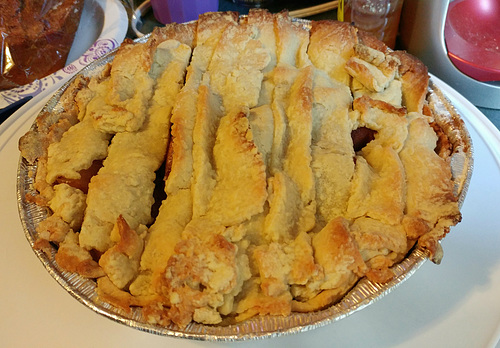
Long time readers will know that for years, I've tried to work on making a good, yummy, apple pie that was also period correct for the SCA. My favorite recipe is a 16th c one. And while the filling is delicious, the crust always left something to be desired. Until now.

Earlier this year, I tried a new way to make a 15th C pie crust but it wasn't quite there. However, I knew I was finally on the right track. This is what I did this time.

First, the recipe for documentation purposes:

then make a dough of sugar, flour, oil, water and salt, mix them together to make the dough, spread it over the bottom of a low pan, and put the mixture in so that it is no more than a finger deep; cook it in the oven or on the fire as is directed for the other tortes; when almost cooked, get wafers, crumble them over the Tart - those wafers should be made with good sugar; when cooked, garnish with sugar and rosewater. (Italy, 15th C)

Then, what I used:

  • 2 1/4 cups flour
  • 1/2 cup of sugar
  • 1/2 cup of oil
  • 1 teaspoon of sea salt
  • 1/2 cup ice cold water


Basically, I cut the oil down from last time and dramatically increased the sugar in the crust. I also kneaded in more flour than is shown here before rolling it out. After mixing everything together and rolling out the dough, I put half the dough in the pie pan and baked it for about 12 min at 375F. The other half I cut into strips to add as the cover for the pie.

The filling was the same as always, sugar and cinnamon on top of the boiled apples. It's simple, it's period, and it's delicious.

The nice thing about this crust is it's thin, it's flaky, and it's pretty good on it's own - basically, everything you want in a crust. Also, it's period correct for the 15c and it's correct for Lent. Yay!

Friday, April 8, 2016

Historical Food Fortnightly: Pretty As A Picture

I'm a day late, again, and I missed last fortnight because of Easter. Whoops! This time, I decided to do something I've been craving for a while now and I love to eat: Medieval Gingerbread. I've made it several times before and I love, love, LOVE this stuff. It's just yummy. It tastes like bread at first but then the spices and honey hit and it really is a medieval fireball. It's got that right amount of spice and sweet. I have yet to find anyone that doesn't love medieval gingerbread.

The Challenge:  7. Pretty As A Picture (March 25 - April 7) If you’re a fan of cooking competition shows (like I am!), you know how the saying goes: we eat first with our eyes. Make a dish that looks just as spectacular as it tastes. Extra points for historically accurate plating - and don’t forget to post pictures!
The Recipe: (where did you find it, link to it if possible)  My original write up along with the 15th century recipes and sources is here.

The Date/Year and Region:  
England, 15th Century

How Did You Make It: (a brief synopsis of the process of creation)
I changed up the recipe a bit this time.  I used an entire bottle of  Orange Blossom honey (16 oz) and an entire box of panko bread crumbs.  I did use stick cinnamon and long pepper - which I promptly crushed in the very medieval blender.  :-D   The blender makes far less of a mess than I do.  I also crushed the bread crumbs and the sandlewood in the blender.  

I boiled the honey and added a mix of saffron and ginger.  I then added a mix of half the breadcrumbs, the cinnamon, and long pepper.   Once that was throughly mixed, I slowly mixed in the rest of the crushed breadcrumbs.  

When the gingerbread was cool enough to touch, I plopped it out on a piece of tinfoil, put some plastic wrap over it, and rolled it out as flat as I could.  I then started with my pie cutters for nice leaf shapes but those weren't working very well.  The cookie cutters ended up working much better so I stuck with the castle and the crown/tiara cookie cutters.   Once they were all cut out, I added some cloves to the tops of one of the crowns and to the castle.  

Time to Complete:  20 minutes
Total Cost:  I had everything in the house already.  I doubt the bread crumbs were very much and honey is normally about $8.

How Successful Was It?: (How did it taste? How did it look? Did it turn out like you thought it would?)  I'll put it this way, it will wreck my diet.  :-)  It's delicious!

How Accurate Is It?: (fess up to your modifications and make-dos here)  Well, cooked over a modern oven and I did use the blender so...that's out.  But all the ingredients are pretty much exactly what they would have used in period.  

Each piece of gingerbread (minus the castle which I'm counting as four!) is about 100 calories each.  At least the tiaras are.  

Thursday, March 17, 2016

Isabella's Cottage Pie


Ingredients:
  • 2 lbs redskin potatoes
  • 1 cup of whole milk
  • 1/4 cup of butter - melted
  • Salt to taste
  • 1 lb ground beef 
  • 1 package of mushrooms
  • 1/2 an onion, minced
  • 2 tbs olive oil
  • 1/2 tbs rosemary
  • 3 cloves garlic or to taste
  • pepper to taste


This is more time consuming than it is difficult.  Particularly if you have a cranky oven like mine.   First, start a pot of boiling water.   There should be enough water to cover the potatoes but don't put them in yet.  Wait until the water is boiling and then put the potatoes in.  Leave them to boil until they are soft (is it easy to pass a fork through them?  Then they are done.).

In a frying pan, put in the olive oil (any oil will do really but I loved the wild mushroom and rosemary infused olive oil with this recipe).  Once it's heated up a bit, put in the minced onion and chopped up mushrooms.   Let them cook until they are browned.  Once they are browned, put in the ground beef.  Let that cook all the way through.

In another bowl, melt some butter (I cheated and did this in the microwave).  Add the butter and milk to a mixing bowl.  Once the potatoes are done, mash them up with a fork (or a masher), in the mixing bowl.  Add some salt and get your mixer to finish blending everything together.  You'll have some very creamy mashed potatoes.

While the meat is cooking, preheat the oven to 400F.  Once the meat is cooked, add the rosemary, salt, pepper, and garlic to the meat, mushrooms, and onions.  Put the meat, mushrooms, and onions in the bottom of a deep, oven safe dish.  On top of that, put the mashed potatoes.  Cook this until the mashed potatoes turn a golden yellow - about 20 more minutes.

The serving size is 4 and it's about 350 calories per a serving.  I might add carrots next time but it was delicious this way as well.  I wanted something with potatoes for Saint Patrick's Day.  :-D

Friday, March 11, 2016

Historical Food Fortnightly Challenge 5: Roasts

A day late but it's done! Since it's Lent, I did a Salmon Roast based on several 15th Century English recipes.

samon Rostyd In Sause
This is an excerpt from Gentyll manly Cokere (MS Pepys 1047)
(England, ca. 1500)

The original source can be found at James L. Matterer's website
Samon rostyd in sause. Cutte thy samon in Rownde pecys and roste hit on a roste Yre take wyne and powder of cannell and draw hem throwgh a streynner. Do ther to onyons mynsed small boyle hit well take vynegyr or verius and pouder of gynger and salt do ther to lay the samon In dyshys and pore the syrrppe ther on and serue forth.

samon Roste In Sauce
This is an excerpt from Two Fifteenth-Century Cookery-Books
(England, 1430)

The original source can be found at the University of Michigan's "Corpus of Middle English Prose and Verse"

Samon roste in Sauce. Take a Salmond, and cut him rounde, chyne and all, and roste the peces on a gredire; And take wyne, and pouder of Canell, and drawe it thorgh a streynour; And take smale myced oynons, and caste there-to, and lete hem boyle; And then take vynegre, or vergeous, and pouder ginger, and cast there-to; And then ley the samon in a dissh, and cast the sirip theron al hote, and serue it forth.

To Mail samon Rost In Sauce
This is an excerpt from A Noble Boke off Cookry
(England, 1468)

The original source can be found at MedievalCookery.com

To mak samon rost in sauce tak a samon and cutt hym in round peces and rost hym on a gredirne and tak wyn and pouder of canelle and draw them throughe a stren and mynce onyans smalle and do ther to and boile them then tak vergius pouder of peper and guinger and salt and do ther to then lay the samon in a disshe and pour on the ceripe and serue it.


My translation of all three (since they really don't differ much):

To make a salmon roast in sauce, take a salmon and cut it in round pieces. Roast the pieces on a grill (or a roaster in the 1500 one). Take wine and cinnamon powder, passing them both through a strainer. Mince onions and boil them in the wine and cinnamon. Take vinegar or verjuice, ginger powder, and salt as well. Lay the salmon in a dish and pore the syrup over it. Serve forth!


The only difference really is that the recipe from 1468 calls for pepper as well. After tasting it, I think it's perfectly fine without the pepper - which would have been long pepper most likely at this point and not black pepper.

My Recipe:

1 cup white cooking wine
1~tablespoon of ground cinnamon
1 small onion, minced - I ended up with about 1/4 cup of onion
1 tablespoon of Sicilian Lemon Balsamic Vinegar (I buy it at Under the Olive Tree for any other DC locals. There is a similar store in OBX as well at mile marker 6)
1 teaspoon powder Ginger
1 teaspoon salt or to taste
1 flank of salmon

I got my salmon frozen at IKEA. Yes, they have salmon in their grocery store. It was on sale for $8 for four flanks in a package so I cooked one of the pieces for this recipe.

I didn't cut it up into round pieces for a couple of reasons: I couldn't think of a logical reason to do so; I'm not sure if they really meant round or if them just meant to clean it. Since it was already clean and cutting it into round pieces seemed more a chef Ramsey thing than actually necessary, I just left it. I preheated the oven to 390F since that's what I've cooked other salmon dishes at. I put the salmon piece into one of those tin foil bread things you get for $1 at the grocery store. Once the oven was preheated, I threw in the salmon and got to work on the sauce.

I minced the onions and ground up the cinnamon. I did start to use the mortar and pestle but it was too messy (chunks of cinnamon bark kept falling to the floor because I was smashing it) so I did use the modern blender - which got the job done in a few seconds. I put the cinnamon in the strainer and poured the cup of cooking wine over it. I then threw the onions in and let them boil.

Once the onions started to boil, I put in the Vinegar, ginger, and salt. At the ten minute mark for the oven, I took the salmon only partially out and poured the still quite liquid wine/vinegar/onion mix over the salmon. I let it cook for another ten minutes.


Final verdict: It was quite tasty! I served it on a bed of wild and brown rice (that I heated up in the microwave) which they probably would have done in the 15th Century.  The bed of rice, not the heating up in the microwave.  I'm not a fan of onions - I love cooking with them to get the taste but I tend to avoid actually eating them. However, I did eat a few of these with the salmon and rice and it works. It's sort of a sweet and sour dish. The final calorie count for this one ended up being just over 500 calories - which is excellent if you are on a diet like me. I think I might have it again next week because it's not a hard recipe at all and it's actually pretty modern in taste really. It really took maybe a total of 25 minutes for the prep and the cooking.

As far as cost:


Salmon$2.00
Onion$1
Cinnamon Sticks25 ¢
Ginger??On hand
Cooking Wine$1.50 for the amount used
Vinegar$2.00 for the amount used
SaltOn hand

For one dish, it was probably about $6 once you figure out the cost of the salt, ginger, and the rice.

Thursday, February 25, 2016

Historical Food Fortnightly: Sweets for the Sweet


The Challenge:4. Sweets for the Sweet (February 12 - February 25) It’s sugar, and maybe spice, and definitely everything nice. Test out a historic recipe for sweets, sweetmeats and candies - but don’t let them spoil your appetite!


The Recipe: (where did you find it, link to it if possible) Take one hundred cocoa beans, two chillies, a handful of anise seed and two of vanilla (two pulverized Alexandria roses can be substituted), two drams of cinnamon, one dozen almonds and the same amount of hazelnuts, half a pound of white sugar and enough annatto to give some color. And there you have the king of chocolates from What's Cooking America?  You can read some of the book it is from here.

The Date/Year and Region: 1631, Spain

How Did You Make It: (a brief synopsis of the process of creation) I obviously didn't use the amounts the original author indicated. Half a pound of sugar is a bit much. Also, I don't like hazelnuts.

  • 1 tablespoon of cocoa powder
  • 1 heaping tablespoon of sugar
  • 1 cup of vanilla flavored almond milk
  • 1/4 teaspoon chili powder
  • 1 teaspoon cinnamon
  • a pinch of anise

I mixed this together and I had hot chocolate!

Time to Complete: A couple of minutes
Total Cost: I had everything on hand

How Successful Was It?: (How did it taste? How did it look? Did it turn out like you thought it would?) The chili powder really changed the taste. However, the rest of it isn't too terribly different from how I make modern hot chocolate so....I loved it!   It's spicy because of the chili powder I used but it's really quite good if you like a rich chocolate taste.

How Accurate Is It?: (fess up to your modifications and make-dos here) I used store bought almond milk and store bought  ground ingredients. I also used the microwave. ;-)  I used almond milk rather than almond flour because, once you add water to the almond flour, the only real difference is that the almond flour would make the drink slightly more thick.   Since the kind of almond milk I buy already had vanilla in it, it makes sense to use that rather than crushing up a bunch of almonds and using vanilla extract (or the vanilla beans I have on hand that are not cheap!).

Friday, February 19, 2016

No Medieval Lenten Diet this year

Although I spoke about doing the medieval Lent thing again this year, I finally gave up today.  The biggest reason was very simple - I could either enjoy medieval food that was typically served during Lent or I could keep to my diet.  There was no way I could do both.

I'm calorie counting and have been since mid November.  It's been working and I'd like to keep it up.   However, even in a snack in the middle ages could easily be well over 500 calories.   I'm trying hard to stick to around 1300 calories a day - give or take 100 calories.   If just a snack - 1/4 cup of raisins, 1/4 cup of walnuts, and a 1/4 of almonds is 500, imagine what some of the dishes are like.   A cup of cooked rice is normally between 200 and 300 calories.  Adding and average serving of salmon to that adds another 400 calories.  This is before veggies and spices.  It came down to having just one meal every day and a snack or giving up and going to modern foods, calorie counting those, and just going to daily mass for Lent instead.   I'm not good on starvation, so daily mass it is.  Because, as anyone who has ever had Chinese take out knows, rice does not fill you up.  

I'm upset with myself a bit because I do love the medieval Lenten foods (I'll be teaching a class on them this year at Pennsic!) but it's not practical if you want to lose weight.  All the foods (And I do mean all!) are very high in calories which probably was great if you went out to work in the fields or had to walk everywhere but not when you have a car, computer, and want to get to a certain weight by Easter.

For the Historically Food Fortnightly, I'll still be making Lenten foods until after Easter - it's just fun and I'll still get an excuse to make some of my favorite dishes.  But as an everyday thing, I just can't pull it off this year.


Wednesday, February 10, 2016

Historical Food Fortnightly '16 3:History Detective

3. History Detective (January 29 - February 11) For this challenge, you get to be the detective! Either use clues from multiple recipes to make a composite recipe, or choose a very vague recipe and investigate how it was made. 

This challenge couldn't be easier for me. Most medieval and Renaissance recipes don't have things like measurements or how hot the dish needs to be or how long it needs to cook for - they assume you know all of this. For instance, the one I used:

Tart for Lenton. Take figges and raisinges, and wassh hom in wyne, and grinde hom, and appuls and peres clene pared, and the corke tane out (the cores taken out); then take fresh samon, or codlynge, or hadok, and grinde hit, and medel hit al togedur, and do hit in a coffyn, and do therto pouder of ginger, and of canelle, ande clowes, and maces; and plaunte hit above (ornament it on the top) with pynes, or almondes, and prunes, and dates quartert, then cover thi coffyn, and bake hit, and serve hit forthe.

The above is from Ancient Cookery [Arundel 334](England, 1425). My translation:

A tart for Lent. Take figs and raisins, wash them in wine, and then grind them. Also get apples and pears that have been peeled and corked. Then take fresh salmon, or cod, or haddock, and grind it small. Mix all these things together and put them in a pie crust. Add powdered ginger, cinnamon, cloves, and mace. On top of this, put pine nuts or almonds, prunes, and quarted dates. Cover the pie crust, bake it, and serve forth.

So the questions begin. Do I make the figs and raisins into a mush? Does the wine just wash the fruit or should I soak them in it? How the heck do I make a pie crust without butter? How long do I cook this for? Do I cook the salmon first and then add or should I keep it raw and cook it with everything else?

Well, some of the questions can be answered through a ton of other medieval cookbooks. This late 14th century one has a recipe for "Tarte of Fysshe" that mentions the salmon should be boiled in almond milk before being put into a pie. Okay, I can do that! This page shows me how long to cook the salmon and using this page I figured out a pie crust. I also used modern renditions of a pie crust to figure out the amounts. Basically, you always have to snoop around other cookbooks to figure out what the heck the original chef meant.

Pie Crust:


then make a dough of sugar, flour, oil, water and salt, mix them together to make the dough, spread it over the bottom of a low pan, and put the mixture in so that it is no more than a finger deep; cook it in the oven or on the fire as is directed for the other tortes; when almost cooked, get wafers, crumble them over the Tart - those wafers should be made with good sugar; when cooked, garnish with sugar and rosewater. (Italy, 15th C)

Sugar, flour, oil, water, and salt - all very normal ingredients for a pie crust. Using modern sites like this one I figured out how much I'd need of each. Rather than vegan butter, I'd use olive oil as the fat.

  • 2 cups flour
  • 2 tablespoons sugar (1 of white and 1 of brown)
  • 3/4 cup of oil (I probably should have used only a half cup)
  • 1 teaspoon of sea salt
  • 1/2 cup ice cold water

I mixed the flour, sugar, oil, and salt until it made sort of a clumpy mess. I added the water until it had a more dough like consistency. I then rolled it out on a floured board (I used a lot of flour. I think it was another half cup while rolling it out). I split the dough into 1/3 and 2/3. The 2/3 became the actual "coffin" and the 1/3 became the cover. Once the pan was covered with the coffin part, I put the pan and the cover in the fridge and went to Mass.

Although they couldn't have used a fridge in the middle ages, they would have used a root cellar and probably just used the dough the next morning rather than a couple of hours later.

At 350F in my very modern oven, I cooked the coffin part for about ten minutes once I came home.

Ingredients:

For the salmon, I cooked it in store bought almond milk at 420F in the oven for 20 minutes. It cooked up beautifully. While I was waiting for it to cook, I peeled the pears and chopped them up, let the raisins and figs sit in the wine I've had in my fridge forever, and I also got out the apples I picked back in September to add them to the pie.

  • 1 cup raisins
  • 12 figs
  • 2 pears
  • 2 apples

I cut up the figs, the pears, and the apples were already cut up. I mixed in the salmon when it was done with this mess - draining the wine beforehand. Once it was mixed, I put this in the coffin. On top of that, I added the ginger, cinnamon, mace, and cloves - all ground. I spinkled it on so I have no idea what I used and of what but I know I used a good bit of ginger and the cinnamon and only put a bit of the mace and cloves on. All the spices were pre-ground in to a powder.

On top of that, I added 7 dates and sprinkled some almonds on. I didn't have prunes but I doubt they are vital to this dish. The cover went on over that. I cooked the pie at 350F for 40 minutes. I tried for 30 but the cover didn't look "cooked" so I added another 10 minutes to the total time.

Verdict:

It just won't cook.  The pears and the apples were only slightly mushy.   The crust wasn't completely baked either - it also could have used a bit more sugar, probably.   However, the consistency of the crust was perfect so I'll just have to work on the baking time part of it.  The salmon tasted fine - it was cooked thanks to the almond milk- but nothing else really seemed to have cooked correctly.   If I try this again, I'll probably put it in at a higher temp and for longer.  

The taste wasn't bad - it's mostly fruit and nuts with ginger and cinnamon.  It really was just a need to bake longer, I think.

Before adding the cover

After I took it out of the oven

De constructed pie!  I'm terrible at taking pies out without destroying them.


Ash Wednesday!!!

It's that time of year again! This year will be slightly different than previous Lents for a couple of reasons: a) I am no longer allergic to dairy and b)I'm trying to keep to a diet.

Granted, for Mardi Gras I sort of didn't keep to the diet but I didn't gain any weight either. I realized that even when I try to splurge now, I really don't go too far over what is recommended for a maintain weight diet. As for the dairy, I knew I had very low Vitamin D which is shown to cause an increase in allergies. By very low, I mean 8. Normal range is 20-50 and doctor's prescribe medication at 12. I wasn't good about taking the Vitamin D like I should until a few months ago. After reading scholarly articles like this I'm sort of kicking myself for not keeping up with the vitamin D more. Not only do I feel better, I can eat dairy! Ordering at a restaurant has gotten easier - as many people can now attest to for me. I can have cheesecake! (I did on Monday.)

So why, only a couple of weeks after figuring out I can eat dairy am I willing to give it up? Well, Sundays are cheat days anyway and I will be chowing down on mashed potatoes, chocolate cake, and lots of cheddar cheese then. I'm only giving it up during the rest of the week. Honestly, I feel more "joyful" for Easter when I've done the medieval Lent thing. I want Easter to come - it's not just an excuse to wear a new dress to Church. It's more of a celebration after all the fasting and staying away from animal products during the week. I like that celebratory feeling. Easter is the biggest holiday on the Christian calendar and doing the medieval Lent helps me to realize that. Plus, I do look forward to some of the foods like almond milk infused rice with raisins and cinnamon or kidney beans and rice.

Today, I've had OJ for breakfast (it's Vitamin D infused and probably not all together period for the 16th century but it is necessary so...) and a mug of hot chocolate. The hot chocolate was the Williamsburg (18th century) stuff I pay way too much for when I go down to Williamsburg but it's so good. They did have hot chocolate in the late 16th century and there is some evidence of vanilla being added to it. I mix the chocolate powder with almond milk and it's yummy. The Smithsonian has a pretty good article on hot chocolate. Wired also has a pretty good time line on chocolate in Europe. So, although the particular mix may not be exactly 16th C, hot chocolate with sugar is.

Tonight, I'm going to make a fish tart for the historical food fortnightly. Keep a look out for that!

Thursday, January 28, 2016

Historical Food Fortnightly 2: Culinary Vices


The Challenge:  2. Culinary Vices (January 15 - January 28) Some foods are really, really naughty. Globs of butter, lashings of sugar and syrup, decadent chocolate and wine. Bring out your naughty, indecorous side with foods associated with all the bad things, in the best ways.


The Recipe: (where did you find it, link to it if possible)  A Book of Cookery, 1591

To to make Bennets.

Put butter and water over the fier in a faire pain, and when it boyleth put therto fine Flower and Salte, and so let them boyle, but stir them well for brenning, and when it is wel thick, put it into an earthen pan, then break Egs into it and boyle them so togither, than boyle a good quantitye of Butter clarified over the fire, and with a spoone put in your other stuffe and so frye them till they be browne, and that doone, serve them foorth with Sugar on them.

The Date/Year and Region:  
1591, England

How Did You Make It: (a brief synopsis of the process of creation)

I realized this sounded and looked very, very familiar.  Sugar?  Eggs? Puffy pastry slathered in butter?  Beignets!!!!  I used this recipe for the measurements since it's made in a very similar way.  However, I followed the directions of the original 16th C recipe (only adding sugar to the dough that isn't included in the original).  

I put a stick of butter (sweat cream, salt) into a pot with 1 cup water.  I boiled that up and added 2 tablespoons of sugar, 1 cup of flour, and a few dashes of sea salt.   Once that was mixed, I took it to another burner so I could put the frying pan on the one I had been using.  I then added four eggs to the mix and put another stick of butter in the frying pan.

Side note:  For those that are long time readers and are thinking "Wait, isn't she allergic to dairy?  What's with this butter?" Yes, I was.  As of this past weekend, I've been eating dairy again.  What happened?  Even I'm not sure but there are two very good possibilities.  One, I really had a secondary lactose intolerance which means the gut itself is damaged - typically due to an illness- and it just takes time to heal back.  Two, and the far more likely knowing me, my vitamin D deficiency caused it.  Normal range is 20 to 50 for Vitamin D.  12 is considered low and when your doctor starts you on pills.  I was at 8.   It may have also been a combo of the two.  I really don't know.  All I do know is I've been gobbing down things like cheeze it's, cheddar cheese, and now butter like there is no tomorrow.  Tomorrow at work we are going out to eat and I plan on ordering everything smothered in dairy.   Mashy taters for the win!

Anyway, I stirred in the eggs to the dough and then made poorly constructed dough balls.  I threw these in the frying pan filled with butter.  After about three minutes, I'd turn them over.  After about six minutes, they'd go to the plate and get covered in organic powdered sugar.  


Time to Complete:  About 15 minutes.  
Total Cost:  I think the butter was $3?   Everything else I had on hand.

How Successful Was It?: (How did it taste? How did it look? Did it turn out like you thought it would?)  I ate Lydia pretty quickly...followed by Mrs. Bennet.  I also ate Mary and Catherine.  Yes, I named them after all the Bennets because they are Bennets.  Plus, with Pride, Prejudice, and Zombies coming out, can you think of a better food than eating Bennets in celebration?

So yes, it was good.  Very, very good.  They didn't quite puff up as much as I thought they would.  I might have had the butter too hot as the insides were still a bit doughy.   Still, they tasted like good ole fashion beignets.  I might make the rest of the dough (I put half in the freezer) for Mardi Gras.  What's more Mardi Gras than beignets?

How Accurate Is It?: (fess up to your modifications and make-dos here)  I added sugar to the dough and cooked it all on a modern stove top.  Other than that, it's pretty accurate.  And two sticks of butter, four eggs, and way too many calories to count is very much a vice.  :-D