Wednesday, April 9, 2014

Apple Pie Picture!

This was dinner.  :-)  The top crust looks funky mainly because I didn't care enough to make it perfect.  I just wanted apple pie for dinner.   Apple pie was a staple in pretty much every medieval cookbook out there. 

There is the one from 1591, an Apple tart with covers.

Another from 1510.

This one from 1390.  And several others.

Basically, if it was Lent, you could expect apple pie. 

This variation is the same pie crust as I used for the Fish Pot Pie with a filling from a 16th Century German recipe.

I sprinkled the brown sugar on the already cooked pie shell, used a dash of cinnamon, and then put all the apples in (I think I technically used 6 apples this time. It was one and a half of the frozen bags I have from the October harvest). I then added more brown sugar on top and a few shakes of the cinnamon again before putting the pastry cover on the pie. I sliced for cuts into the pastry cover so the pie could breathe. I then cooked it at 375F for 30 minutes.

Verdict:

Nom.   I had two slices.   The filling is *perfect*.   The crust (obviously) could use a little work.  I think it might need more honey or sugar next time.   

Monday, April 7, 2014

An Award!!!


1. Thank the blogger who nominated you.

Thank you to Gloria of In the Long Run. :-) I didn't think many people bothered to read this blog at all!

2. Nominate 10 other bloggers, and notify them of their award.
      From my pen and power is regarding the diary of a lady who lived in the very start of the Victorian era (right now, the diary is on 1842) It's fabulous reading the day and life of someone who lived at that time.
      Isis' Wardrobe Her focus is on the 18th Century and she makes some amazing accessories for an 18th Century wardrobe (not to mention makeup!)
      If I had my own blue box All about recreating fashions in the 19th Century! (and a hint of a sci-fi geeky side as well. :-) )
      Beauty Through Ashes Garbing for a bunch of different eras and all of the garb looks fabulous
      A Gentlewoman's Blog Lots and lots of amazing 16th Century research
      Emily's Vintage Visions Lovely recreations of vintage clothing
      Teacups among the fabric Lots of different sewing projects, all wonderful to behold, of course. :-)
      I Like Historical Clothing This blog is a lot photos/paintings/prints from the various fashion eras. There is an emphasis right now on hair but there are also some extant garments as well.
      Silk Damask Stunning examples of 18th Century clothing and research
      'Broider Me 'Bethan Fabulous 16th Century research and garbing


3. Come up with 10 questions you want your nominees to answer.
I won't bother everyone with 10 questions. :-) Instead, I'd like everyone to explain why they started blogging and what they have found useful about blogging. Also, any downsides they've found to blogging, any funny stories regarding their blog, and what they might do differently if they were starting a blog now.

4. And lastly: Answer the questions you received from the one who nominated you.

I’d like to know the story behind your favorite garment that you’ve made. What did you make it for? What inspirations did you use? What did you learn in making it? Would you make it again?

For which century? :-D

I think one of my favorites is my tan 18th Century dress.

I've changed it slightly over the years but I always feel comfortable in it. It fits. It looks right. It's not overly fancy but it's not "common" either. It looks really cute when I wear it with a bit of velvet for a belt. :-) I made it for Under the Redcoat and I think I was just going after the basic late 18th Century patterns. Really, it was the fabric itself that inspired me - a decent print linen at Joanns that is perfect for dress making? Yes, please! I learned I like staying simple. All the trims really aren't necessary. And I'd love to make another 18th Century dress. I probably will before the end of the month. ;-)

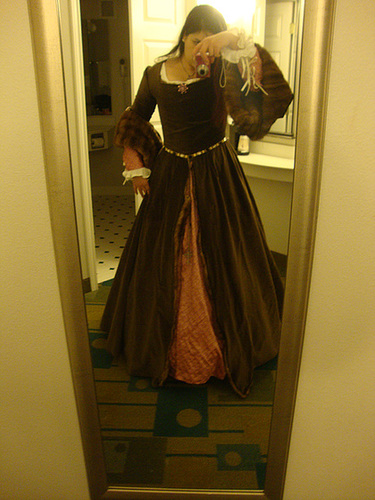
For the 16th Century, my favorite is probably my brown Tudor gown I made last year:
071

I made this one for 12th Night (SCA) and even blogged a bit about the making of the gown. Most of my inspiration came from 1520's-1540's paintings as the theme, I think, was 1530's. I just remember being frustrated with the underpinnings - the pattern for the dress was one I used a ton. My lesson from that is to always check the underpinning way ahead of time - as anyone that knows me already knows, that's not a lesson I really have learned yet. ;-)

I love the style and I probably will make a few more gowns like it.


Thursday, April 3, 2014

Fish Pot Pie!

tart For Lenton


This is an excerpt from Ancient Cookery [Arundel 334]
(England, 1425)
The original source can be found at R. Warner's "Antiquitates culinariae" (1791)
Tart for Lenton. Take figges and raisinges, and wassh hom in wyne, and grinde hom, and appuls and peres clene pared, and the corke tane out (the cores taken out); then take fresh samon, or codlynge, or hadok, and grinde hit, and medel hit al togedur, and do hit in a coffyn, and do therto pouder of ginger, and of canelle, ande clowes, and maces; and plaunte hit above (ornament it on the top) with pynes, or almondes, and prunes, and dates quartert, then cover thi coffyn, and bake hit, and serve hit forthe.


First, medieval cookery is my new favorite site. They have a search function that allows you to type in an ingredient (like salmon in this case) and it will pop up with all the recipes from all the online medieval cookbooks the search engine knows of that include that ingredient - even if it's not spelled the same way.

Second, my redaction:

Pastry for the coffin:

This is one I've been using for pies since last year with only a couple of minor differences.

1 1/2 cups flour
2 generous tablespoons of olive oil
1 generous tablespoon of honey
1/2 teaspoon salt
1/2 cup water (maybe)

Mix all the ingredients together until they form a dough. Knead this dough with more flour (I tend to pour about another 1/2 cup on the counter) until it doesn't feel sticky anymore. Split the dough in half. Roll one half out to form the bottom of the coffin. (I just stick it in my small bread pan). Grease the pan you plan to use this coffin in. Put the first half in and bake for 10 min at 375 F. The other half will form the top part of the coffin.

The actual medieval recipe redaction:

1 salmon (the have individual sizes of salmon at MOM's now! It's only $4.50)
5 dates or figs (I used dates)
1/2 a cup of raisins
1/4 cup of almond slices
1 teaspoon cinnamon
1/2 teaspoon ginger
1/2 teaspoon whole cloves
2 peeled and cored apples
1 beer or ale
1/2 cup of water

What I should have also used but didn't have:
2 peeled and cored pears
2 prunes
1/2 teaspoon of mace

Start with the salmon. I cooked it in a mix of beer and water for 10 minutes (based upon a later recipe but I've seen some *somewhere* that are 15th c calling for beer as well. I think it was a German recipe).

While it was cooking, I took my blender (so medieval, right?) and put in 2 of my frozen but already peeled and cored back in October apples, 2 dates, and 1/2 cup of raisins. Once that was blended together, I added the cooked salmon, the cinnamon, ginger, and cloves. That got blended too. I then put that in the coffin.

Here's what that looks like:


Probably doesn't look that appetizing to most people. :-) Now to a cat...maybe.

Anyway, I then added the other 3 dates, quartered, to the top, and sprinkled on sliced almonds. I didn't have pears but I would have added those too. Oh well, next time!

I then put the coffin lid on and made to cuts on top so the pie could breathe.


I cooked this at 375F for 20 minutes. I probably should have cooked it at 390 or 400F but the salmon was already pretty well cooked and the rest of the ingredients are perfectly fine raw so not a biggie.

Once it was out of the oven it looked like this:


And then I took a slice to eat. You can see the insides and the almonds sticking out in this picture:

My very poorly cut slice:

Verdict:

It's pretty decent. I think it would taste better with the mace and the pears in it. As is, it was a pretty decent dinner. Much sweeter than our modern seafood but it was really filling and the cloves really added a nice bit of spice to the filling. I might add more cinnamon and ginger next time as well. They seemed to get lost in all the other sweet tastes of this dish.

Wednesday, April 2, 2014

Interesting Medical Study on Omnivores versus Vegetarians

The link to the actual study

An excerpt:

Population-based studies have consistently shown that our diet has an influence on health. Therefore, the aim of our study was to analyze differences between different dietary habit groups in terms of health-related variables. The sample used for this cross-sectional study was taken from the Austrian Health Interview Survey AT-HIS 2006/07. In a first step, subjects were matched according to their age, sex, and socioeconomic status (SES). After matching, the total number of subjects included in the analysis was 1320 (N=330 for each form of diet – vegetarian, carnivorous diet rich in fruits and vegetables, carnivorous diet less rich in meat, and carnivorous diet rich in meat). Analyses of variance were conducted controlling for lifestyle factors in the following domains: health (self-assessed health, impairment, number of chronic conditions, vascular risk), health care (medical treatment, vaccinations, preventive check-ups), and quality of life. In addition, differences concerning the presence of 18 chronic conditions were analyzed by means of Chi-square tests. Overall, 76.4% of all subjects were female. 40.0% of the individuals were younger than 30 years, 35.4% between 30 and 49 years, and 24.0% older than 50 years. 30.3% of the subjects had a low SES, 48.8% a middle one, and 20.9% had a high SES. Our results revealed that a vegetarian diet is related to a lower BMI and less frequent alcohol consumption. Moreover, our results showed that a vegetarian diet is associated with poorer health (higher incidences of cancer, allergies, and mental health disorders), a higher need for health care, and poorer quality of life. Therefore, public health programs are needed in order to reduce the health risk due to nutritional factors.

This is interesting for a lot of reasons. Yes, vegetarians are skinnier in general and don't destroy their livers as much but...that's it. They tend to have higher cancer rates (probably because our bodies were built to eat fish and meat) and allergies (dear God, like I would need anymore! Meat and potatoes please after Lent. For right now, Salmon and rice, please!). What I find interesting though is the mental health disorders part. Possibly due to not getting certain proteins needed to make various chemicals in the body? I'm not sure.

At any rate, the study is an interesting read and does prove one thing, being fat and happy isn't necessarily a bad thing. ;-)

Friday, March 28, 2014

Cinnamon Swirl Bread

This is not a medieval recipe for Cinnamon Swirl Bread but I've been making a lot of it and I appear to have forgotten to post it!  Everywhere I take it (it's an awesome bread for get togethers or picnics), people love it.   I've made a couple of different versions of it and both are wonderful.   
The original version is here.   This is my version.

Ingredients:
1 cup vanilla almond milk
 2 teaspoons vanilla balsamic vinegar (regular vinegar will do but I like the vanilla taste in the bread)
1 1/3 cups sugar, divided
1/4 cup coconut spread
1 egg or 2 apples, cored and peeled, cooked and then mashed.
 2  4 cups all-purpose flour
 1 teaspoon baking powder (I use a corn free baking powder)
1/2 teaspoon baking soda
 1/2 teaspoon salt
1 tablespoon ground cinnamon

Preheat oven to 350f.  Grease your bread pan.  Combine almond milk and balsamic vinegar in a small bowl - stir it and set aside.  It will curdle pretty much immediately.   In a medium bowl, combine 1 cup sugar, the coconut spread, and either an egg or egg replacer.  The egg replacer I've used was just two peeled and cored apples that I boiled in a pot for about 15 minutes, strained, and then easily mashed.   This works really well and tastes great in the cinnamon bread.   
In a large bowl, combine the flour, baking powder, baking soda, and salt.  I then combine the wet ingredients bowl with the dry.  This includes the curdled milk.  
Pour 1/3 of the batter into the bread pan.  This won't look like much but this bread will rise a LOT in the oven.  In yet another bowl (be glad if you have a dishwasher.  I don't), combine 1/3 cup of sugar with cinnamon.  Use this to sprinkle on the bottom layer of the bread.   Pour half of the remaining batter on the layer.  You might have to smooth it out a bit.  These layers look pancake thin.   Sprinkle half of the remaining sugar and cinnamon on top of this layer.   Pour the remaining batter on top.  This time, combine a small amount (1/2 teaspoon) of olive oil to the sugar and cinnamon.  Sprinkle this on the top of the bread.  The olive oil helps it to stick to the bread. 
Bake for 45 minutes.  Once it's done, let it cool for about 10 minutes at least.   It's absolutely delicious.  It's a cross between a bread (really, really good for toast) and a coffee cake.  

Wednesday, March 26, 2014

Modern Clothing


I used McCalls M5314 as a base for this dress.  I left off the cuffs because of the pretty border on the sari fabric I used.   More of the border was used to create the ties.   I wanted to keep the border on the skirt as well so this meant pleating the skirt to the bodice rather than doing a circle skirt.  

I'm not really in love with it.  It looks too 1970's for my taste.   I was hoping for more 1950's.   I think it's more the pattern of the sari than anything else.  Still, I did sew!   And there is evidence!

Sunday, March 23, 2014

Medieval Leomonade


From From an Andalusian Anonymous Cookbook, 13th Century:

Syrup of Lemon
Take lemon, after peeling its outer skin, press it and take a ratl of juice, and add as much of sugar. Cook it until it takes the form of a syrup. Its advantages are for the heat of bile; it cuts the thirst and binds the bowels.

I have no idea what a ratl is but it doesn't really matter for this.   My redaction below

  • 5 or 6 Fresh Lemons
  • One cup sugar
  • 5 or so cups water (or to taste)
I squeezed about 5 lemons until I got a cup of fresh juice.   I then put a white cloth over a pot and poured the juice over that- this was to get rid of the seeds and any pulp.  I then added the sugar and set it to boil.  I accidently burned the sugar.  Grr.  But it wasn't horrible when I taste tested it.  It never got super thick - it was more like cough medicine syrup.   I added this syrup to the water, stirred it, and it was ready to serve.  

It tastes like...lemonade! It's actually really, really good.  Even if I burnt the sugar a bit.  :-)