Showing posts with label Norse. Show all posts

Thursday, May 26, 2016

The true origins of the "Bog"/"Norse"/"X" chairs

Pennsic 064

If you have ever been to an SCA event, you've seen them. The chairs that many call Norse (or Viking if they have yet to be corrected). They are two planks, one whittled out a bit and inserted into the other forming a lopsided X. The photo above is from Pennsic in 2010 at my campsite in n24.  There are several such chairs around the firepit.

Like probably many of you, I just took for granted that they are period for a lot of reasons.  A) They are wood;  B) They are simple;  and C) There are a ton of them at any SCA event.  However, they are not period.  In fact, what they really are gave me quite a delightful giggle when I found out and I hope you love the irony too.


A question came up about the authenticity of the Norse chairs and I was curious as well - so, I took to searching for any information on them.

First, I found this "my-fingers-hurt-from-just-looking-at-it-but-it's-lovely" chair:
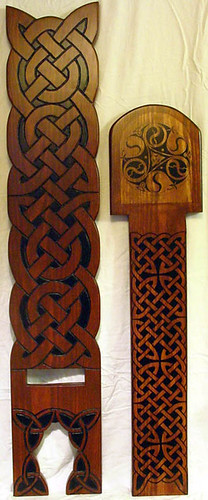
bog chair standing


The person posting the picture called it a bog chair so I searched for bog chairs. I know, it sounds a bit to basic but this is how I typically find things - just follow the rabbit down the hole.

I came across The Anglo Scandinavian Chronicle Blog and found an entry on the chairs from back in 2011.  In that, I found another important clue.

Simply put, there are no such chairs from the Viking Age in northern Europe. The chair, it has been conjectured, was introduced from Africa in the nineteenth century and became really popular in the early twentieth century when Boy Scouts began to manufacture and make them. All this is second hand and not even trustworthy second hand. Like folding stools with backs, they seem to have just popped up!


Okay, so I started to search African chairs and found...

African Chair


Tada! Something that looks like the "Norse" Chairs! Yay! So where is the humor in all this?

Well, when most people think of the Norse, or more commonly by the verb Viking (seriously, it ends in ING for a reason. You went a Viking. You weren't a Viking anymore than a mall rat today would be called a Shopping.) they think big burly bearded men with axes. Crazy, strong warriors who fight and drink and fight some more. They think "manly" men!

So what is it really? It's a birthing chair.

That's right, this style chair is not only not period for the SCA, it's also incredibly feminine! I am greatly amused at the irony.

African Birthing Chair

Notice in the picture above, there are four women carved into it with a cradle. From the auction page:
An intricately hand carved vintage African birthing chair. The characters include a bee, snake, 4 female figures, a crocodile, and more.
It is made of thick heavy wood. The back piece is 42 inches tall, and the seat is 33 inches tall. The two pieces fit together nicely and are well balanced. The birthing chair is an ancient practice intended to provide balance and support to mothers giving birth. The chair is in very good overall condition with minor chips.


Although, the only problem is that all the sites that mention birthing chairs tend to be auction sites and the books that mention African birthing chairs don't give descriptions or pictures.  So, it's impossible to tell if that's what these really are or if it's also something made up.   More research needed!

Tuesday, July 21, 2015

Historical Sew Monthly: Accessorize


The Challenge: July – Accessorize: The final touch of the right accessory creates the perfect period look. Bring an outfit together by creating an accessory to go with your historical wardrobe.

Fabric: Wool, linen

Pattern: Based off this Norse hood

Year: roughly 1100 AD give or take 100 years

Notions:Just the green wool thread

How historically accurate is it? It's completely visually accurate. The stitches I used are seen in several digs, including Birka. However, I did use the sewing machine to bag line the various pieces so that's no historically accurate - not that anyone would ever see the machine stitches the way I sewed it up!

Hours to complete: About four hours

First worn: I hope either of their majesties will be able to wear it at least one night at Pennsic.

Total Cost:  The white wool was a remnant at Joanns that was 50% so $8.16.  The red linen was left over from another outfit.  The green wool thread I think was about $4.00 but I really can't remember.  It's been in the stash thread for a very long time.

This is what the hood looks like lying perfectly flat.  It really is just two gussets and a long rectangle.
Close up of the decorative stitching.

This is really for the Pennsic gift basket.  The kingdom Atlantia is giving a basket to has a King and Queen who are very into Norse.  Luckily, I had some lovely white wool, red linen, and green wool thread on hand to make up something that is both Norse but easy to carry back home to Utah.  :-)

I bag lined each of the pieces individually and then used the decorative stitching to bind the pieces together.  So the gussets are just squares with the square lining attached to them.  If you cut the decorative stitching, the hood would fall apart.

I did try the hood on to make sure it fits.  It fits.  I know, I look like death warmed over right now.  Oh well.

The entire edge of the hood is done in a simple running stitch.  The pieces are bound in a herringbone stitch - which is a very simple way to add a bit of decoration.

Overall, I'm pretty pleased with it and I hope their majesties are as well.

Sunday, September 14, 2014

My little Viking Cap

What I wrote in my documentation:

Based on the Jorvik excavation, this cap is made out of brown silk with buttercream silk thread stitches. The linen twill tape was used based on speculation within the archeology reports due to stitches showing that some sort of tie was at the bottom of the cap.


The original cap is made from a single rectangle and then shaped at the crown to give it a curve. I pieced my cap due to the limited amount of fabric I had that looked correct for the 10th Century. Brown color, achieved with madder among many other popular dyes in the 10th century, is plausible as well as the soft yellow from lichen. Silk was believed to be imported from the Byzantines at this time.
The cap I have presented to the A&S is entirely hand sewn and uses the closest possible materials to the original artifact.

You can read more about Norse dyes here and see the extant cap here.  Since this particular competition was "Winner take all", I didn't want to have something that was completely awesome - since I might not win- but I did want something that was accurate, fun, small, and something that I wouldn't mind having in the garb closet but wouldn't mind loosing either.  However, I - and everyone else- really didn't have a chance since someone made an accurate bone comb.

The only way to have competed with that would have been to enter a fully embroidered, hand woven apron with complete documentation on the embroidery style.  Pretty much everyone else was wire weaving - which was cool but yeah, we never really had a chance.  ;-)  

Admittedly, the cap was out of scrap silk.  The silk originally was used for lining of bell sleeves in another gown I made last year.  However, I had enough to make a decent cap.  I still have some and might do another cap - but with purple silk thread because that would be awesome.  :-)

Tuesday, May 6, 2014

Norse Disc Brooches

Most people are familiar with the Norse Turtle Brooches. They look like this:

The problem is, that if you are into Norse garb that is, getting replicas of the turtle brooches will set you back at least $80, easily.  I've seen about an average of $120 for a set.  This isn't good if you aren't sure if you like Norse or if you don't want to do Norse all the time.     It's an investiment that isn't for everyone.

In comes the far less talked about but very much used in period disc brooches.


These were sometimes decorated with gems or enamal themselves.  Other times, they were more just sculpted metal like the above.   Both the Anglo-Saxons and the Norse had disc brooches for fastening clothing (probably due to all the trading/raiding between the two!).   These brooches were used for fastening apron gowns just like the turtle brooches.  The good thing is, you can typically make your own disc brooches for a lot cheaper.

Here are mine:

I took old earrings from a vintage jewerly sale and took the backs off of the discs.  I then hot glued pins to the back of the discs.  Period?  No.  Will it look it  from the face of them?  Yes!   Besides, these were each only $1.  The bag of 50 pin backs was maybe $3.  $6 for three sets of brooches is an easy investment for anyone that is interested in Norse garb.   I really love the plain metal one as it has four holes for adding beads at the bottom of each brooch - it originally had dangling beads that I took off the disc.   The plain one really looks "period" for the 7th - 11th Centuries - the disc brooches were being used for a very long time.  You'll find examples going back before the SCA period (600-1600) and well into the late SCA period.  If you find some nice round 1980's earrings, buy them to change them into brooches.  It's easy and cheap.