Showing posts with label dye. Show all posts

Saturday, April 26, 2025

Alkanet - the Mediterranean sometimes purple dye

 Everything I've been told and read about alkanet since I first heard of it is that it is tricky.  It might give you a purple, it might give you a blue.  It will probably give you a grayish color.  Maybe.  Even Jenny Dean had problems with it which did not give me much hope.  Still, I figured I'd play with it.  

First thing I did was use the sake I ended up not likely and mixed that with half the jug of powdered alkanet I got from Anne George's.  I put this slug into a tubberware container and just left it under the bathroom sink for a couple of weeks.  I might try cheap vodka next time to see if that affects the results at all.  

Then, I took it out and put the slug into the dye put.  I used some of Wildcraft dyeing's advice on PH levels as I wanted purple!  I added 75%~80% vinegar to the normal water and got a PH of 2...which was way too acidic.  I did get it to stay at 4.5~5.5 after adding some baking soda.   Yes, lots of fizziness when adjusting the PH level.  

Once the pot was hot but not boiling, I cleared out as much of the alkanet slug with the mesh colander as I could.  It didn't get it all out but it did get most of it.  Only after most of it was out did I add the fibers.

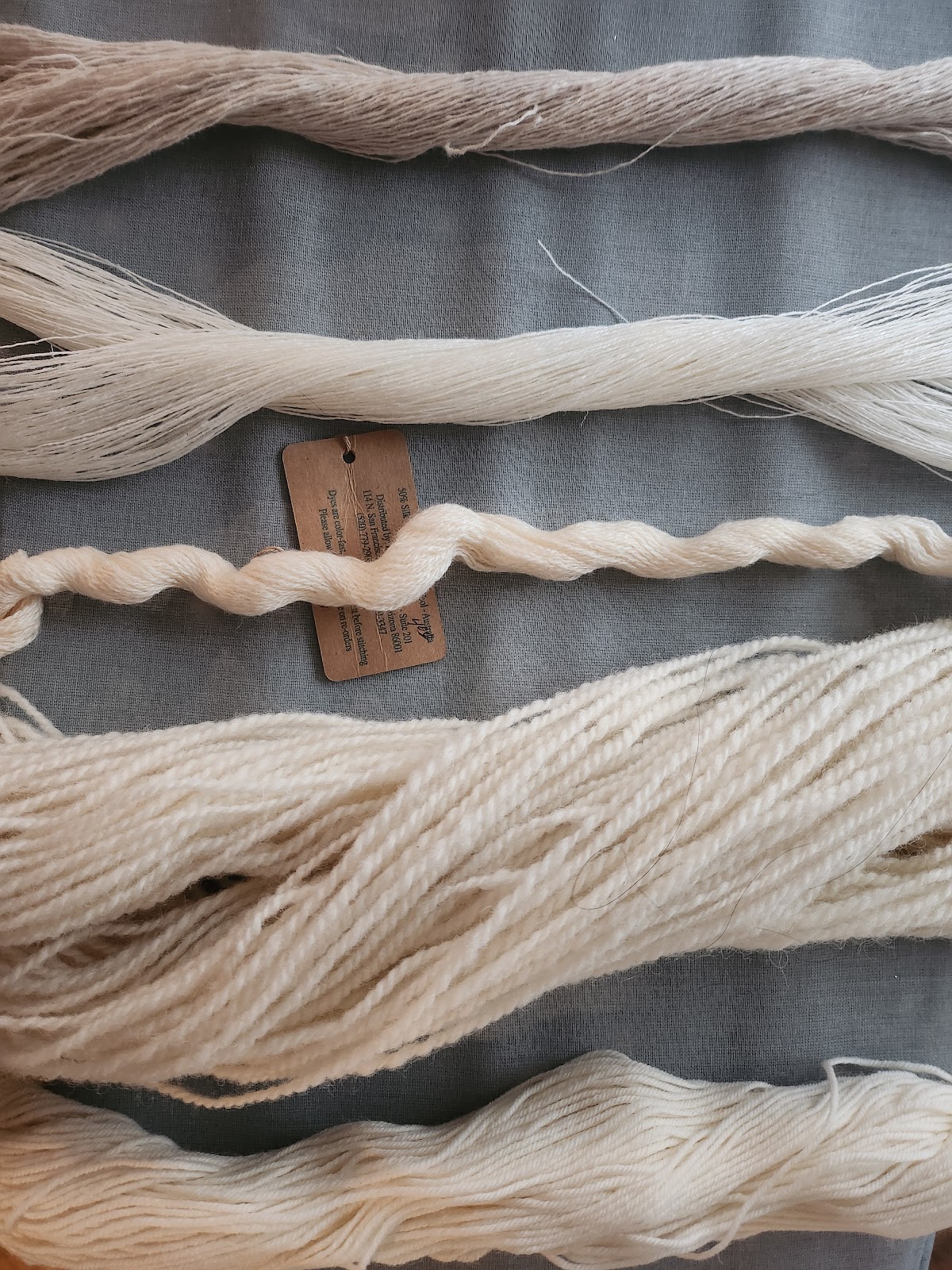
For this experiment, I did two skeins of wool, one of natural linen, and even a yard of silk taffeta.  The silk isn't in the picture since it really came out far too light.  I think if I try this again, I leave the silk in for a few days and see what happens.   


I used alum on all of them.  I have no idea why the top skein and the middle one, both wool, are two different colors.  Honestly, the top one is the color of my parent's car when I was a kid.  It wasn't brown and it wasn't purple.  It was something inbetween and we could never figure it out.  The middle one is straight up lavender.  It's hard to tell in this photo but it's very lavender in person.   The linen really didn't catch the dye but does have a very slight tone now to it.   


Anyone have any theories on why the two wools came out two different colors?  Maybe different sheep?  I did get the wools from two different companies...

Sunday, March 23, 2025

Red Onion Dye - a somewhat failed experiment

 Yesterday, I tried to dye with red onions and....it was a fail.  I should have read Rebecca Desnos' blog post before starting on my own dye pot.  Instead, all I got was brown.  A lovely, soft brown with a reddish tinge in the case of the alum mordant wool but brown.  


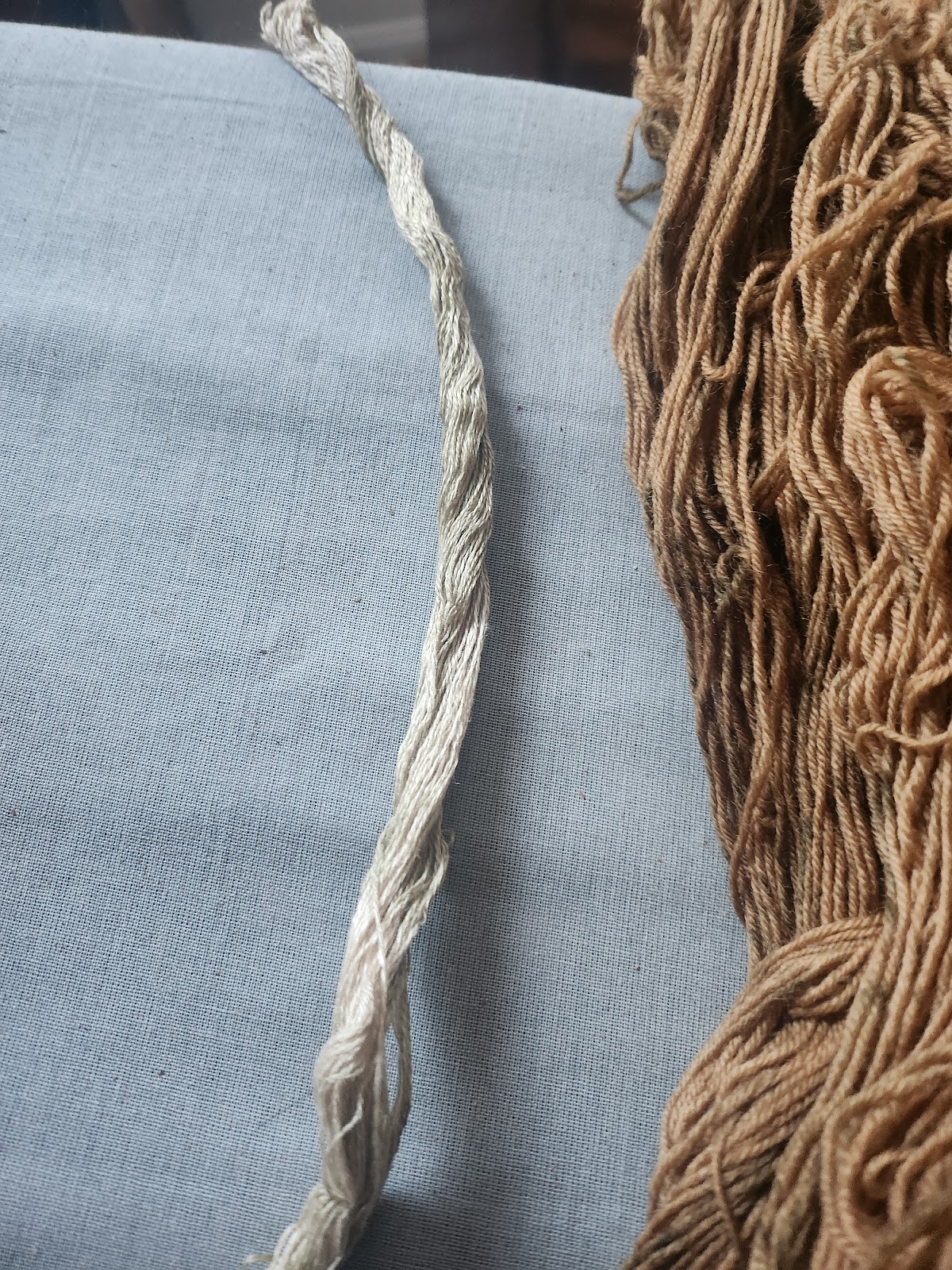
The linen pretty much didn't dye.  The alum linen (top of the photo) does have a very slight burnished green hint to it.  The natural linen I used an iron mordant (bottom of the photo) on is still...natural.  The alum mordant wool is almost an auburn/light brown color and probably will make a funny winter hat for next year.  The iron mordant wool just looks blah.  Parts where there was still iron on the yarn (I didn't rinse it and that really showed) are dark gray to almost black.  So, maybe, it might make a good black if I use iron water in the dye pot?


Above is an image of the onion skins after I had exhausted them.  I used one plastic grocery bag full of purple onion skins.


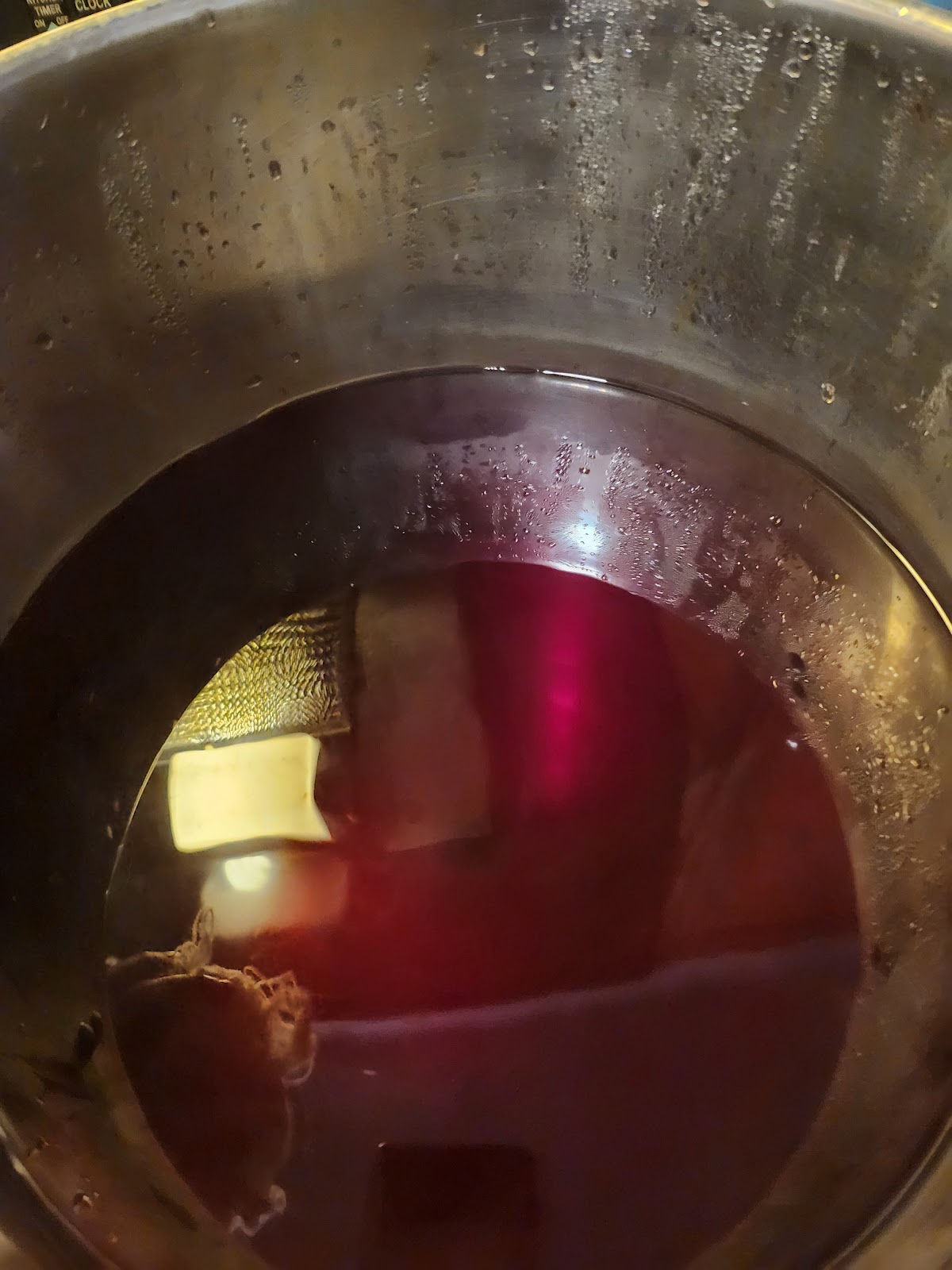
The resulting dye was a rather fabulous reddish purple.  I was hoping to get a nice burgundy or maroon from the dye bath but alas!


Everything was turning yellow!   I checked the ph and it was 6.8.  That was when I looked up Rebecca's blog.  I figured a yellow or army green - as it was coming up at the time- would at least be pretty interesting.  However, I forgot about the heat on the oven and went upstairs, got distracted, and came down to a paraboil (it was probably another few minutes from boiling!).  Somehow, that activated what little soap I accidentally left in the pot and....


Yeah, lots and lots of soap bubbles!   This affected the ph which suddenly shot up to 8.1!  I ended up trying to get the dye pot's ph down to see if I could get a good green or red out of it and added 75% vinegar solution to it.  It went down to 4.


So I thought with this image, I'd get a neat orange.  The dye was completely exhausted when I let it sit through the night.  However, when I pulled the yarns out, the linen suddenly didn't have a color and the wools were brown.


Alum mordant on linen and wool

Iron mordant on wool and natural linen


I will redye the linen (probably in the alkanet solution I have sitting) and see how that goes.   I have more wool to dye and a big piece of linen.  I think the big piece of linen will go into another madder pot!


Tuesday, January 7, 2025

Madder Dye


I've had this jar of dried madder for probably three years now, at least.  It may be longer than that.  I've read that old madder won't dye and I've also read that old madder gives the best reds.   I figured I could sacrifice some of the yarn I have and see what I end up with.


This time, I dyed three wools and two linens.  One of the wools and the natural linen were given an iron mordant and the others were all dunked into the alum mordant.  I wanted to see if it would give me different shades or even different colors.   For the iron, I just used old SOS pads that had rusted.   I keep them in a small bowl after I do the dishes.   


The dye pot once again looks like spaghetti.  I had the water and white vinegar mix at 70°C before I turned the gas off the stove.  I just left the lid on the pot and waited for three hours to see what colors I might get.   


This is just the wools after I rinsed them. They looked very, very Christmas red and Turkey Red!   The linens didn't have much color so I left them overnight.   I'm so glad I did.   I also overdyed the onion skin wool that wasn't as bright as the others.  


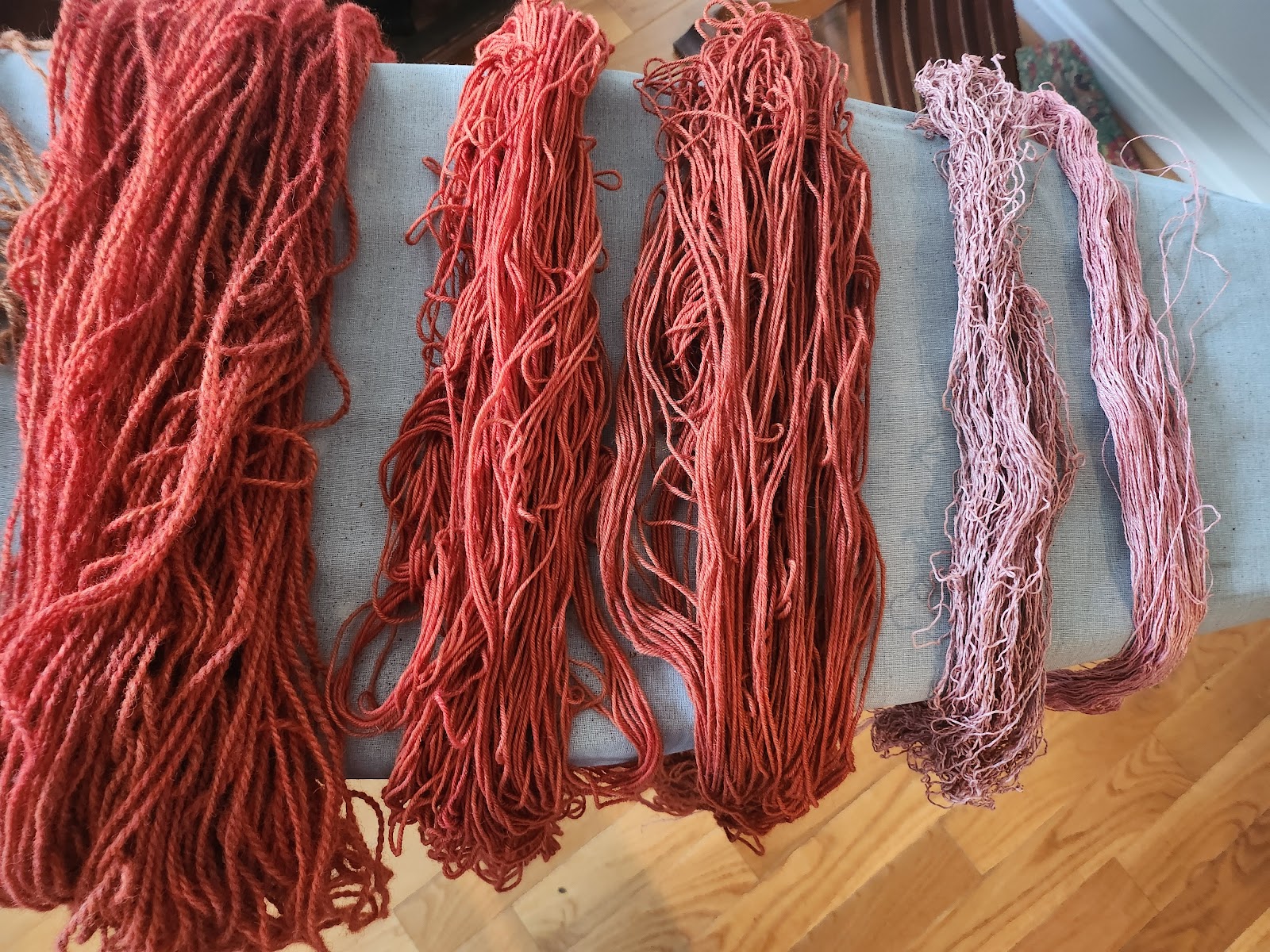
From left to right, madder with alum, madder with alum, madder with iron, linen madder with iron, and linen madder with alum.  I need to show a close up of the linens because they are fabulous pinks!!!


This is more true to the color in person.  The natural linen with an iron mordant came out a nice mauve and the bleached linen with an alum mordant came out petal pink!   I'm really happy with the way those came out.


All the yarns I've dyed this week!   There is the two linens with the onion skin dye, one wool with the onion skin dye, the wool I originally dyed with onion skin and then overdyed with madder, plus all the madder yarns!   I'm not in love with the overdye.  It looks more burnt siena in person than the flesh tone it shows here.  However, I think it will go really well with some of the other yarns I have as a secondary color.   

Besides, getting pink on linen really is the best part of all this experiment!

Thursday, January 2, 2025

Onion dye!

 I'm going to try and restart this blogging thing.  My first finished crafty thing of the year is dyeing with yellow onion skins!   I've seen some pretty amazing oranges when other people have tried it and figured I'd give it a go myself.  

My local grocery store isn't the best at cleaning the produce stands, which is lucky for me.  I'd go there, buy an onion and fill the plastic bag they had with the one onion and as much of the loose onion skins lying on the table as possible.  After a few weeks of just going in and buying an onion when I needed it for dinner plus a bag of loose onion skins, I had enough to dye with.   


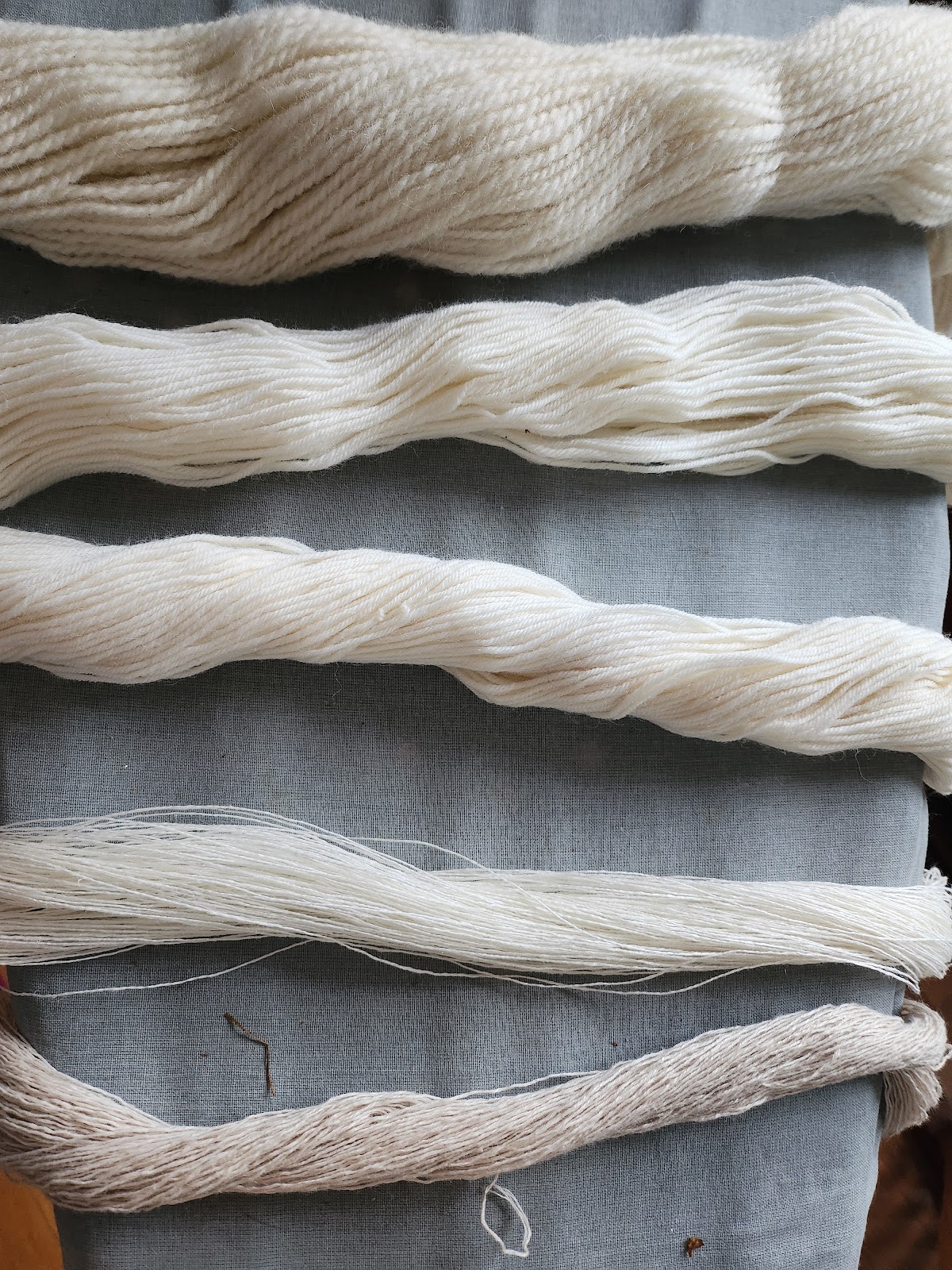
Above are the experimental yarns for dyeing.  The top is natural undyed linen, the second is bleached linen, the middle is a silk and wool blend that I ended up not dyeing, and the last two are wools.  I have no idea where the silk and wool blend ended up.  I went from the dining room to the kitchen and it disappeared.  Likely, I took it with me when I went downstairs to let the pup out and put it down somewhere there.   I'll find it eventually but, because I lost it, it did not get dyed.


I filled my dye pot about half way with water and then threw four bags of onion skins in.   This was the look.  I then turned the stove on and heated the water until it was just steamy, followed by leaving it on low for about an hour.

This was the result after an hour.  I turned the stove off and then put the lid on the pot to leave it for a bit longer. During this time, I put the yarns into a bowl with alum and water to get them ready to dye.   I had washed the yarns earlier to get rid of any oils.  One yarn smelled heavily of sheep after that.  

Two hours after adding the onion skins, I took the skins out of the dye pot.  I just used my basket colander scoop the skins out and throw them away.  I missed a couple of skins but it got most of them out without the need for two different pots.  The dye looked to be a very lovely red when I finished but, really, as you will see, it becomes very, very orange!


The dye pot with the yarn looks like some sort of weird spaghetti.  I let the yarns soak in the pot for about an hour and then heated it back up gently for five minutes (just until there was steam) before leaving them for another half hour.


The final colors!   I will add a picture when they are completely dry (this was just the plastic box to carrier them to a place where they could dry!) but I wanted to show the good oranges I did end up with.   The linen dyed exceptionally well!  It's the wool that is the paler of the yarns.   I don't think I got all the lanolin out of it which might be part of the problem.  Still, not a bad color. 

I did rinse the yarns in cold water before I took the photo.  


The color is a bit more yellow now that it has dried.  In person, it is a very lovely goldenrod color for each of the yarns.  The brightest is the bleached linen - second from the bottom.  The very bottom of the photo is the natural linen.  The top is the wool I'm not sure I got all the lanolin out of which might have affected how well the dye took to it.  

Of these, I'm going to overdye the top and bottom yarns in the photo with madder or another red at some point.  

Monday, June 3, 2024

Cabbage dye and Avocado dye


The results of my red cabbage dye experiment last month!


The yarn came out pretty variegated but that was my own fault.  I still like the colors and it's sort of a "sea glass" blue in person.  I might try the cabbage again with a couple of other tricks, such as using baking soda to change up the color.  My Mom *loves* the pale blue of the linen. She wants to paint her room that color!


Sadly, the avocado dye experiment last month didn't work out quite as well.  This was before I even rinsed the yarn fully.  Once it was fully rinsed, both the wool yarn and the linen fabric became....white again.  There really wasn't a drop of color that adhered to it.  

So, this time I decided to try a different method.  Rather than leaving three avocado pits in a jar of vinegar and water to make a dye, I just put 14 avocado pits in a big ole soup pot with a lot of water and simmered it.  

At first, it seemed like it was going the same way as the avocado vinegar experiment until I tested the PH of the water.  For some reason, it was only 5!  I added a lot of baking soda and got the PH at least up to 6.5.   

After simmering the pits for about 3 hours, I added the wool yarn (the same one I used in the previous because, seriously, zero color), and left that to simmer for an hour before I took it off the heat.  I then left the yarn in the dye pot overnight.  Below is what color it is now!

In person, it's a fabulous light mauve that I'm very happy with.  Also, the dye vat smells 100% better than the cabbage vat did.  :-)  I'll post pictures of it when it dries to see fully what color it ends up.  

Wednesday, May 8, 2024

More Experimenting with dyes


Not the best picture but it does show that the linen I dyed in the very blue cabbage water is...blue.  I will do a full write up with video (hopefully!) later but I wanted to share this much.  I'm holding a roll of paper towels above it just for the color focus.  You can easily tell it is not white that way.   


I used leaves of a purple cabbage and boiled it for an hour and a half.  When the leaves were pretty much green from all the purple being leeched out of them, the dye bath was ready.  The linen here has a rust mordant and still came out a rather lovely color.  


I did try to dye with the avocado and ammonia solution but it really didn't work.  I'm going to try boiling the avocado pits next to see if that works at all.  However, that won't be until later in the month.  

Saturday, May 4, 2024

Experimenting with dye!

 I've been collecting avacado pits with the help my family, friends, and co-workers.  So far, I have enough for a couple of experiments.  The first of which I started yesterday!


The first experiment is just cut up halves or chunks of avocado pits (did you know they have seams?) in a solution that is 1 part ammonia and 4 parts water.  This picture above is a close up of the first halved avocado pit in the solution.  The jar I'm using I got for maybe $3 at the local thrift store.  It has a nice cork top that keeps out the smell of the ammonia.  

The plan is to keep the jar in the sun (see nice living peace lily next to it!) for the next three days.  I'm hoping it will get a neat reddish color on the wool I have but we'll see.  

I took this photo about a half hour later and you can already see an orange tint to the water.  

This was last night before I went to bed.  The water was very orange!

The next morning it looked like a reddish iced tea!  

I just took this picture and it is very dark.  I'm hoping to use it tomorrow!

For the other 20+ avocado pits I have, I plan on just boiling them.  The entire experiment will involve putting some wool in alum as an mordant, some in iron (thanks, SOS pad!).  I'll then put one alum, at least, in the boiled pits and one in the ammonia solution.  For the iron, it will also be one in the boiled and one in the ammonia. I'm really curious as to what range of color I'll get from these.

I also almost have enough onion skins for some fun dyes and I will boil a red cabbage to get a neat blue or even pink dye.  


Sunday, April 9, 2023

Happy Easter! Naturally Dyed Easter Eggs!

 I've been slowly getting into natural dyeing for years now.  This year, I wanted to naturally dye the Easter eggs.  After looking at a few different options, I went with Turmeric for yellow and purple cabbage for blue.  


The one green/gray one is due to dyeing it with turmeric for a couple of hours and then throwing it in the cabbage dye overnight.  

Yellow Dye Recipe:


  • Two heaping spoons of tumeric
  • A couple of cups of water
  • About 1/4 cup of white vinegar


I put this all on a glass bowl and mixed it up.  I didn't heat up the mixture (which may have made it quicker but eh).  Really, I just put the hard boiled eggs in the mix and left them in the fridge (with a lid) overnight.  


Blue Dye Recipe:

  • Half a head of purple cabbage
  • A couple of cups of water
  • another 1/4 cup of white vinegar
Just rip up the cabbage leaves or chop them and thrown them into a pot.  Add in the water and once, the water is boiling, set it to simmer for 15 minutes.  I accidentally used too much water (4 cups) and while it worked, I think it would have been slightly quicker to dye if I hadn't used so much water.   

Once it's boiled, the leaved will be a pale purple with a lot of green.  It was really amusing to see.  Just gather up the purple water and add the white vinegar to that for your dye bath.  I left the eggs in the dye bath overnight (glass bowl with the lid) to get the indigo color.  


I was hoping for a bright green with the cross dyed one but oh well.  It was a fun experiment.   The nice thing is that purple cabbage was known in the Middle Ages.  I need to see if I can find a recipe or mention of using it as a dye as this does seem to work well and is easy to accomplish for a pretty decent blue.  

Sunday, September 8, 2019

Colors the Peasantry wore in the Middle Ages and Renaissance Part Two

In part one, we looked at various paintings that show the poor were anything but monochrome. Now, we'll look at writings and archaeological evidence that further proves the poor had dyed clothing.

I'm going to go with the most obvious first.  Why and how could the poor have access to dyes to have colorful clothing?  The easiest way was to get hand me downs.   Just like now, giving clothing to the poor was very much a thing in the middle ages and renaissance.  Works of Mercy included giving away clothing to the poor. 

There were also second hand shops; basically pawn or thrift stores, in the middle ages.  Again, it wouldn't be the latest fashion but it would be a way for someone with a few extra pennies to get a nice dyed garment that is a season or three too old to be fashionable.  Second hand clothes shops were essential to medieval life.

However, probably the most compelling evidence that the peasantry wasn't monochrome comes from the archaeological evidence itself.  In a study of textiles from both bog and grave digs in Northern Europe, all time periods, including 8th-10th C, showed indications of blue dye being used.  Sometimes, the blue dyes were found in conjection with a yellow dye - meaning that green was a probable color.  In fact, red appears to only show up in the wealthier graves but both blue and green are in the archaeological remains.

More fun is a test of textiles found in the waste layers from Medieval Prague.  172 samples were taken for dye analysis based on a dig site that dates from between the 14th and 15th Centuries.  The entire paper is here and is a fascinating read on it's own.  The 172 samples are broken down into (34 silk and 138 wool samples - which is slightly disproportionate to the overall finds.  Only 4% of the textiles found were silk.  However, some of the textiles were also items such as rope or other non-clothing piece as well as the silk pieces possibly being larger or more easy to test for dyes than some of the wool fragments.

Taken from a presentation by Helena BÅ™ezinová
Of the 172 pieces tests, only 27 or 15% of all the samples had no dyes detected.  85% of the samples had at least one dye at this medieval dump site.  The dump site would have pieces from across the classes; however, those with estates would dump items on the estate.  (I've been to one too many archaeological field schools where you are digging in the trash pit for the kitchen of some sort of manor/plantation house.)  So, for this dump site in the "New Town" area of Prague, it's pretty safe to assume you are mostly looking at the lower and middle classes with only a few upper class textiles involved in the dump.

The coccid is most likely polish cochineal which makes for a nice variety of orange, pinks, and reds depending on the dye bath and mordant used.  Madder is more oranges and reds.  Cochineal is brighter and more pinkish in it's hue while madder is more the color of a natural Ginger's hair.  :-)  Brazilwood is another red; this one is most likely the east Indian stuff and not from the New World.

Woad gives you a beautiful range of blues.  Tannin dyes, most likely walnuts, gives an array of browns; from khaki to almost black.  Weld will give you primary color yellow. Persian berries is the one outlier and also gives you a neat yellow.

Basically, in this pit, you have a range of reds, woad for blue, some browns, and two different ways to get yellow.  You have your primary colors so any color, pretty much, is possible.  Again, this is the waste layers of a city - you'd expect to find a high amount of items from a variety of classes but mostly the lower and middle classes.  Only 15% has no dye.  Everything else comes in a wide variety of color.

Want purple?  According to this archaeological report, madder (red) and woad (blue) together (purple!) account for 19 of the 60 double combinations; it's one of the most popular.  The tannis were most likely used to give the dye a darker overall hue so the 2 pieces that show woad (blue), weld (yellow), and tannis (brownish) probably came out to a lovely forest green.

Granted, this is just one archaeological report but it does show that the lower classes had color.  How popular that color was, based on the other archaeological paper focusing on digs further north and a few centuries older, depended on both time and location - just like everything else in the SCA period.  So wear that pink tunic with purple trousers as a serf, it's completely period.  :-)


Thursday, January 10, 2019

Colors the Peasantry wore in the Middle Ages and Renaissance Part One

So, I ran across a post on the superiority of chemical dyes over natural dyes that stated the lower classes didn't even have access to colors before chemical dyes.  ......  The individual honestly believes that everyone who wasn't rich or upper middle class only wore white, brown, and black before the 19th C.   Now, I put that up in the "we didn't have color before the 1930s.  Haven't you seen the old films?!?" category.  I just found it rather strange that anyone would actually believe that old joke.

To help put an end to the idea that peasant=boring, drab colors, I figured I'd put a new compilation together regarding colors in the middle ages and Renaissance.  Here's the first post to the series I did last time on fabric types and colors available in the middle ages and Renaissance.  In that, I went over what was available to show that, for the SCA, there really isn't such a thing as "that color didn't exist yet!!!!".   If you can document it, you can wear it.  I documented everything from hot pink to lime green and eye blinding yellow.

The difference this time around is that I'll explore a specific class in the medieval society to see what they were wearing.   Yes, the poor wouldn't have been wearing the expensive dyes but they weren't wearing monochrome either.  I'm looking at paintings, written evidence, and archeology to show what colors were possible. 

Paintings

Now, I know a few people will say "paintings?! But those were highly stylized and meant to be pretty for the people viewing them, not true representations of life!"  However, I call bupkis on that idea.  First, there are just too many different illuminations and paintings that show colorful garments for the beggars and peasants that it just doesn't hold water. Second, as I will show with the archaeological and written evidence, the poor were wearing colorful garments.

St Stephen Distributing Alms by Fra Angelico, 1440's
Above is a popular motif in the middle ages and Renaissance - a saint distributing alms.  Any time a saint's life is shown, this is likely to show up at some point.  There are manuscripts, paintings, and drawings showing various saints handing out alms.  Since the alms are always being handed out to the poorest of the poor, it gives us a chance to look at their clothing. 

In the background, we can see the donor who commissioned the painting in a lovely green, with his hands in prayer.  However, in front of him are some examples of the poor in the mid 15th century.  The lady is wearing a peachy pink dress with a light blue scarf around her waist and arm.  The child in front of her is wearing a dusty mauve tunic.  Behind the lady is a poor man wearing a nice blue shade.   They may not be the brightest colors but they aren't monochrome either.

Saint Lawrence giving alms, Fra Angelico, 1450s
Just a few years later, the same artist depicted a different saint, Saint Lawrence, giving alms.   Here, one of the beggars wears a rather rich red. The little girl with the little boy to the right of the saint is wearing an old green dress.  The baby in his/her mother's arms on the left is also wearing green.  Although there are beggars wearing gray, black, and brown, there are also blues, greens, and reds.  Check out the guy wearing blue on the right's burgundy hosen.  Again, it might not be the best of colors but they aren't colorless either.

"Catherine of Cleves Distributing Alms" by the Master of Catherine of Cleves, circa 1440
Although the two paintings by Fra Angelico might have been considered a bit low key on the color, this one is anything but!  This illumination shows a lady wearing a worn green cloak, a rather nice rose pink hood, and a mauve dress.  The man begging besides her has on a very bright blue doublet and an orange boot.  In front of him is a guy with an older styled, patched up doublet in a light green with rose pink collar and cuffs.  These are nice, BRIGHT colors but given the holes and patches, they are all clearly beggars.

Saint Lucy giving Alms circa 1435


The gentleman at the front of the beggars may be wearing gray but check out the lady behind him!  She is wearing a rather nice wine purple with her black veil.  And the gentleman next to her?  A good orange outfit with a green cap.   Even the beggar wearing gray as blue hosen on.  These aren't boring colors.  They are very much dyed garments.


The Alms of St. Anthony', oil on wood painting by Lorenzo Lotto, 1542. Basilica dei Santi Giovanni e Paolo, Venice
This one is pretty much 100 years later than the others but, again, we see green on the bottom left and yellow, orange, and red.  Although there are some blacks and browns, the over all colors are pretty much like what, really, you'd see today on the street.  It's a good mixture. 

Now, the giving of alms isn't the only time we see the poor depicted in medieval and Renaissance artwork.  Another common theme is one of my favorites for other reasons: shepherds.  Anyone who knows me, knows about my love for Shepherd's huts.  Shepherds were not rich by any means; they were the working poor.  Often, they are shown in rags; but, mostly, they are shown in common, peasantry outfits.

I love these guys. Mister mis-matched hosen and his ruined hemmed shirt.  Look at what the shepherds are wearing.  Yeah, the one guy on the right is wearing gray...but with lots of red.  Mister mis-matched hosen has yellow, red, and blue.  He's wearing primary colors!  The lady in the back who has her shepherds purse with her is wearing a lovely shade of red as well.  Theses are not boring colors at all!

Heures à l'usage de Rome Bellemare, Noël (14..-1546). Enlumineur
In this, yes, the guy in the back is wearing boring brown and gray but the lady sheering the sheep certainly isn't.  She's wearing a lovely deep red and a blue overdress. 

Livre d'heures du Maître du Bréviaire de Jean sans Peur (Paris ou Bourgogne, vers 1413-1419
Again, some brown but lots of blues and reds.  This is pretty common through everything I've found - lots of blue and lots of red.  Other colors are less frequent.  There is a good reason for this and I'll show later in the writings and archeology of the period. 

MS M.1004, fol. 044v ca. 1420-1425
There is no question these guys are poor.  Look at the tatters the shepherd's clothing is in.  However, they have fabulous colors!  Pink, blue, yellow, and an orangy red as well as brown.  Another example of not boring colors. 

MS M.0179, fol. 076r ca 1480-1500
Tell me that isn't lavender purple the lady is wearing.  Again, blues, reds, and now lavender purple.  The shepherds are pretty colorful.

MS H.5, fol. 059v ca 1500
I had to include these guys too because more lavender purple but also that fabulous "dear me!" orange on the guy to the left. 

Despite the amount of evidence here that poor did not mean boring colors in the least bit, I know there will still be people who will claim "but these are paintings!  They are meant to be pretty!  It's not what was really worn!"   So, in the next post, I'll show some of the written evidence and the archaeological evidence of the poor wearing colorful garments in the middle ages and renaissance. 


Monday, January 15, 2018

Everything you need to know about garbing you learned in Kindergarten part 4! Orange, Green, Brown, Pink and Purple!

I was thinking of splitting up these colors and doing a separate post just on pink and purple because of the mythology regarding those two colors.  It's really just sad how many people believe that purple was only worn by royalty and that pink isn't a period color.  The truth is that a specific dye to make purple was only allowed to be worn by a select few in England in the later Renaissance and that the word pink didn't come about to mean a specific color until after the SCA period.  They had pink, they just called it light red. 

Orange, green, and brown were all very, very common colors in the middle ages and renaissance.  Of course, most people are familiar with Sherwood Green thanks to a well beloved outlaw. The part most don't understand is how bright green could be.  As you will see lime green, safety cone orange, and every shade of brown you can imagine are perfectly period correct.

Orange: So safety cone orange. Orange is pretty easy to get with madder and saffron mixed together. I've also seen wool dyed with yellow onion skins turn pumpkin. Really, there are multiple ways to get orange depending on what dyes you have available.

Detail from The Luttrell Psalter, British Library Add MS 42130 (medieval manuscript,1325-1340), f54r

I love the above little guy. He has a lovely bright orange lining on his lavender garment (a color we'll come to in a bit) and green shoes!  He's colorful and, being an archer and lacking any ornamentations, he's not rich.  He's just a regular peasant and yet, he has access to some fabulous colors. 

The Marriage of the Virgin 1490 Luca Signorelli
I took the above photo myself in DC.  The orange you see is really quite...bright.  I'll cover the pinkish mauves and the vibrant greens as well soon.

1410 - The Book of the Queen - the Duke of True Love - by Master of the Cite Des Dames
In this one, we can see pretty much every color so you know that orange is a vibrant, safety cone, orange.  In the doorway, there is a blond guy with a red collar.  We also have the guy wearing primary color blue and the guy with the grey hat wearing a soft burgundy.  The tablecloth is a lovely green.  And then we have mister black and orange.   Very bright, can't miss it, orange.

Now, there are faded oranges and other associated orange colors.  In the previous post, I showed the madder dyed wool that was an orangy red.   However, with this, I want to show that bright, vibrant colors are not unknown.   If you want to wear safety cone orange, go for it!


Green:


Wenceslaus IV of Bohemia's Bible part V: 20/66 (14th c)

I love this manuscript for a variety of reasons.  One, the bubblegum pink - a color I'll come to in a bit.  However, the color I'd like to focus on bright lime green.  Yes, the faces look a little green but that's because of the oxidation of the copper that, originally, made the faces glow with a slight golden hue.   The lime green can be achieved using a slight bit of either woad or indigo and safflower or saffron.   In fact, before oxidation, indigo dyes fabric lime green.   When I showed the above image to my class a Pennsic, one guy's eyes nearly popped out of his head.  If the colors aren't ridiculously late 1980's bright to you, adjust your monitor.

Adoration of the Shepherds,  San Vicente, Juan Vicente Macip (Juan de Juanes),  1525-30, Museo Diocesano de Segorbe, Castellón 
I love showing the shepherds because they weren't rich. If they are wearing the color, then pretty much anyone with a half way decent pay rate could afford it. Yes, in some paintings, they might be in their Sunday best but this is about what different stations could afford, not when they might wear it.

I have heard a myth about the green dye that I thought was odd the moment I heard it. According to the myth, green was not possible in itself without mixing weld and indigo or some other yellow and blue dye together. While it is possible - and was done to get Sherwood or Lincoln Green - my immediate reaction, upon hearing it was "Did the person that state this never mow their yard?" Anyone who has worked outside every knows one thing very quickly - grass stains are a nice yellow-green color and they are ridiculously hard to get out.  Also, foxglove which is native to Europe, produces a green dye bath. Verdigris which is oxidized copper was also used to make green dye. Basically, there are a ton of ways to get green dye naturally.
British Library MS Harley 4961, Late 11th/Early 12th C

The guy juggling is wearing a fabulous green cape and a lovely purple tunic.  If you look closely, you can also see he has red embroidery around the cuffs of his undertunic. 


Brown:

Brown occurs naturally with wool.  There are brown sheep.  Leather is typically brown once it's been tanned.  

Breed of sheep that has been around since the 12th C
Walnut and acorn can be used to dye things brown as well as many, many other things.   However, despite all that, brown just wasn't all that popular of a color.  Reds, blues, greens - pretty much every single other color will pop up long before brown.  Now, there could be a couple of reasons for this: the paintings and manuscripts we have are almost always of people trying to look their best and brown wouldn't be your Sunday best for the most part.  The other reason is that people in the middle ages and Renaissance just found it boring.

Now, that's not to say there aren't any browns in period artwork - there are- but it's just not a popular color.  Red is far more common - and studies on medieval textiles bare this out.   In a study, almost two thirds of the medieval textiles tested were positive for madder.  Given that, I'm going with that medieval people just found brown boring.

 Cathedral of Santa Maria Assunta, apse fresco work of Andrea De Litio, Annunciation

Paris, BnF, MS fr. 5054. In father's hands Paris, 1485.
Valerius Maximus. Facta et Dicta Memorabilia. MS Harley 4375, fol. 179; French c. 1475. British Library, London. 


Pink: We've all heard the myth: Pink is not period. I always giggled at the idea until someone actually posted that pink wasn't period and ranted about ladies wearing it to the Renn Faire of all places. A few of us started showing her period artwork to which the lady responded "that's just because it's so old and the sun faded it. They really didn't have pink!" ....Why she couldn't get it through her head that if the sun faded the red to pink, they could have achieved that in period is still a bit beyond me. However, we then inundated her with at least 50 images of period artwork showing both pink and red together. Only after that did she relent.

Pink can be faded red. Linen dyed with boiled, acidic safflower can be bright, bubblegum pink. Really, it can be quite pink even with silk.  Of course, berries will also dye fibers various shades on pink.


Wenceslaus IV of Bohemia's Bible  1390s
1401-1500 Ms-5070 réserve Folio 25v

1401-1500 Ms-5070 réserve Folio 84r


Purple: Okay, the most common myth: Purple was reserved for royalty. The origin of this myth is from the Henrican and Elizabethan sumptuary laws. The actual text of the law is this:

None shall weare in his apparell any{ Silke of the colour of purpure.—Cloth of {golde, Tissue.—}But onlye the —{Kyng— Quene} {Kinges {Mother. Chyldren. Brethré & Sisters. Uncles & Auntes}and Except {Dukes & Marquesses, to be may weare in dublets and sleevelesse cotes, Cloth of Gold, of Tissue, not exceadyng. v. if. the yarde, and Purpure in mantelles of the Garter.


So what is purpure?  It's a very specific dye, also known as Tyrian Purple. It's made from snails blood. The dye itself could give the range from purple to red - it mostly came out as a maroon based on ancient and medieval paintings. It's the dye that is restricted, not the color. This is very important to understand. Purple and violet are considered two separate colors in the middle ages. We use them interchangeable today. You could, absolutely, overdye a madder garment with woad - and, as mentioned previous, this was done. Purple itself is not restricted, purpure or Tyrian Purple dye is. Also, this law only deals with England - different countries and areas of Europe had different rules.

Another, very popular source, for purple dye were the lichen dyes. There are several examples of lichen dyes which get a very grape-y purple. Several people have dyed with them in this modern age because you get a fabulous bright purple. The dye was used from at least the 9th century. There is some evidence that it was being used as early as the classical age.


Roman de la Rose, MS M.245 fol. 2v 
The above shows an older, clearly poorer woman wearing...lavender.  You can see the full page here that is comes from.  I've already posted a few images with lavender.  This one, the lady with holes and tears in her dress, shows that she's poor.  This busts the "purple is for royalty" myth.  Although, some might argue "well, she's not wearing purple purple!"
Tacuinum Sanitatis; early 15th Century Italian 
And the lady is wearing...purple!   
Image from an italian breviary,c. 1380
Very, very purple.  And the lady wearing purple above is not a queen.  She may be nobility, but not royalty.   

So wear purple!  Wear pretty much any color you please!  I've personally seen teals, pastels, and all sorts of crazy colors in artwork throughout the middle ages and Renaissance.  


If you'd like further information on natural dyes, I highly suggest this list. It goes by color and the dyes that can achieve that color. Not all are period correct for the SCA but enough are that it's an invaluable resource. You'll hear a lot about mordants if you do any natural dying. For alum, you can buy that at the store pretty cheaply. I used to get it from my local "Amish" market in the spices area. For iron, which was a popular mordant, just wait a couple of days for your SOS pad you use for cleaning pots to rust. It works beautifully. Different mordants will get you very different colors.

If anyone has any questions, feel free to ask.  The next and last section will be on free patterns for SCA garments available online.