Showing posts with label embroidery. Show all posts

Saturday, July 20, 2019

16th Century Style Italian Camica


Handsewn Late 16th Century Italian Style Chemise
By Lady Isabella D'Angelo


Figure 1 Close up of Chemise sleeves and embroidery

The chemise or camica was an undergarment worn by both men and women from the middle ages until fairly recently, historically.  It was made of either linen or cotton, with most extant garments being made of linen.[i]  The purpose of the garment was meant to have an undyed undershirt of sorts that could aborb the sweat and body oils, leaving the over garments clean.  No one wanted to clean their heavy wool or, if you were rich, heavy velvet garments every day; just as we today do not wash our winter coats every day.
The garments could be embroidered, typically using silk or linen thread.  Silk was domestically produced right here in Veneto between Vicenza and Verona.[ii]  Linen was common everywhere in the Old World.  The embroidery could be dyed or done with undyed silk – the latter called whitework.  Lace, which was only first developed in the 15th century, could also be added.[iii]

Extant examples
There are several extant examples of chemises from Italy located around the world.  Some of these are embroidered, some to these are not.  Both women and men would have their sleeves embroidered but, typically, only women had the bodies of the chemise with any decoration, if they wished. 


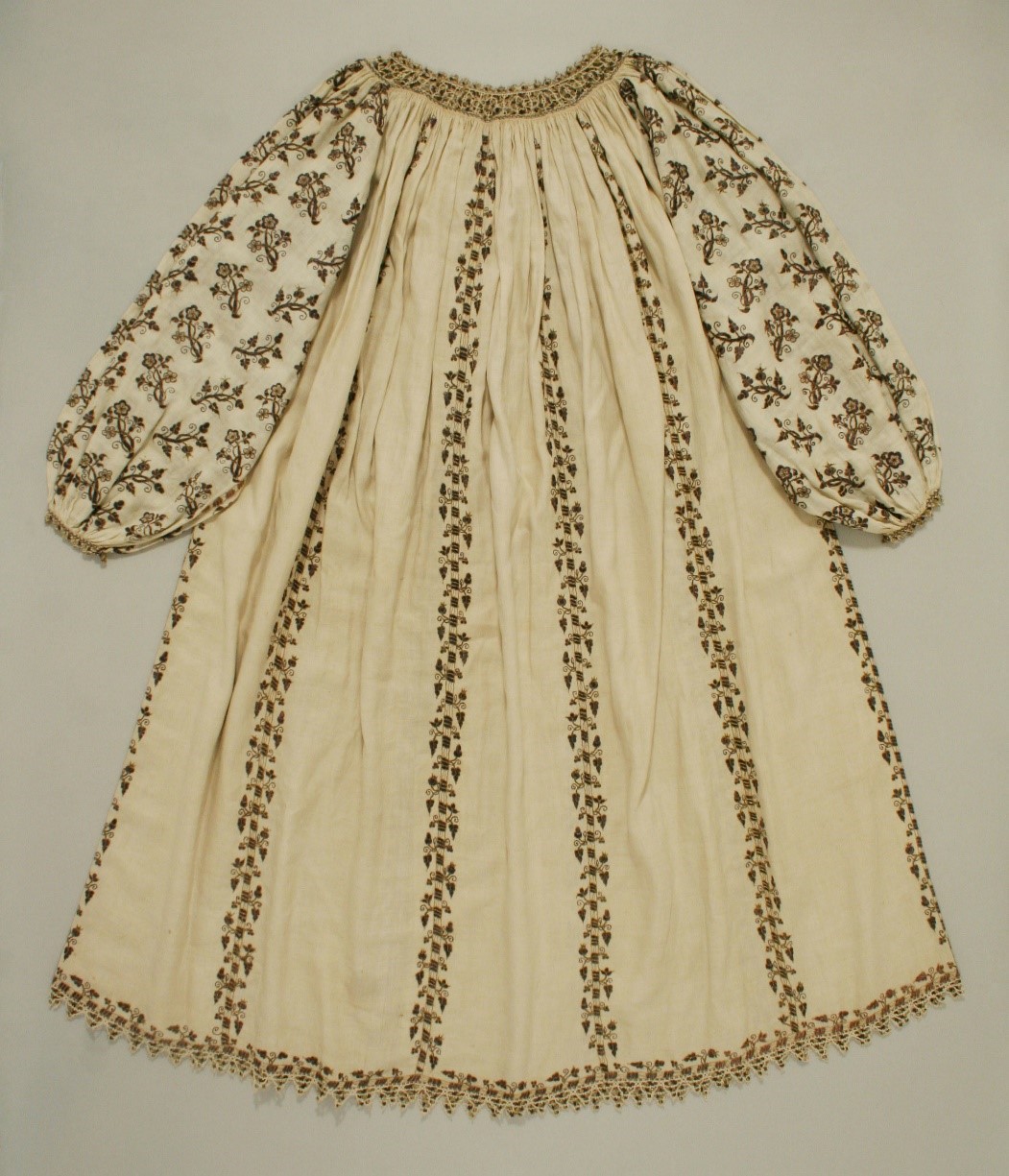
 Late 16th Century chemise at the Metropolitian Museum of Art in NYC[iv]
Figure 2 is one example of a late 16th Century Italian styled chemise.  The sleeves are heavily embroidered in purple silk and the body of the chemise is made up of thin panels that are then sewn together and the seams are embroidered over.   Because of the time it would take to make such a piece and the cost of the materials, this most likely belonged to an aristocrat.

Figure 3 Detail of a chemise with lace insertion, showing the upper part of the sleeve[v]

Figure 3 shows the underarm and the sleevehead to a late 16th Century style chemise.  Various laces are inserted between panels as well as around the neckline.  This is similar to what I attempted to do with the chemise on display.  The location of this extant chemise is currently unknown.


Figure 4 16th Century chemise close up showing needlework lace[vi]

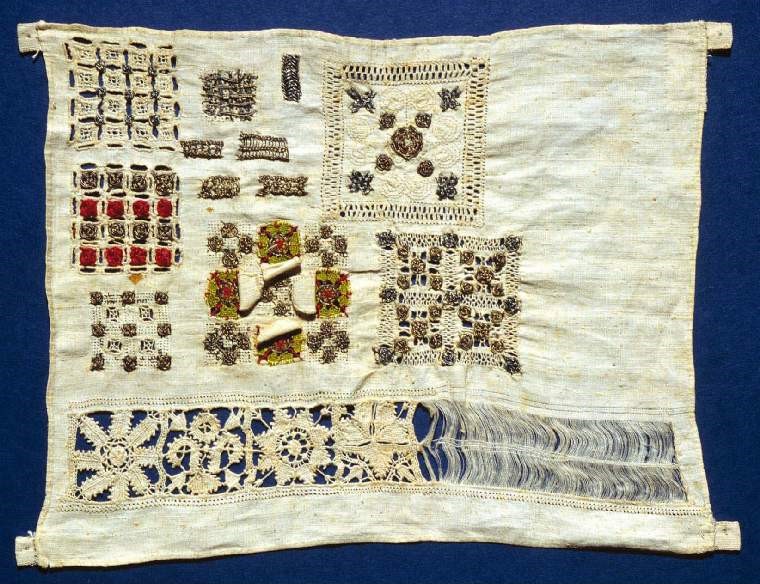
Figure 4 is not a true lace as we would know it today but a very specific type of embroidery called drawnwork.   The embroiderer would cut out some of the threads from the base fabric and wrap the remaining threads to create designs.  Figure 5 shows and example of needle work where it is half finished. 
Figure 5 Sampler from the late 16th C/ Early 17th C showing various types of embroidery[vii]

The mix of blue silk hippocampus and white bobbin lace I chose for the chemise comes from a few different embroidery examples.
Figure 6 Strip of blue embroidery with drawnwork, 16th C Italy[viii]
Figure 6 is from the Metropolitan Museum of Art in New York City.  It shows a mix of light blue embroidered flowers with cutwork or drawnwork. 
Figure 7 16th C textile showing lace insertion and dark blue silk embroidery

Figure 7 is closer to the techniques I used and shows both lace insertion and dark blue embroidery.  The base is linen with the blue thread embroidery being silk.  It is unknown what the textile itself was used for but most likely a table or alter cloth.
Figure 8 Seahorse or hippocampus, most likely done by Mary Queen of Scots
The hippocampus, or a mythical type of seahorse, was a popular motif throughout Europe in the late 16th C.  Not only does is show up in various drawings of the time, but, in Figure 8, there is an extant embroidery of one.  The embroidery is attributed to either Mary Queen of Scots or Elizabeth Talbot, Countess of Shrewsbury.[ix]

Technical Details

The main base of the chemise is linen.  The embroidered bands in the sleeves are older – I did them almost a decade ago- which is why the color of the linen is slightly different.  The bobbin lace is out of cotton.  Both linen thread and silk thread were used to sew everything together.

Italian Chemise Pattern

Placement Guide

The above patterns aren't the best but it is pretty much what I used.  (Ignore the orange pattern, it really is rectangular and not with a small bit cut out).  The green is what I used for casing along the gathered neckline. 

The Art Show where the finished chemise was first on exhibit

Close up of the full exhibit


Another close up of the embroidery


[i] http://costumedabbler.ca/cotton
[ii] https://www.luigi-bevilacqua.com/en/silk-and-venetian-fabrics-renaissance/
[iii] https://owlcation.com/humanities/History-of-Lace-Making
[iv] https://www.metmuseum.org/art/collection/search/83860?&searchField=All&sortBy=Relevance&when=A.D.+1400-1600&what=Costume%7cLinen&ft=linen+embroidery+italian&offset=20&rpp=20&pos=29
[v] http://realmofvenus.renaissanceitaly.net/workbox/extcam6.htm
[vi] http://realmofvenus.renaissanceitaly.net/workbox/extcam5.htm
[vii] https://webapps.fitzmuseum.cam.ac.uk/explorer/index.php?qu=Name:sampler&oid=110905
[viii] https://www.metmuseum.org/art/collection/search/215421
[ix] http://collections.vam.ac.uk/item/O138524/the-oxburgh-hangings-panel-mary-queen-of/

Sunday, March 25, 2018

Bunratty Folk Park, Ireland part one

I'm going to start this off with one very simple request: if you ever get a change to go to Ireland, go to Bunratty.  Seriously, despite a problem with some mis-information by the interpretors, it is completely fabulous.   The biggest issue with Bunratty is they have no clue of what a gem they really have.   The castle and the grounds cover everything from the 15th up to the early 20th Century.  It's 500 years of history in one little park where you can peak back in time.   The castle, the homes, and many of the artifacts are all extant.

The problem is that the interpretors have zero idea of what they are talking about.  I think Bunratty got hit hard during the recession of '08 and is just starting to bounce back.  I recall the medieval banquet I went to uh....many, many years ago and it was very different from what it is now.  Not that it's bad now - it's definitely better than the Medieval Times in the U.S. but only just.

Some issues - the costuming.  Okay, granted, that's the first thing I would notice.  The castle was built in the mid 15th Century.  The garments the actors and actresses wore were want-to-be-16th Century.  I get that you need garments that can be used by other actors and can be cleaned easily but there are plenty of garments from that range that fit the bill that don't involve zippers up the back.   ...Or panne velvet. 

Really, I think hoppelande gowns or even just really basic sideless surcotes (which were worn for festive occasions up into the 16th Century) over a-tunics would be perfect for the actressess.  The sideless will fit pretty much any size and the a-tunics are very easy to make.  Making them out of linen and wool - to show off what would have been worn in Ireland anyway- would also look stunning.  For the men, a short hoppelande or a liene with hosen would look nice.

The second problem was the entire dinner.  Don't get me wrong - it was delicious- but BBQ ribs with tomato sauce (they gave me mine without the sauce) and potato soup are pretty distinctly post period for the castle.  It's clear they wanted to give a 15th/16th vibe.  The potato was introduced from the New World in the 16th C - but you don't see many recipes for it until the later half.  Even then, it's more baked potato stuff.  The tomato isn't commonly eaten until the late 18th/early 19th C.

Also, the actors and actresses claimed that any cutlery other than a knife wasn't a thing which is blatantly false.  I'm not sure why that is even still a common myth.  We had to eat our soup without a spoon.  This goes directly against the Irish archeology finds in southern Ireland that include...wooden spoons. Now, this entire event could have been an excellent learning experience and still allowed the castle to get away without having spoons. Really, in the middle ages, people were expected to bring their own cutlery - to include spoons. Since we, as 21st guests, don't regularly keep our flatware on our persons, the "host" of the evening could declare that they don't have enough spoons for more than the household. Therefore, the guests will need to sop up their soup with the bread - which is what we pretty much did without anyone telling us too. Still, teaching about sopping up the soup and going into that part of history would be much more accurate and truthful than just saying spoons weren't a thing despite direct evidence against that.

As for forks, they aren't a thing until pretty late in the 16th c so it's doubtful they'd be a thing in Ireland for the time that the medieval banquet is trying to re-create. Still, providing a spoon and a knife and explaining about the archeology of Ireland would be beautiful.
Medieval Banquet Hall

A couple of days later, I went back to the folk park to get some better pictures of the castle (since I was an idiot and forgot my camera in my bag back in the B&B) as well as check out the rest of the park.  My memories of the park many years ago are a bit fuzzy but I do recall the 19th C village and the people dressed up talking about various aspects of pre and post famine Ireland. 

Bunratty Castle
I wanted to get photos of some of the tapestries in the castle and other antiques because, what Bunratty does have, is absolutely fabulous artifacts from the 15th ~18th Centuries.   When I went into the main hall, a gentleman was dressed up in far better 16th Century garb than I saw at the banquet.  However, what I heard him say made me cringe and I had to walk away. 

According to him, the Irish didn't have glass for windows until the 17th Century.   /facepalm   The way he said it, it made it sound like glass hadn't been invented yet.   I later had to explain to a few people that - no, glass is ancient.  Even the Romans had it.   I also eventually piped up a bit and did point out they had shutters on the archer windows.  It's not like our medieval ancestor let all the heat from the fireplace go out an open window in the middle of winter.  We have manuscripts from England, Germany, and Italy showing glass windows as early as the 14th Century.   

Now, you wouldn't want to glass over an archer's window because it would just get in the way.  Having shutters that come inside the window and covering the window with those fabulous heavy velvets or tapestries also kept the cold outside.   Despite what the gentleman said about it being very cold and how spoiled we are with our heating and a/c - it's just not that bad in the middle ages.  Anyone who has been camping in the winter knows a good fire will keep you pretty darn warm.  Add that having four walls and roof?  Well, I know I've been in power outages for as long as a week in winter.  A good fireplace, good curtains, and warm clothing will keep you plenty warm.   

The Great Hall
Another myth the gentleman spoke about that made me cringe was that, apparently, according to him, there were no vegetables or fruit in Ireland before Sir Walter Raleigh brought back the potato.  ....  I'm not joking.  That's what he said.

I guess carrots, turnips, onions, and apples which were common in England never made it across with all the nobles going back and forth? Of course, that's not the least bit true. The truth is that apples have been a part of Ireland for at least 3,000 years. In fact, crabapples, hazelnuts, and waterlily seeds were part of the mesolithic diet. So, they had fruit. Various types of cabbage were a thing since the Roman era (I mean, come on! Irish and boiled cabbage is almost more Irish that potatoes!!) with the Savoy cabbage being introduced in the late 16th century. The biggest part of the medieval Irish diet, however (which both this gentleman and the actors at the banquet overlooked) was cheese. Dairy was a huge part of the medieval Irish diet. Add that with some fish, bread, and apples...and I think they ate rather healthily in times when there wasn't a famine.

They certainly weren't just hunting elk and eating that - unlike what the gentleman said. Seriously, he said they only ate meat....which uh. No. Just no. Meat was actually pretty rare except for the rich. He mentioned that the Irish deer were smaller so there wasn't much meat. Really, he made out the medieval Irish to be small, starving, people who were constantly cold and died at 20. Yet, somehow, there are Irish today....

Yeap, he did the whole life expectancy thing. While life expectancy was lower before, well, antibiotics, it didn't mean you dropped dead at 30. Nor did it mean that a bunch of people were dying at 30. Rather, a LOT of people died before they got to be five years old and a lot of people died when they were in their mid to late 60s. You get an average life expectancy of 30 from that. Yes, more women died in childbirth than they do today - but the rate (thank you Dublinia for getting right!) was 15% of women died in childbirth. Not exactly the 50/50 chance that many people make it out to be.

Another aspect that the gentleman said that rubbed be the wrong way was that women were second class citizens in Ireland and were expected to just sit around and have ten children, with a couple of male heirs maybe making it to adulthood. Well...no. I mean, just look at Grace O'Malley who is still considered one of the greatest pirate Queens in history. She had control over her own lands, ships, and got such a reputation as a pirate, that Queen Elizabeth of England demanded an audience with her. Also, Grace had three kids - not ten.

Okay, so pretty much everything he said was a myth. The Irish weren't always cold, starving, and dying - although there were famines. Women weren't just baby factories - they had more rights than their English counterparts. And the Irish had veggies and fruit. I mean...seriously! Cabbage! /sigh

Anyway, on to the beauty that is Bunratty castle itself.


The pantry is right off the main hall.  Amazingly, they actually have this pretty accurate for the late 15th/early 16th C.   It's basically slightly poorer version of what King Henry VIII would have had.  Also, those look like water fowl hanging up to be prepared - not small starving deer.   /headdesk
Late 15th Century/early 16th C tapestry on one of the walls in the great hall.  Luckily, my camera got an excellent shot of them.
Late 16th Century tapestry.  This one was the best preserved of the lot.  


A lovely gothic window.  The windows appear to be a mix of glass from various time periods put together with some modern methods.  Really, most of the glass was quite lovely up close but was all recreations of other pieces.
This bed.  Let me tell you how much I love this bedroom.  The bedspread is a bit blurry but is is, in fact, early 17th Century Jacobean embroidery.  Real.  Not a recreation.   And the canopy?
Oh the canopy....
I got as close as I dared to get a good close up of the polychrome embroidery on the purple silk.   Yes, it is a real late 16th/early 17th Century embroidery piece - most likely Italian.   A similar style of embroidery is at the Hermitage and seen in in this embroidery pattern book form 1608.  

Another fabulous bedroom with 16th and 17th C artifacts
The upper hall
A 16th Century Gentleman
15th Century original floor tiles
This photo is hard to see but I wanted to show how hard it was to see the next beauty.  It's in the corner, to the right.  See the cross?  Okay, the next beauty is inside the glass case...
See that embroidery?  I know it's difficult - there was no way to get close to it as the room was roped off.  However, the embroidery style?  This green velvet chasuble has early 15th Century Embroidery all over it.   *dies*   Did I mention that the Bunratty Folk park have no clue what they really have?   This is evidence of that...  This poor chasuble is back in a corner where no one can see it properly and yet early 15th Century embroidery?!?

It was like that through out the entire castle.   In my next post on the Folk Park, I'll actually get to the folk park.  :-)   One item I do remember of the original banquet I went to ...err..a while ago, I'd like them to bring the snuff boxes back.  They had them many years ago and I remember trying it.  Let's just say, I didn't have sinus issues for weeks afterwards!   :-)


Monday, August 12, 2013

Historical Fortnightly Challenge #16: Separates


Better pictures in the morning, I swear.  I just wanted to get this posted before the deadline
The Challenge: Seperates
Fabric: Linen
Pattern:  Based upon extant high necked smocks a la Janet Arnold
Year:  16th Century and early 17th Century, really. The embroidery is from 1526 but was a common pattern throughout the 16th Century.
Notions: silk thread, linen thread
How historically accurate is it? I doubt it could be more H/A without time traveling back, really. I suppose it could use a bit more embroidery but the point was to show that an embroidered, accurate smock was possible in 2 weeks.
Hours to complete: 30 very long hours
First worn: Probably tomorrow. :-)
Total cost: I think I got the linen on sale for $5 a yard and the silk was $5...and the linen thread was $7 so about $32 unless you want to count the beeswax used on the linen thread then it's $35.

Research!

The idea was a two fold one - to prove that a hand stitched, hand embroidered smock was possible in a pretty tight window (15 days) and also to get a high neck smock to use during cooler events. Most of my chemises/smocks/shifts are all open around the neckline. This helps in the summer when it can get HOT at outdoor events but it's just not practical during the cooler events. I didn't want a partlet since they weren't always worn and they don't work with some of the gowns that have embroidered necklines (even if it's the linen ones, then you have to tie them beneath the arms and it's just more fuss. A high neck smock just made more sense).

High neck smocks appear all over Europe and they stay in Europe for over a century. There is this one from 1540 that I really loved and this one from a hundred years later. So, a high neck smock would go with a lot of different outfits from a lot of different eras.

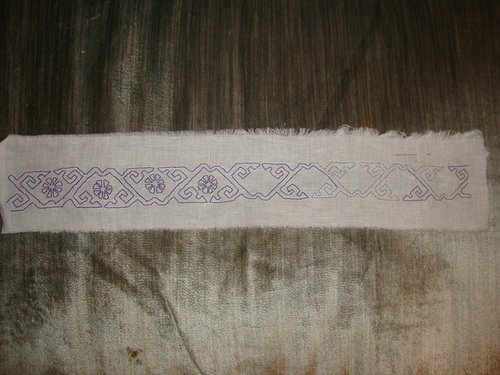
I've sewn a chemise before by hand and knew how quickly that can go but I haven't really completed an embroidery project like this before. That was interesting. My five year old nephew declared the collar his when he saw it. I had to be disciplined to work on the embroidery a bit every day. It's far from perfect - the lines look like my five year old nephew helped with the sewing- but it does look neat. I used violet thread similar to the collar in this extant Italian chemise simply because I wanted something that would have high contrast against the white linen but also would look good with a variety of colors.

More inspiration photos and pictures later - I'm beat from sewing all day to get this finished!

EDIT: I added a couple more pictures.  One of the actual finished smock up on the dress dummy and the other of one of the neck gussets (you can see my finger in that photo for size).  Edging the neck gussets was an interesting experience since they are so terribly small and triangular.  Everything else on the smock is a rectangle or square, making edging very easy.   Luckily, I had enough foresight to edge the neck gussets first.  :-)  

For the body of the smock, I used the selvage on both the hem and the shoulders - using the selvage is both period and practical.  I couldn't sew the body together at the shoulders by edging it since the rest of the top of the smock makes up the gathered neckline - it would get messy quickly and there would be raw edges sticking out somewhere near a neck gusset.   So, using the selvage, the fabric was still thin enough to gather at the neckline but wouldn't unravel at the shoulders without being rolled either.  

Portrait inspiration:
 photo moronischoolspain.jpg photo anguissolacrem2.jpg
 

Deadline tomorrow update on the embroidery project


I'm about an hour behind where I'd like to be right now. Saturday, I really didn't get a chance to sew much so I ended up getting way behind.  All four roses on the not quite finished cuff are brought to you by the movie Despicable Me.  The collar is done, one cuff is done, the other cuff has a little over an hour of work left on it.  The shift is cut and I just need to sew straight lines - no going back over them like with embroidery- to finish this thing.  We'll see how well I do...

Thursday, August 8, 2013

Day 10 Update!

Sorry for going quiet the past couple of days.  I have been working on the embroidery, see?


The collar is done (yay!) and I've starting working on one of the cuffs.  Hopefully, this cuff will go quickly and I can start on the other cuff tomorrow.  We'll see.  I'd like to have all the embroidery done before 5pm EST or so Saturday.   Sunday, I can put together the chemise.  I've done handsewn smocks before and it's actually not that bad - just a lot of straight lines to sew up.   So, movie marathon have Church!!!!

You might notice that I have traced the pattern on to both cuffs to go over.   I took a picture of how I do that thinking it's probably something and least a few people might be curious about.  I don't use tracing paper. 


Instead, I printed out the pattern from this page done by Aelia Apollonia from the West Kingdom (SCA). I edited it using photoshop to get straight lines and to change up the size so it would be easier to trace.

After printing out the pattern, I place the linen fabric over the piece and center the fabric. I then taped the paper and the linen down together to give me a slightly more stable working surface, but also to pull the fabric tightly over the paper pattern. In the picture above, you can tell the left of center rose is only halfway traced.  The black lines on the left of that rose are actually the pattern showing through the fabric.  (I'm sure there a ton of political jokes in here somewhere).

To trace, I used a simple light blue colored pencil. Once I'm done tracing, I start sewing!


Close up of the cuff I'm currently working on.


And to show I'm not just working on a high neck smock and a Regency gown that is finally out of the bad corner (pictures tomorrow), took a picture of the skirt I decided to wear today...after I made it this morning. My old, very worn, but fit perfectly jeans deserved a new life. The pink shiny fabric isn't really that shiny - it's a left over piece of sari I used last year for my Titanic Ghost costume at Dress U. The piece was roughly 2+ yards - enough to do something with. I made it into a tube, cut out a piece of muslin for an attached slip, made a tube of that, cut the legs off the jeans and gathered the tube of fabrics. Attach the gathered tube to the bottom of the jeans and you have a new skirt! It takes all of 15 minutes and makes for a fabulous summer skirt - plus giving those very worn jeans a new life.


Monday, August 5, 2013

Day 7 and Regency Gown Progress

Warning: This post is brought to you by sleep depervation. I was awoken four times this morning, starting at 4:30 am, by a strange male staring at me. It's rather eerie to feel someone or something watching you at O'dark thirty, open your eyes, and see this:


A strange male glaring at you because you won't get up at four freakin' thirty in the morning to feed him. He would then meow and rub up against my hands to pet him until I pushed him off the bed and attempted to go back to sleep. He'd wait for about a half hour or so and do the same thing again. Gah! Anyway, your regularly scheduled post is brought to you today by that dumb cat who can't find his way outside of a shopping bag, Jasper.


I finished the bottom row of the embroider and made one rose.  Yay!

 I also spent an hour at the thrift store trying to find a basic, thin, cotton (or non dead dino) curtain or even thread bare sheet with no luck.  I wanted either a soft white or soft black petticoat to go with the Regency dress I'm working on.  They had nothing.  They did have a lovely scarf, several interesting dresses, a grey knit sheet that was begging to be made into a new work dress, and a guy that smelled like he hadn't bathed in years (he was on the other side of the store and it's a BIG store, thankfully) but no thin cotton sheets/curtains.  So I went to Hobby Lobby.  They had cotton batiste in the "clearance" section in 1 7/8 yard and 1 1/4 yard remnants - enough to make a basic petticoat- for a grand total of $5.  Yay!

I now have enough to make a petticoat. 

So, now to finish the embroidery, finish the Regency gown, and start some other completely random project simply because I can.  Probably a giornea in blue for the robe & robing challenge.   It's a big loose garment...and it's totally period as a robe because, see?

The Princess Bride is a completely historical account of life in late 15th/early 16th C Italy.  Seriously.


...Shut up, Indigo.

Sunday, August 4, 2013

Day 6 and new project started


DSC03562


The outline is done, I just need to go back over it. I also need to finish up the roses. I'm guessing maybe another 3 days and then the collar will be done. After that, I still need to make the two cuffs and then put together the chemise itself. This will be interesting.

Because I cannot keep to just one project for more than five minutes (where's the fun in just one project?), I've also started a 1790's gown. I've cut it out and will sew it up tomorrow, hopefully.

DSC03563


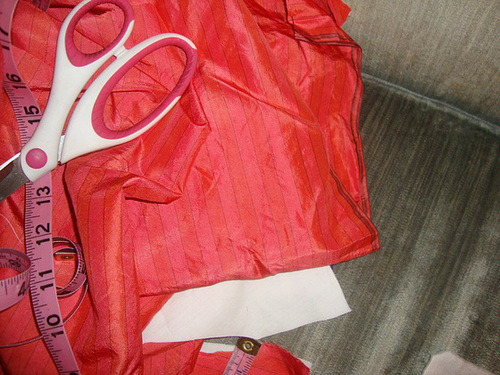
The red on red striped silk is what I'm using for the dress. It's not nearly as bright as in the picture. It's a few shades more subdued and has an orange/peach tint to it.