Showing posts with label 16th Century. Show all posts

Wednesday, March 4, 2026

Wednesday 4 March meal


Rice with Raisins

This is one of those meals that we'd probably be more likely to eat for breakfast today than just anytime of day during the Renaissance.  Overall, it's very simple:  Rice cooked in almond milk with a bit of sugar, saffron, and raisins.   That's pretty much it.  

This very basic recipe shows up in a few different places.  Sometimes it's rice flour and sometimes it's just rice.  However, rice with almond milk and saffron seems to be pretty common.  

Taken from Medieval Cookery


Taken from Medieval Cookery
"Take good almond milk and let it boil.  And do there in almond with flour of rice and color it with saffron.  And after, dress it with grains of pomegranates or otherwise with raisons, if you don't have the other.  And take sugar and do therein, and serve it forth."

Taken from Medieval Cookery

  "To make rice of Genoa.  Take rice and parboil them in fair water and steep them well.  And then take them off and cast them in a fair vessel and pick them clean and set them on the fire.  And then do to it a broth of fresh beef or of good bone broth and let them boil well and add ground saffron and salt.  And if it be a fasting day, make it with almond milk and serve forth."


Rice wasn't always cleaned of it's husk in the middle ages so boiling the rice to clean it and then boiling it again to cook it makes sense. 

Really, I took the middle recipe and just used rice grains rather than rice flour.  I also added some poudre dulce.   I'll probably have the rest for breakfast in the morning.  


Friday, February 27, 2026

27 Feb Friday's Dish


Taken from Medieval Cookery

This one was a successful failure.  What I mean by that is that the mixture failed to retain ball shape when I fried them up but the hash that I did fry up was pretty darn good.  It is a recipe I'll try again with a few changes.  

One, make sure I blend everything separately and thoroughly.  I chucked the golden raisins (sultanas), the blanched almond slivers, and pieces of cod in the blender together.  I should have had each done up separately and then combined them to make the fish balls.

Two, use a bit more fish and a few less raisins.  I used equal amounts, more or less, of each of the three ingredients.  

I did add some Poudre Forte to the recipe which really made it taste amazing.  The ground up raisins should act as a binding agent for the almonds and the fish - I used cod- but nothing got completely ground up so this was the result.  I fried them up in olive oil.  


The result!  Yes, I know it doesn't photograph well.  At all.  As you can see, the almonds weren't ground up properly but I got tired of fighting with the blender and just made up what I had.  And yes, I used a blender rather than a mortar and pestle.  


Friday, February 20, 2026

1st Friday of Lent meal


Taken from Medieval Cookery

This morning, I tried to make almond milk with my new fangled Christmas gift of a soy milk machine.  It worked -and I had hot chocolate- but I ended up with a lot of ground up almond paste.  I looked up recipes that use almond paste and this was one of the ones that sounded both simple and pretty decent.  Plus, I got to use up the rice from Wednesday!  Woohoo!

The Almond Porridge; yes it looks like milk

Ingredients

1/2 cup of almonds ground into paste

1/2 cup of rice ground into paste

1 tablespoon brown sugar

Raisins for garnish


Really, just heat the pastes together and you have the porridge.  I added too much water to the rice paste and the porridge came out more as a very thick soup.  


I ended up eating it more as a dip for these lovelies:


It was DELICIOUS that way.   I highly recommend it.  I may have also gotten the good dates and eaten those as a side dish...


Saturday, April 26, 2025

The case of Paisley from a Medieval and Renaissance perspective

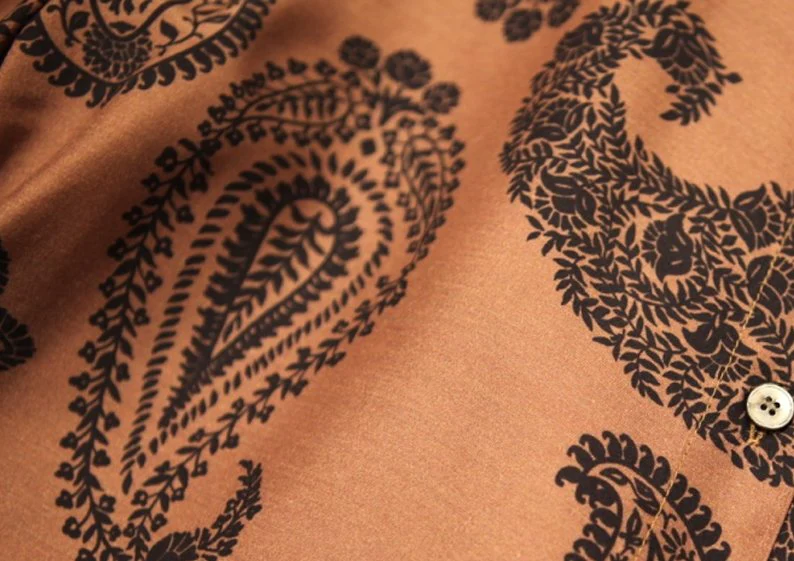
There is a lot of mythology around the paisley print. Some say it has ancient origins but came to the West in the 16th C. Others argue that it wasn't a thing in Europe until the 18th century. This is evident in multiple blog posts on the subject of paisleys.

Taken from Toast Magazine

I personally had been told the "no paisley in the medieval and Renaissance period" so many times, I figured it must be true.  Afterall, the closest thing I found for a while was this 17th century portrait which is just outside of the SCA period:

Taken from Tate
However, it looks like it's another "word" problem, similar to the word "pink".   Pink as a color existed in the SCA period but the word pink to *mean* the color did not.  The same seems to go for the word paisley.  

Paisley, in the SCA period, means the Scottish town which is just outside of Glasgow.  I've been to it and through it a few times.  It's a lovely manufacturing town which, as many sources suggest, is where the design paisley got it's name from when the weavers in the town Paisley started to turn out the design in the 18th century.   

Before that?  I'm not sure if there is an English name for it.  However, the design itself did exist in Europe well within the SCA period. Here is the evidence:

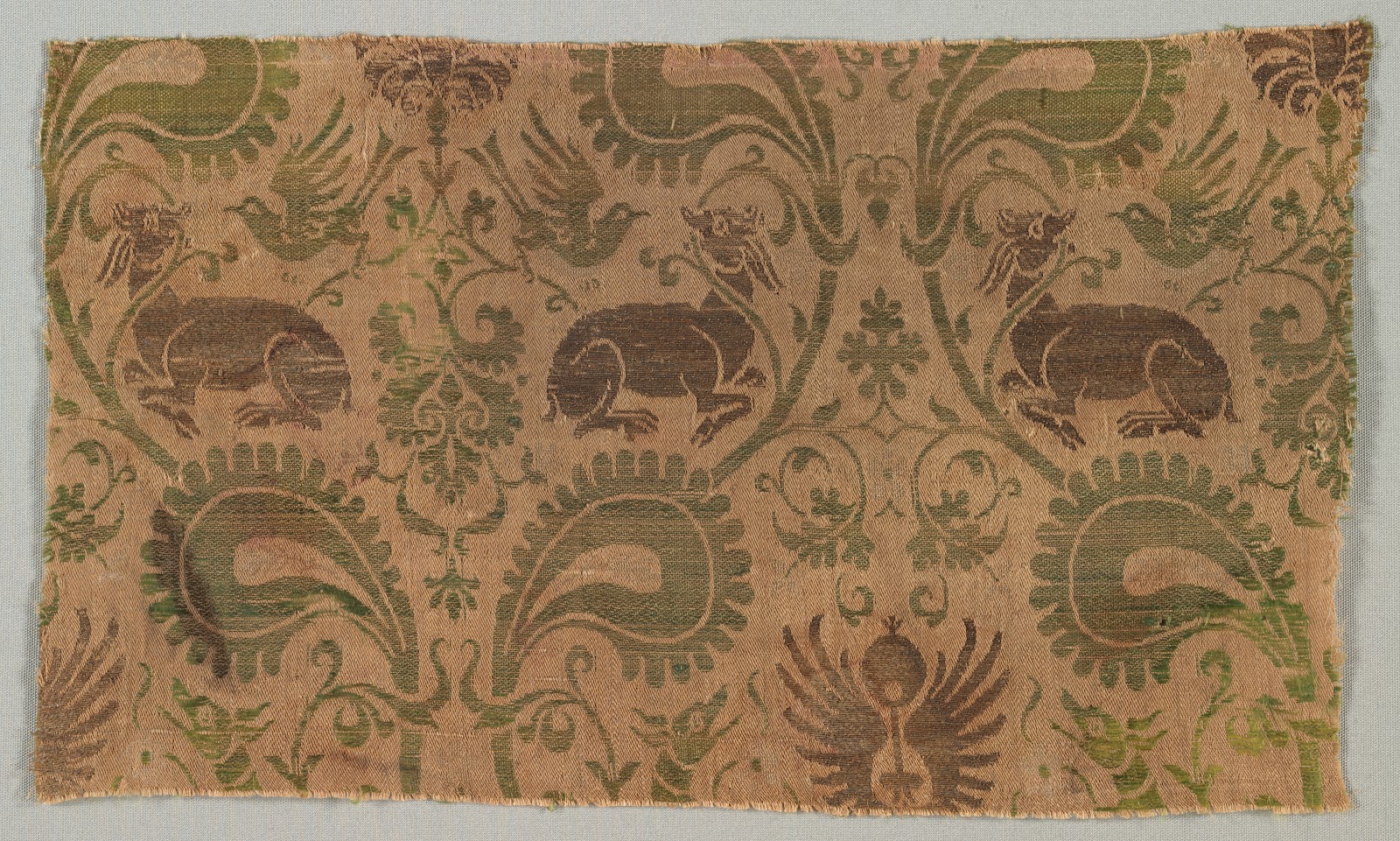
Taken from the Cleveland Museum

The above is a piece of silk lampas, manufactured in the second half of the 14th century...in Italy.  Those big green things below the heraldic dogs certainly look like paisleys to me!   To show it's not a one off, look above the back of the bird's head in this next 14th century piece.


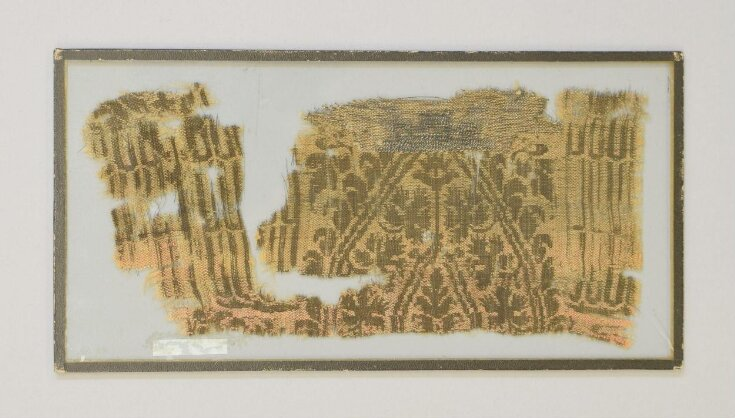
Taken from the V&A Museum

It's also a fun one since it was made in Iran - where we know they did have paisley designs in the 14th and 15th centuries- but used in 14th century Germany for a dalmatic.  This also seems to be the more popular form of the paisley design as it shows up, again, in 14th Century Italy.

Taken from the V&A Museum


The more modernly common paisley shows up again in Italy in the 16th century.

Taken from the MET

As well as in 16th century Spain!

Taken from the MET


And one last late 14th century one that is Italian made, but found in France.

Taken from the V&A


Really, it looks like the paisley was fairly popular in 14th C Europe, though it is a part of other designs.  Hopefully, this will be helpful for anyone else trying to document the paisley into the later medieval period and up into the Renaissance era.   Now, I can safely say that even the design elements on my sari turned 1490's gown are period correct.  :-)


Edit to add:  I wanted to add this image as well:

While the Turkish lady is from the 17th century, her hat clearly has paisleys.  This, again, pushes that whole "18th century" idea back.  Plus, the painting may be as early as the 1610's.  

Thursday, August 10, 2023

New sheer handsewn linen camica


The camica laid out on my bed at Pennsic.   It's too sheer to model as it's out of 2.5oz linen I bought from Fabric Store.   


Close up of the neckline.  I used linen thread I would run through beeswax to sew the entire camica.   Each of the edges are rolled or are wrapped in what is essentially linen bias tape.   


Close up of one of the cuffs.  I still need to add twill tape or some sort of fastener to the cuffs.  

Overall, it took me maybe three days, on and off, to sew the camica up while at Pennsic?  This included cutting out the garment and going to classes or walking around.   It really didn't take too terribly long.

The pattern is very simple.  One yard of linen for the front.  One yard of linen for the back.  30" of  the linen, cut in half for the sleeves (so the "top" of the yard is one sleeve and the "bottom" is the other).  5"ish to make squares.  I cut the bottom of the front and back to make binding for the neckline and cuffs.  Overall:  3 yards of fabric used.  

It's very lightweight and perfect for summer.   I'll probably wear it to the North Carolina Renaissance Festival in a few weeks.  :-) 

Saturday, May 6, 2023

Late 16th Century Venetian Style Peasant Dress


Materials

3 1/2 yards of red linen/cotton blend from Fabric Mart

1/2 yard of cotton duck cloth

1/2 yard of white cotton

1/2 yard of linen rayon blend stripes from Fabric Mart

DMC thread because no one carries red linen and I thought the event originally was a weekend ago

White linen thread from Thimble and Plume

A boot lace

3 ish yards of trim I bought from Lace & Trims on ebay

Pattern

I used McCalls M7763 for the bodice but with edits. I upped the neckline by at least a good inch. I took two inches off the front shoulder strap and redesigned them to be more narrow at the top. I took some off the upper inside of the front side seam as well.

The skirt is just pleated yardage that I then attached to the bodice. The apron is well, a rectangle with a long, thin strap of material to make the ties.

First Wearing

I didn't get the chemise I wanted to wear with the outfit done in time.  I ended up just wearing a blouse I found at Goodwill that looked close enough.   


The bodice probably could have been laced a bit tighter but, overall, it was pretty comfy to wear.  I love the length of it and will probably make a couple more dresses from the pattern.


It was also the correct outfit to wear as it was pretty warm in the sun at the event.  Unfortunately, I had to leave early because the pup wasn't used to the heat.  She's fine - she cooled down quickly on the car ride home- but I just didn't want her to get sick.   


Research


It was pretty much based on the same images as I used for my friend's dress a couple of years ago.  This one in particular:


Pietro Ronzelli: Nativita di Maria, Chiesa del Carmine, Bergamo


I just did the inverse colors - primarily because I didn't have a bright red Venetian dress.  Now that I do, I think I'll work on making more chemises to wear with my dresses and gowns.  I'll need them come Pennsic!   Who else is going?


Monday, September 30, 2019

HSM2019Sep:Katina's Pretty New Green 16th Century Italian Dress


Having fun at the Castle

Back of the dress

The Challenge: September: Everyday: It’s not all special occasion frocks. Make something that would have been worn or used for everyday.

Material: Avocado green linen, orange linen, cotton canvas (inner lining), cotton muslin (lining).

Pattern: Very heavily modified McCalls 2806 which is out of print. I used the bodice pieces only and drafted the darts out. I also changed the neckline and the width to fit Katina better.

Year: 1570s/1580s

Painting by Federico Zuccaro dated to 1579

Attributed to Pietro Ronzelli, date unknown


Notions:  The shoelace to lace the bodice up, thread, and my old green apron

How historically accurate is it? I machine sewed the insides but all the trim and the eyelets were done by hand so about 90%?

Hours to complete: I'm honestly not sure.  I know I started on it in September but I can't recall how long this one took - maybe five or six hours total?

First worn: September 28th, 2019

Total cost:  The avocado linen was $10 a yard and I had three yards to play with.  The orange linen was $7.50 a yard and I also had 3 yards of that.  I'm not sure how much I paid for the cotton canvas originally - maybe $4 a yard?   I only used a half yard for the project.   The muslin was $4 a yard but 90" wide so I only used 1/4 of that. 

I made two gowns like this - one orange with green trim which I started on back in August- and one green with orange trim - which I started on in September.   They are exactly the same in style - the colors are just reversed. 

Katina wanted a dress similar to my old dresses so this is one of the three I made for her.   The orange isn't as bright as in the picture but, well, bright orange is documentable (saffron with madder gets you safety cone orange).  I think she had fun wearing the dresses this weekend.

Sunday, September 8, 2019

Colors the Peasantry wore in the Middle Ages and Renaissance Part Two

In part one, we looked at various paintings that show the poor were anything but monochrome. Now, we'll look at writings and archaeological evidence that further proves the poor had dyed clothing.

I'm going to go with the most obvious first.  Why and how could the poor have access to dyes to have colorful clothing?  The easiest way was to get hand me downs.   Just like now, giving clothing to the poor was very much a thing in the middle ages and renaissance.  Works of Mercy included giving away clothing to the poor. 

There were also second hand shops; basically pawn or thrift stores, in the middle ages.  Again, it wouldn't be the latest fashion but it would be a way for someone with a few extra pennies to get a nice dyed garment that is a season or three too old to be fashionable.  Second hand clothes shops were essential to medieval life.

However, probably the most compelling evidence that the peasantry wasn't monochrome comes from the archaeological evidence itself.  In a study of textiles from both bog and grave digs in Northern Europe, all time periods, including 8th-10th C, showed indications of blue dye being used.  Sometimes, the blue dyes were found in conjection with a yellow dye - meaning that green was a probable color.  In fact, red appears to only show up in the wealthier graves but both blue and green are in the archaeological remains.

More fun is a test of textiles found in the waste layers from Medieval Prague.  172 samples were taken for dye analysis based on a dig site that dates from between the 14th and 15th Centuries.  The entire paper is here and is a fascinating read on it's own.  The 172 samples are broken down into (34 silk and 138 wool samples - which is slightly disproportionate to the overall finds.  Only 4% of the textiles found were silk.  However, some of the textiles were also items such as rope or other non-clothing piece as well as the silk pieces possibly being larger or more easy to test for dyes than some of the wool fragments.

Taken from a presentation by Helena Březinová
Of the 172 pieces tests, only 27 or 15% of all the samples had no dyes detected.  85% of the samples had at least one dye at this medieval dump site.  The dump site would have pieces from across the classes; however, those with estates would dump items on the estate.  (I've been to one too many archaeological field schools where you are digging in the trash pit for the kitchen of some sort of manor/plantation house.)  So, for this dump site in the "New Town" area of Prague, it's pretty safe to assume you are mostly looking at the lower and middle classes with only a few upper class textiles involved in the dump.

The coccid is most likely polish cochineal which makes for a nice variety of orange, pinks, and reds depending on the dye bath and mordant used.  Madder is more oranges and reds.  Cochineal is brighter and more pinkish in it's hue while madder is more the color of a natural Ginger's hair.  :-)  Brazilwood is another red; this one is most likely the east Indian stuff and not from the New World.

Woad gives you a beautiful range of blues.  Tannin dyes, most likely walnuts, gives an array of browns; from khaki to almost black.  Weld will give you primary color yellow. Persian berries is the one outlier and also gives you a neat yellow.

Basically, in this pit, you have a range of reds, woad for blue, some browns, and two different ways to get yellow.  You have your primary colors so any color, pretty much, is possible.  Again, this is the waste layers of a city - you'd expect to find a high amount of items from a variety of classes but mostly the lower and middle classes.  Only 15% has no dye.  Everything else comes in a wide variety of color.

Want purple?  According to this archaeological report, madder (red) and woad (blue) together (purple!) account for 19 of the 60 double combinations; it's one of the most popular.  The tannis were most likely used to give the dye a darker overall hue so the 2 pieces that show woad (blue), weld (yellow), and tannis (brownish) probably came out to a lovely forest green.

Granted, this is just one archaeological report but it does show that the lower classes had color.  How popular that color was, based on the other archaeological paper focusing on digs further north and a few centuries older, depended on both time and location - just like everything else in the SCA period.  So wear that pink tunic with purple trousers as a serf, it's completely period.  :-)


Saturday, July 20, 2019

16th Century Style Italian Camica


Handsewn Late 16th Century Italian Style Chemise
By Lady Isabella D'Angelo


Figure 1 Close up of Chemise sleeves and embroidery

The chemise or camica was an undergarment worn by both men and women from the middle ages until fairly recently, historically.  It was made of either linen or cotton, with most extant garments being made of linen.[i]  The purpose of the garment was meant to have an undyed undershirt of sorts that could aborb the sweat and body oils, leaving the over garments clean.  No one wanted to clean their heavy wool or, if you were rich, heavy velvet garments every day; just as we today do not wash our winter coats every day.
The garments could be embroidered, typically using silk or linen thread.  Silk was domestically produced right here in Veneto between Vicenza and Verona.[ii]  Linen was common everywhere in the Old World.  The embroidery could be dyed or done with undyed silk – the latter called whitework.  Lace, which was only first developed in the 15th century, could also be added.[iii]

Extant examples
There are several extant examples of chemises from Italy located around the world.  Some of these are embroidered, some to these are not.  Both women and men would have their sleeves embroidered but, typically, only women had the bodies of the chemise with any decoration, if they wished. 


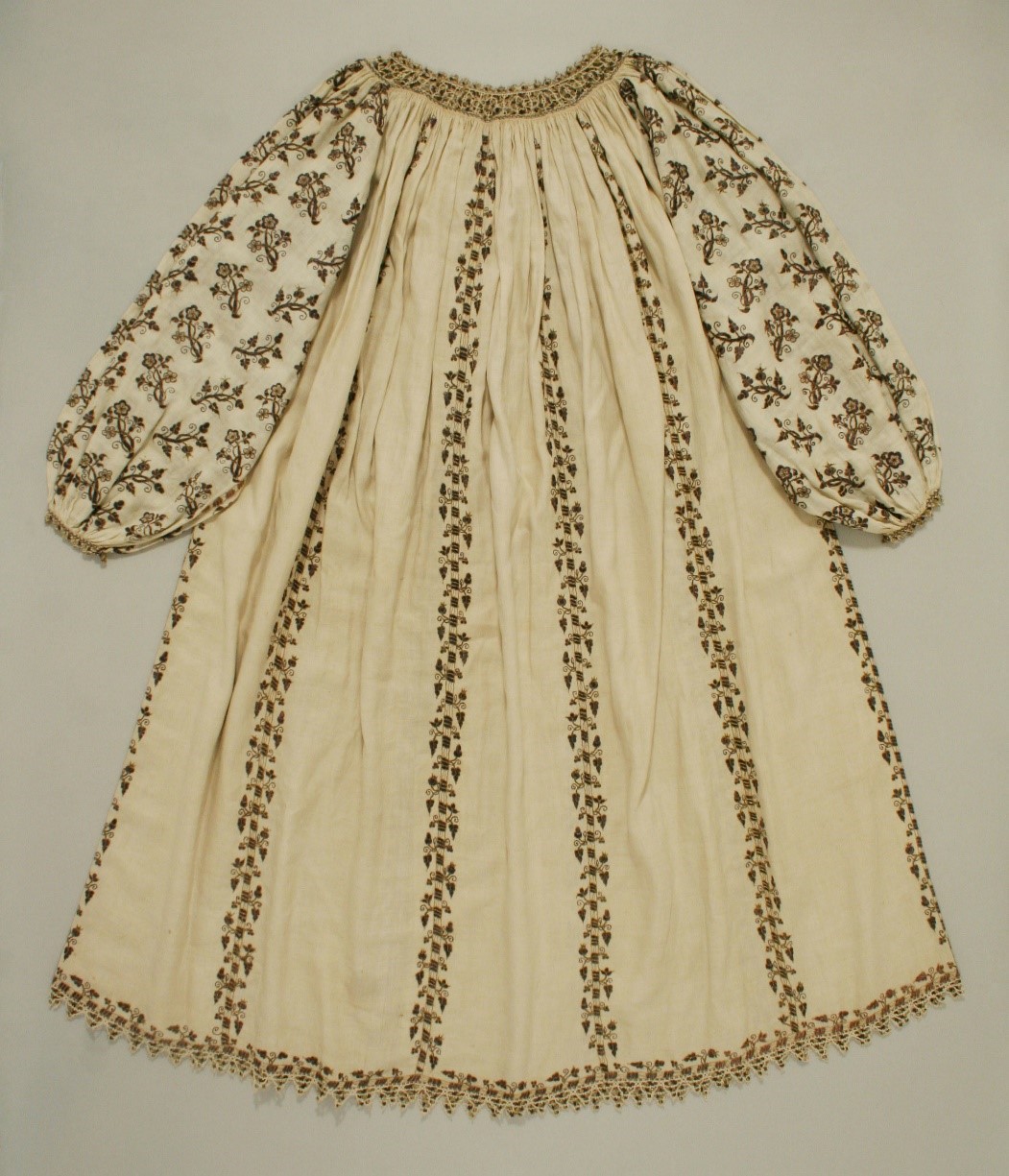
 Late 16th Century chemise at the Metropolitian Museum of Art in NYC[iv]
Figure 2 is one example of a late 16th Century Italian styled chemise.  The sleeves are heavily embroidered in purple silk and the body of the chemise is made up of thin panels that are then sewn together and the seams are embroidered over.   Because of the time it would take to make such a piece and the cost of the materials, this most likely belonged to an aristocrat.

Figure 3 Detail of a chemise with lace insertion, showing the upper part of the sleeve[v]

Figure 3 shows the underarm and the sleevehead to a late 16th Century style chemise.  Various laces are inserted between panels as well as around the neckline.  This is similar to what I attempted to do with the chemise on display.  The location of this extant chemise is currently unknown.


Figure 4 16th Century chemise close up showing needlework lace[vi]

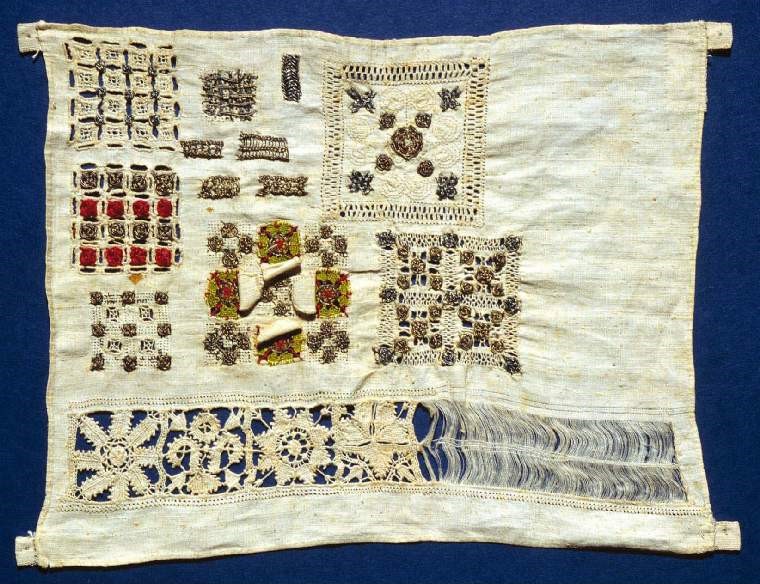
Figure 4 is not a true lace as we would know it today but a very specific type of embroidery called drawnwork.   The embroiderer would cut out some of the threads from the base fabric and wrap the remaining threads to create designs.  Figure 5 shows and example of needle work where it is half finished. 
Figure 5 Sampler from the late 16th C/ Early 17th C showing various types of embroidery[vii]

The mix of blue silk hippocampus and white bobbin lace I chose for the chemise comes from a few different embroidery examples.
Figure 6 Strip of blue embroidery with drawnwork, 16th C Italy[viii]
Figure 6 is from the Metropolitan Museum of Art in New York City.  It shows a mix of light blue embroidered flowers with cutwork or drawnwork. 
Figure 7 16th C textile showing lace insertion and dark blue silk embroidery

Figure 7 is closer to the techniques I used and shows both lace insertion and dark blue embroidery.  The base is linen with the blue thread embroidery being silk.  It is unknown what the textile itself was used for but most likely a table or alter cloth.
Figure 8 Seahorse or hippocampus, most likely done by Mary Queen of Scots
The hippocampus, or a mythical type of seahorse, was a popular motif throughout Europe in the late 16th C.  Not only does is show up in various drawings of the time, but, in Figure 8, there is an extant embroidery of one.  The embroidery is attributed to either Mary Queen of Scots or Elizabeth Talbot, Countess of Shrewsbury.[ix]

Technical Details

The main base of the chemise is linen.  The embroidered bands in the sleeves are older – I did them almost a decade ago- which is why the color of the linen is slightly different.  The bobbin lace is out of cotton.  Both linen thread and silk thread were used to sew everything together.

Italian Chemise Pattern

Placement Guide

The above patterns aren't the best but it is pretty much what I used.  (Ignore the orange pattern, it really is rectangular and not with a small bit cut out).  The green is what I used for casing along the gathered neckline. 

The Art Show where the finished chemise was first on exhibit

Close up of the full exhibit


Another close up of the embroidery


[i] http://costumedabbler.ca/cotton
[ii] https://www.luigi-bevilacqua.com/en/silk-and-venetian-fabrics-renaissance/
[iii] https://owlcation.com/humanities/History-of-Lace-Making
[iv] https://www.metmuseum.org/art/collection/search/83860?&searchField=All&sortBy=Relevance&when=A.D.+1400-1600&what=Costume%7cLinen&ft=linen+embroidery+italian&offset=20&rpp=20&pos=29
[v] http://realmofvenus.renaissanceitaly.net/workbox/extcam6.htm
[vi] http://realmofvenus.renaissanceitaly.net/workbox/extcam5.htm
[vii] https://webapps.fitzmuseum.cam.ac.uk/explorer/index.php?qu=Name:sampler&oid=110905
[viii] https://www.metmuseum.org/art/collection/search/215421
[ix] http://collections.vam.ac.uk/item/O138524/the-oxburgh-hangings-panel-mary-queen-of/

Thursday, January 10, 2019

Colors the Peasantry wore in the Middle Ages and Renaissance Part One

So, I ran across a post on the superiority of chemical dyes over natural dyes that stated the lower classes didn't even have access to colors before chemical dyes.  ......  The individual honestly believes that everyone who wasn't rich or upper middle class only wore white, brown, and black before the 19th C.   Now, I put that up in the "we didn't have color before the 1930s.  Haven't you seen the old films?!?" category.  I just found it rather strange that anyone would actually believe that old joke.

To help put an end to the idea that peasant=boring, drab colors, I figured I'd put a new compilation together regarding colors in the middle ages and Renaissance.  Here's the first post to the series I did last time on fabric types and colors available in the middle ages and Renaissance.  In that, I went over what was available to show that, for the SCA, there really isn't such a thing as "that color didn't exist yet!!!!".   If you can document it, you can wear it.  I documented everything from hot pink to lime green and eye blinding yellow.

The difference this time around is that I'll explore a specific class in the medieval society to see what they were wearing.   Yes, the poor wouldn't have been wearing the expensive dyes but they weren't wearing monochrome either.  I'm looking at paintings, written evidence, and archeology to show what colors were possible. 

Paintings

Now, I know a few people will say "paintings?! But those were highly stylized and meant to be pretty for the people viewing them, not true representations of life!"  However, I call bupkis on that idea.  First, there are just too many different illuminations and paintings that show colorful garments for the beggars and peasants that it just doesn't hold water. Second, as I will show with the archaeological and written evidence, the poor were wearing colorful garments.

St Stephen Distributing Alms by Fra Angelico, 1440's
Above is a popular motif in the middle ages and Renaissance - a saint distributing alms.  Any time a saint's life is shown, this is likely to show up at some point.  There are manuscripts, paintings, and drawings showing various saints handing out alms.  Since the alms are always being handed out to the poorest of the poor, it gives us a chance to look at their clothing. 

In the background, we can see the donor who commissioned the painting in a lovely green, with his hands in prayer.  However, in front of him are some examples of the poor in the mid 15th century.  The lady is wearing a peachy pink dress with a light blue scarf around her waist and arm.  The child in front of her is wearing a dusty mauve tunic.  Behind the lady is a poor man wearing a nice blue shade.   They may not be the brightest colors but they aren't monochrome either.

Saint Lawrence giving alms, Fra Angelico, 1450s
Just a few years later, the same artist depicted a different saint, Saint Lawrence, giving alms.   Here, one of the beggars wears a rather rich red. The little girl with the little boy to the right of the saint is wearing an old green dress.  The baby in his/her mother's arms on the left is also wearing green.  Although there are beggars wearing gray, black, and brown, there are also blues, greens, and reds.  Check out the guy wearing blue on the right's burgundy hosen.  Again, it might not be the best of colors but they aren't colorless either.

"Catherine of Cleves Distributing Alms" by the Master of Catherine of Cleves, circa 1440
Although the two paintings by Fra Angelico might have been considered a bit low key on the color, this one is anything but!  This illumination shows a lady wearing a worn green cloak, a rather nice rose pink hood, and a mauve dress.  The man begging besides her has on a very bright blue doublet and an orange boot.  In front of him is a guy with an older styled, patched up doublet in a light green with rose pink collar and cuffs.  These are nice, BRIGHT colors but given the holes and patches, they are all clearly beggars.

Saint Lucy giving Alms circa 1435


The gentleman at the front of the beggars may be wearing gray but check out the lady behind him!  She is wearing a rather nice wine purple with her black veil.  And the gentleman next to her?  A good orange outfit with a green cap.   Even the beggar wearing gray as blue hosen on.  These aren't boring colors.  They are very much dyed garments.


The Alms of St. Anthony', oil on wood painting by Lorenzo Lotto, 1542. Basilica dei Santi Giovanni e Paolo, Venice
This one is pretty much 100 years later than the others but, again, we see green on the bottom left and yellow, orange, and red.  Although there are some blacks and browns, the over all colors are pretty much like what, really, you'd see today on the street.  It's a good mixture. 

Now, the giving of alms isn't the only time we see the poor depicted in medieval and Renaissance artwork.  Another common theme is one of my favorites for other reasons: shepherds.  Anyone who knows me, knows about my love for Shepherd's huts.  Shepherds were not rich by any means; they were the working poor.  Often, they are shown in rags; but, mostly, they are shown in common, peasantry outfits.

I love these guys. Mister mis-matched hosen and his ruined hemmed shirt.  Look at what the shepherds are wearing.  Yeah, the one guy on the right is wearing gray...but with lots of red.  Mister mis-matched hosen has yellow, red, and blue.  He's wearing primary colors!  The lady in the back who has her shepherds purse with her is wearing a lovely shade of red as well.  Theses are not boring colors at all!

Heures à l'usage de Rome Bellemare, Noël (14..-1546). Enlumineur
In this, yes, the guy in the back is wearing boring brown and gray but the lady sheering the sheep certainly isn't.  She's wearing a lovely deep red and a blue overdress. 

Livre d'heures du Maître du Bréviaire de Jean sans Peur (Paris ou Bourgogne, vers 1413-1419
Again, some brown but lots of blues and reds.  This is pretty common through everything I've found - lots of blue and lots of red.  Other colors are less frequent.  There is a good reason for this and I'll show later in the writings and archeology of the period. 

MS M.1004, fol. 044v ca. 1420-1425
There is no question these guys are poor.  Look at the tatters the shepherd's clothing is in.  However, they have fabulous colors!  Pink, blue, yellow, and an orangy red as well as brown.  Another example of not boring colors. 

MS M.0179, fol. 076r ca 1480-1500
Tell me that isn't lavender purple the lady is wearing.  Again, blues, reds, and now lavender purple.  The shepherds are pretty colorful.

MS H.5, fol. 059v ca 1500
I had to include these guys too because more lavender purple but also that fabulous "dear me!" orange on the guy to the left. 

Despite the amount of evidence here that poor did not mean boring colors in the least bit, I know there will still be people who will claim "but these are paintings!  They are meant to be pretty!  It's not what was really worn!"   So, in the next post, I'll show some of the written evidence and the archaeological evidence of the poor wearing colorful garments in the middle ages and renaissance.