Tuesday, March 17, 2026

A delicious "failure" - Medieval bread experiment


I decided to try and work with the rye dough and, sadly, only the rye dough.  I should have [mixed it with other flours](https://historicalitaliancooking.home.blog/english/recipes/medieval-bread-with-fennel-seeds-and-onion-salad-a-peasants-meal/), which would have been period correct.  I did add [fennel seeds](https://www.petersyard.com/recipes/rye-bread/) to it which makes it a good "savory" bread.  

It's not a bad bread, just very, very dense.  I'll still eat it because I'm sure that's what they did in the medieval period.  I'm actually looking forward to using it with my soup tonight.  

I've had to give up on the Wednesday/Friday only medieval thing only because my schedule changed and we must be in the office all the days of the work week.  Not a big deal and I'll still try to do one or two medieval meals a week.  I'm still sticking to the "no meat" for the rest of Lent.  

Last week, I did have pasta, peas, and olive oil for lunch and that was quite good, honestly.  I also made bread (white flour), and had my beer brined salmon dish that I've had multiple times over the years.    

Friday, March 6, 2026

Friday 6 March


Within itself, bread is not a meal but it was a vital part of the Medieval and Renaissance diet.  The Medievalists already did an excellent run down on bread in the middle ages so I won't bore you here with repeating what they've already done.

For my bread, I used mostly what I had around the house.  The all-purpose baking flour would have been for the rich in the Renaissance but it is something that was used.  I also used olive oil, honey, salt, and a cheater starter.  Honey I've previous documented as being used specifically during lent.  The cheater starter is just half flour, half water, and a teaspoon or so of yeast left for 24 hours before I made the bread.  

This isn't too out there for what they did in the medieval period.  Ale-barm has been used since the Romans, really.  All ale-barm is is the yeasty foam on top of ale.  Bakers would collect this and use it in breads and cakes.  This still happens today though the practice mostly lessened in the 18th and 19th centuries.  While the English Housewife is from the early 17th century (the link says 1660, but it also says it's the seventh printing.  The original is from 1615.), it at least shows multiple uses for barm as a leavening agent.  

The cheater starter also happened to smell like ale after 24 hours.  :-)  

To Make a Cheater Starter

1/2 cup of flour 
1/2 cup of warm water
1 teaspoon of yeast ( I used Fleischmann's Active Dry Yeast)

Mix it all together in a jar.  I used a cleaned out jalapeƱos jar.  Leave with only a cloth or a napkin covering it somewhere out of the way but warmish.  It will smell fermented after 24 hours.  

To Make Bread

3~ cups of flour
1 tablespoon of salt
1 tablespoon of olive oil (any oil or fat will do)
3 tablespoons of the charter starter
1/4 cup of honey (sugar is also fine here)
1 cup of water

I added half a cup of water to start to the above mix.  KEEP THE FLOUR ON HAND!  You'll want to add more to the mix as you are blending and kneading it.  Once you've mixed everything to a dough consistancy, add some more flour and just mix it in with your hands.  Keep kneading it until the dough no longer feels sticky.  You'll have to play with the water versus flour levels as you are mixing it and kneading it.  If it's all clumpy and not forming one bit clump, add more water.  If it's not doughy enough and too wet, add more flour.  

Once it feels not sticky, put it in a pan.  Let it rise for a few hours and then punch it down.  Put some olive oil over the top of the dough and let it rise overnight.   

Bake at 375F/190C for 35 minutes.   


The bread is honestly really good.  I had some this morning with just a bit of my butter flavored olive oil (Yes, it's a thing) and salt.  I'll have more later but it's good it's a fasting day or I'd eat the whole thing!


Wednesday, March 4, 2026

Wednesday 4 March meal


Rice with Raisins

This is one of those meals that we'd probably be more likely to eat for breakfast today than just anytime of day during the Renaissance.  Overall, it's very simple:  Rice cooked in almond milk with a bit of sugar, saffron, and raisins.   That's pretty much it.  

This very basic recipe shows up in a few different places.  Sometimes it's rice flour and sometimes it's just rice.  However, rice with almond milk and saffron seems to be pretty common.  

Taken from Medieval Cookery


Taken from Medieval Cookery
"Take good almond milk and let it boil.  And do there in almond with flour of rice and color it with saffron.  And after, dress it with grains of pomegranates or otherwise with raisons, if you don't have the other.  And take sugar and do therein, and serve it forth."

Taken from Medieval Cookery

  "To make rice of Genoa.  Take rice and parboil them in fair water and steep them well.  And then take them off and cast them in a fair vessel and pick them clean and set them on the fire.  And then do to it a broth of fresh beef or of good bone broth and let them boil well and add ground saffron and salt.  And if it be a fasting day, make it with almond milk and serve forth."


Rice wasn't always cleaned of it's husk in the middle ages so boiling the rice to clean it and then boiling it again to cook it makes sense. 

Really, I took the middle recipe and just used rice grains rather than rice flour.  I also added some poudre dulce.   I'll probably have the rest for breakfast in the morning.  


Friday, February 27, 2026

27 Feb Friday's Dish


Taken from Medieval Cookery

This one was a successful failure.  What I mean by that is that the mixture failed to retain ball shape when I fried them up but the hash that I did fry up was pretty darn good.  It is a recipe I'll try again with a few changes.  

One, make sure I blend everything separately and thoroughly.  I chucked the golden raisins (sultanas), the blanched almond slivers, and pieces of cod in the blender together.  I should have had each done up separately and then combined them to make the fish balls.

Two, use a bit more fish and a few less raisins.  I used equal amounts, more or less, of each of the three ingredients.  

I did add some Poudre Forte to the recipe which really made it taste amazing.  The ground up raisins should act as a binding agent for the almonds and the fish - I used cod- but nothing got completely ground up so this was the result.  I fried them up in olive oil.  


The result!  Yes, I know it doesn't photograph well.  At all.  As you can see, the almonds weren't ground up properly but I got tired of fighting with the blender and just made up what I had.  And yes, I used a blender rather than a mortar and pestle.  


Wednesday, February 25, 2026

Wednesday Medieval dish


Taken from Medieval Cookery

This is honestly one of my comfort foods when I've done medieval Lent in the past.  It's a good, hardy recipe that I've even made for others.  I simply serve it over a bed of saffron rice.

Now, some of you may be wondering, "But wait!  Aren't kidney beans native to the New World?  What are they doing in a 15th C recipe book?!?"  Yes, the red kidney beans we know and love are from Peru.  However, the original Italian calls for "fasoli" beans which just beans beans.  So you can use any beans you want for the dish.  I typically stick with kidney beans of some sort simply because it's what I have on hand.  Not 100% correct but it works well.  


In this case, I used cannellini beans or white kidney beans. 

Ingredients:

 1 can of beans
1 1/2 tablespoons of dried minced onions (you can use half a regular onion if you want, I just was being lazy and didn't want to cut an onion)
2 teaspoons of cinnamon
1/4 cup of Garden Vegetable broth
Pepper to taste
Salt to taste
A pinch of saffron

I stir fried the beans with the ingredients for maybe seven minutes?   I was waiting on the rice - which is the kind from a bag - to finish.

This is such a good dish simply because it's not super complex, it's stuff we still easily eat today, and who doesn't like rice and beans?

Friday, February 20, 2026

1st Friday of Lent meal


Taken from Medieval Cookery

This morning, I tried to make almond milk with my new fangled Christmas gift of a soy milk machine.  It worked -and I had hot chocolate- but I ended up with a lot of ground up almond paste.  I looked up recipes that use almond paste and this was one of the ones that sounded both simple and pretty decent.  Plus, I got to use up the rice from Wednesday!  Woohoo!

The Almond Porridge; yes it looks like milk

Ingredients

1/2 cup of almonds ground into paste

1/2 cup of rice ground into paste

1 tablespoon brown sugar

Raisins for garnish


Really, just heat the pastes together and you have the porridge.  I added too much water to the rice paste and the porridge came out more as a very thick soup.  


I ended up eating it more as a dip for these lovelies:


It was DELICIOUS that way.   I highly recommend it.  I may have also gotten the good dates and eaten those as a side dish...


Wednesday, February 18, 2026

Ash Wednesday Medieval Meal


For Lent this year, I will only be doing the medieval meals on Wednesdays and Fridays.  I found out, the hard way, that too much almond milk can cause you to have kidney stones.  

For Ash Wednesday, I wanted a lunch that was easy to make but fit the medieval lenten rules.  Not only on Wednesdays and Fridays will I not have meat - fish is fine-, but no eggs or dairy.  This means no cheese, butter, or yogurt for the full 40 days of Lent if you do the real medieval Lent.  Sundays are a cheat day.  :-)  However, I'm only giving up meat for the full 40 days with Wednesdays and Fridays being "medieval" days.  

For lunch, I fixed a bowl of chickpeas over rice.  The recipe I ended up making came from a number of different sources but here are the main ones.


Taken from Medieval Cookery

Another preparation during Lent. Take crushed or whole chickpeas, set them to cook with oil, salt and peas that have been split, or beaten and diluted in the mortar; and add spices and saffron, and serve.


Taken from Medieval Cookery

Chyches. XX.III. XII. Take chiches and wry hem in ashes all nyzt, oþer lay hem in hoot aymers, at morrowe, waisshe hem in clene water and do hem ouer the fire with clene water. seeþ hem up and do þerto oyle, garlec, hole safroun. powdour fort and salt, seeþ it and messe it forth.

Translation: Chickepeas.  20. 3. 12.  Take chickpeas and dry them in ashes all night, otherwise lay them in hot embers, and in the morning, wash them in clean water and cook them over the fire with clean water.  Cook them up and add to them oil, garlic, whole saffron, pouder forte, and salt.  Cook it and serve it forth.  


Taken from Medieval Cookery

Another preparation. Take boiled crushed chickpeas, and throw away their cooking water, and add fried onions to the aforementioned things, and preserve them well with oil or lard, as the time or day requires.


I added the last one because, well, I added onions.  Having chickpeas with just spices seemed wrong.  Adding the onions and serving it over rice was pretty good, actually.   Here's the recipe I came up with based on these three together.

Ingredients:
 1 can of chickpeas
1 cup of  rice
1 tablespoon of Poudre Forte
1/2 a yellow onion
Salt to taste
A couple of pinches of saffron - about five strands per a pinch
3 garlic cloves, pressed
Olive oil

Preparation

I used enough oil to coat the bottom of the frying pan and added a pinch of saffron.  While that was heating up, I rinsed the rice, added enough clean water to the pot to cook the rice, and added a pinch of saffron to the rice pot.  I also added some salt and started heating the rice up to cook that.

I then returned to the frying pan and added the chopped onion.   After a few minutes, when the onions were soft, I added the chickpeas and let them fry up for about five minutes.  The rice should be done at this point.  Remove from heat but let it sit until the chickpeas are done.

Add in the poudre forte, garlic, and salt.  Stir that up and cook for another minute.  Serve this over the bed of rice.


Conclusion

  I'll probably play with the spices a bit more.  As is, it's fine.  However, I think a bit more of the poudre forte would be great.  For a fasting day medieval meal, I'll probably make it again.   


Sunday, November 23, 2025

Holiday Faire Sale!


For the first time, I sold stuff at an SCA event.  95% of the stuff I was selling was fabric I've accidentally collected, rather than used, over the years.  The above is a picture of my booth.  It was a bit messy but I knew people would be digging through the piles to find items.  

I had saris, dupattas, silks, linens, wools, a bit of geeky quilting cottons, velvets, and mystery fibers.  These were all from cleaning out my fabric stash.  Sadly, this is only 25% of the stash.  It will go down another 10% for Christmas (quilts and blankets!  Real fabric gift bags!) which should get the stash down to manageable.  

Because I had only finished clearing out everything Friday morning, I decided rather than pricing everything, just to make everything flat rates.  Linens were $6 a yard, wools were $5, and silks were $7.  The saris and dupattas were $25.  Mystery fibers and some of the cotton fabric were $3 a yard.  

What I learned?   Trying to add and multiple at the same time in your head doesn't work when you are already tired.  :-)  Really though, the wools went quick.  Almost all of them were "boring" colors (various shades of gray, literally) but the guys, especially, seemed to love them.  The saris pared down well but I was shocked that the velvet didn't sell.  I ended up selling the 4~5 yards of lavender silk velvet (upper left corner of the photo) to a friend this morning.  She wants it for her daughter.  The linen, of course, sold well as did a lot of the mystery pieces.  


This is what the table looked like towards the end of the event.  The thread holder draped with ribbon and trim is a good indicator of how much sold.  You can barely see the top of it in the first picture.  I had to take a Uhaul to bring everything and managed to fit what is left into only three Rubbermaid containers!   I even had a fourth one that was fully empty!   (Plus, the stupid heavy large moving box filled with fabric when I got there was now empty!)  Everything left ended up fitting into the back of my car.  

I didn't get to see much of the event beyond court, sadly.  The life of a vendor means you need to man your booth.  My brother did come and help out half the day but I wasn't able to go and see the pretty horses.  

One thing that did help with selling was being able to take tap credit card payments on my phone.  I set up a business account on paypal for my real side hustle.  I just had to enable the app to take payments via credit card and that ended up accounting for about half of my sales.  Not trying to shill for them, just pointing out if anyone else is considering becoming a vendor, this might be a good way to accept payment.  

Saturday, April 26, 2025

Alkanet - the Mediterranean sometimes purple dye

 Everything I've been told and read about alkanet since I first heard of it is that it is tricky.  It might give you a purple, it might give you a blue.  It will probably give you a grayish color.  Maybe.  Even Jenny Dean had problems with it which did not give me much hope.  Still, I figured I'd play with it.  

First thing I did was use the sake I ended up not likely and mixed that with half the jug of powdered alkanet I got from Anne George's.  I put this slug into a tubberware container and just left it under the bathroom sink for a couple of weeks.  I might try cheap vodka next time to see if that affects the results at all.  

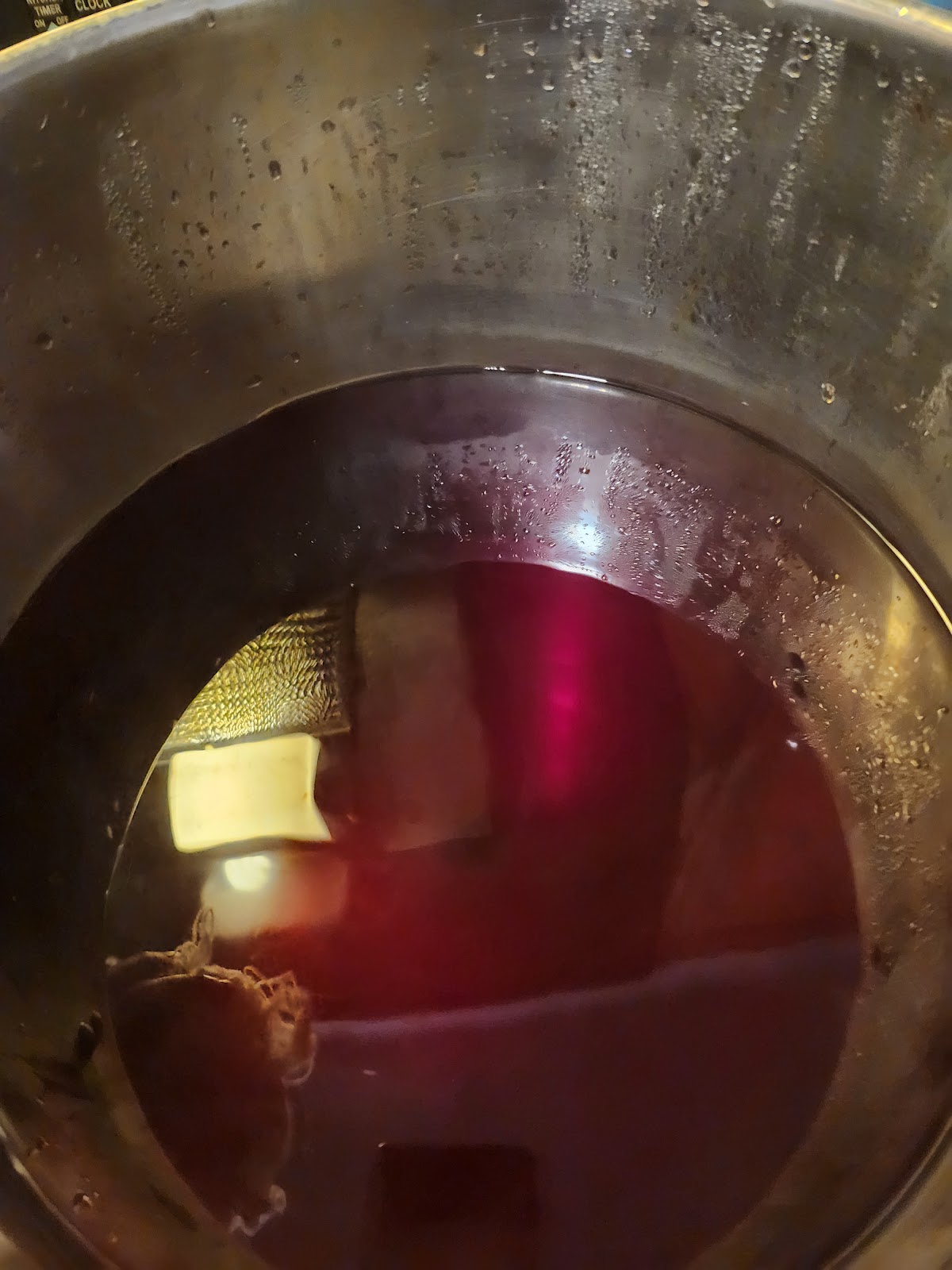
Then, I took it out and put the slug into the dye put.  I used some of Wildcraft dyeing's advice on PH levels as I wanted purple!  I added 75%~80% vinegar to the normal water and got a PH of 2...which was way too acidic.  I did get it to stay at 4.5~5.5 after adding some baking soda.   Yes, lots of fizziness when adjusting the PH level.  

Once the pot was hot but not boiling, I cleared out as much of the alkanet slug with the mesh colander as I could.  It didn't get it all out but it did get most of it.  Only after most of it was out did I add the fibers.

For this experiment, I did two skeins of wool, one of natural linen, and even a yard of silk taffeta.  The silk isn't in the picture since it really came out far too light.  I think if I try this again, I leave the silk in for a few days and see what happens.   


I used alum on all of them.  I have no idea why the top skein and the middle one, both wool, are two different colors.  Honestly, the top one is the color of my parent's car when I was a kid.  It wasn't brown and it wasn't purple.  It was something inbetween and we could never figure it out.  The middle one is straight up lavender.  It's hard to tell in this photo but it's very lavender in person.   The linen really didn't catch the dye but does have a very slight tone now to it.   

Anyone have any theories on why the two wools came out two different colors?  Maybe different sheep?  I did get the wools from two different companies...

The case of Paisley from a Medieval and Renaissance perspective

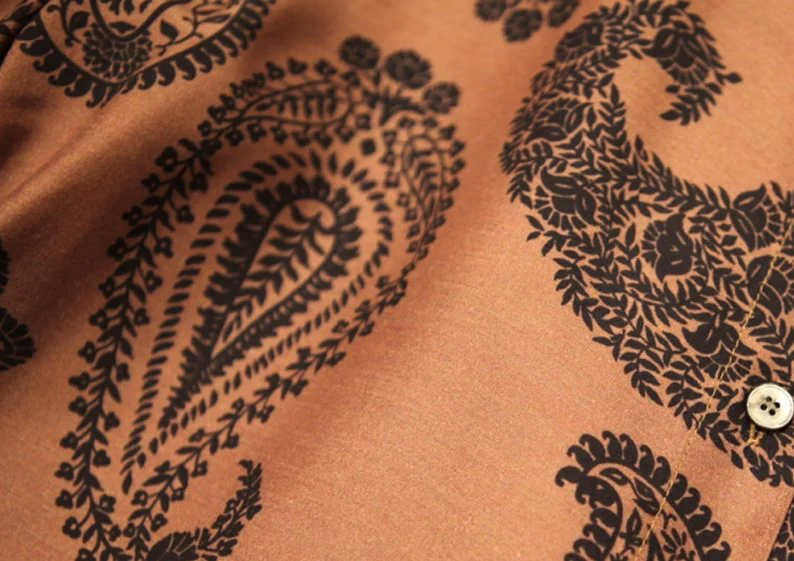
There is a lot of mythology around the paisley print. Some say it has ancient origins but came to the West in the 16th C. Others argue that it wasn't a thing in Europe until the 18th century. This is evident in multiple blog posts on the subject of paisleys.

Taken from Toast Magazine

I personally had been told the "no paisley in the medieval and Renaissance period" so many times, I figured it must be true.  Afterall, the closest thing I found for a while was this 17th century portrait which is just outside of the SCA period:

Taken from Tate
However, it looks like it's another "word" problem, similar to the word "pink".   Pink as a color existed in the SCA period but the word pink to *mean* the color did not.  The same seems to go for the word paisley.  

Paisley, in the SCA period, means the Scottish town which is just outside of Glasgow.  I've been to it and through it a few times.  It's a lovely manufacturing town which, as many sources suggest, is where the design paisley got it's name from when the weavers in the town Paisley started to turn out the design in the 18th century.   

Before that?  I'm not sure if there is an English name for it.  However, the design itself did exist in Europe well within the SCA period. Here is the evidence:

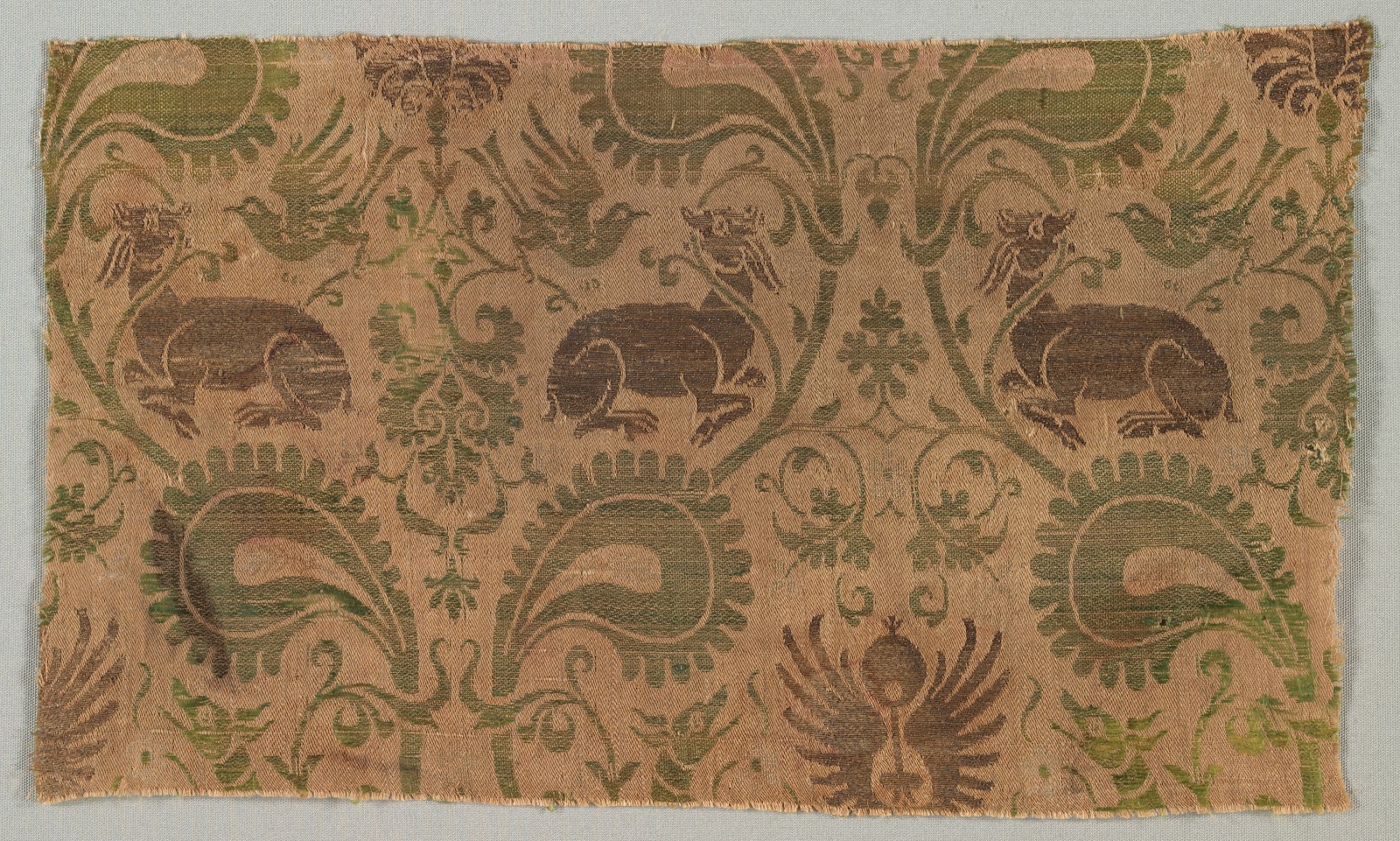
Taken from the Cleveland Museum

The above is a piece of silk lampas, manufactured in the second half of the 14th century...in Italy.  Those big green things below the heraldic dogs certainly look like paisleys to me!   To show it's not a one off, look above the back of the bird's head in this next 14th century piece.


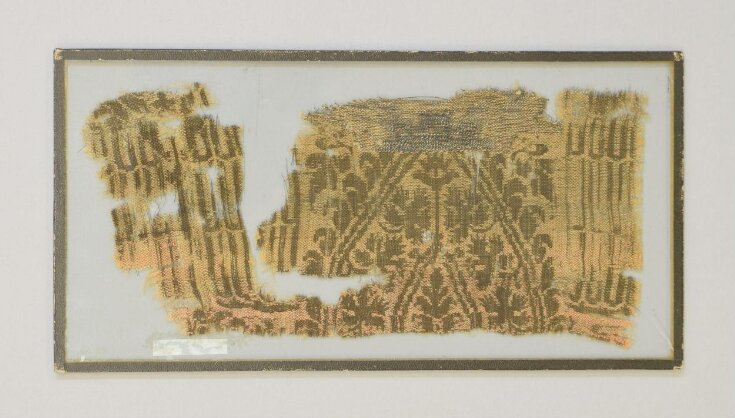
Taken from the V&A Museum

It's also a fun one since it was made in Iran - where we know they did have paisley designs in the 14th and 15th centuries- but used in 14th century Germany for a dalmatic.  This also seems to be the more popular form of the paisley design as it shows up, again, in 14th Century Italy.

Taken from the V&A Museum


The more modernly common paisley shows up again in Italy in the 16th century.

Taken from the MET

As well as in 16th century Spain!

Taken from the MET


And one last late 14th century one that is Italian made, but found in France.

Taken from the V&A


Really, it looks like the paisley was fairly popular in 14th C Europe, though it is a part of other designs.  Hopefully, this will be helpful for anyone else trying to document the paisley into the later medieval period and up into the Renaissance era.   Now, I can safely say that even the design elements on my sari turned 1490's gown are period correct.  :-)


Edit to add:  I wanted to add this image as well:

While the Turkish lady is from the 17th century, her hat clearly has paisleys.  This, again, pushes that whole "18th century" idea back.  Plus, the painting may be as early as the 1610's.  

Sunday, March 23, 2025

Red Onion Dye - a somewhat failed experiment

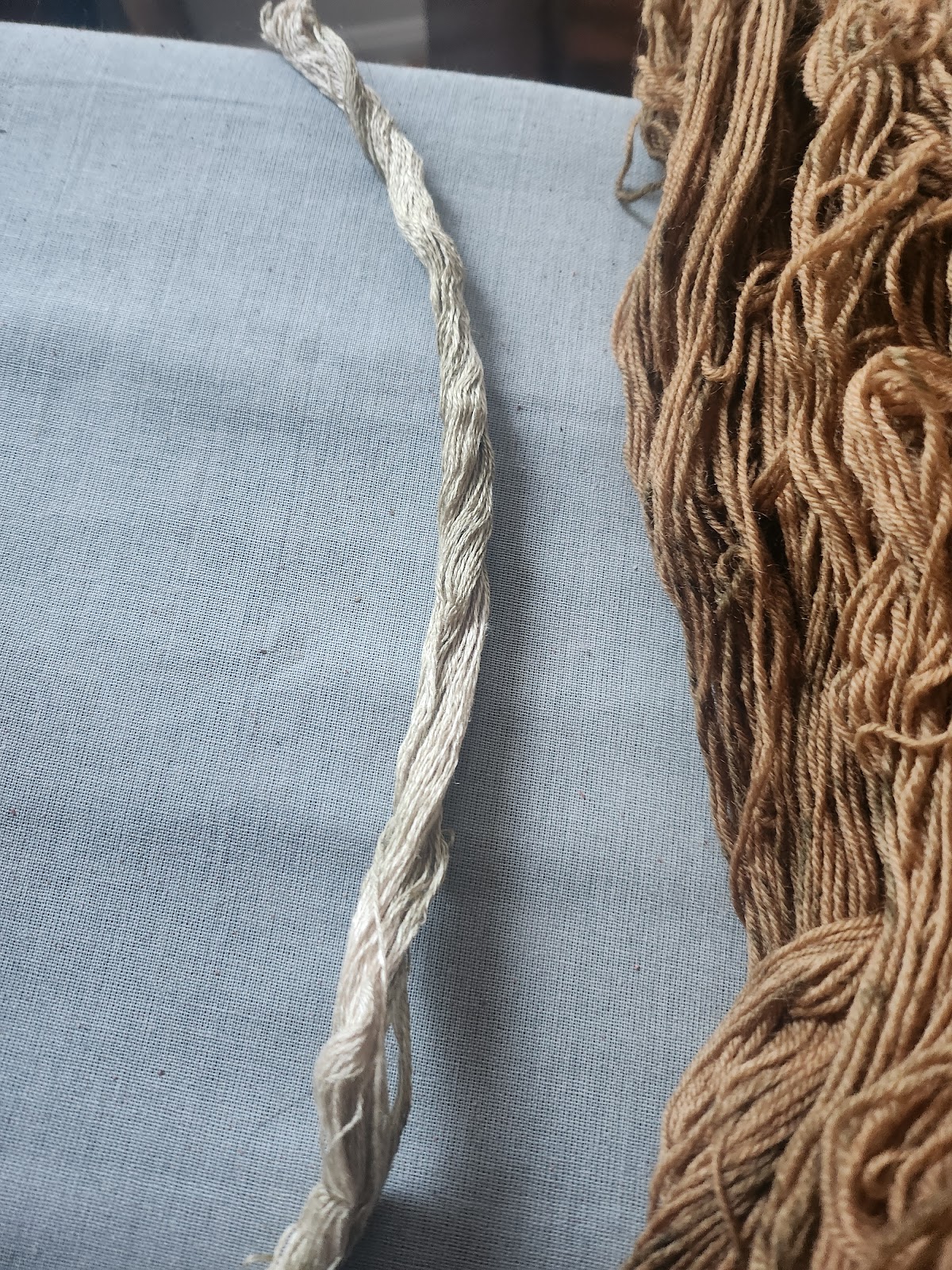
 Yesterday, I tried to dye with red onions and....it was a fail.  I should have read Rebecca Desnos' blog post before starting on my own dye pot.  Instead, all I got was brown.  A lovely, soft brown with a reddish tinge in the case of the alum mordant wool but brown.  


The linen pretty much didn't dye.  The alum linen (top of the photo) does have a very slight burnished green hint to it.  The natural linen I used an iron mordant (bottom of the photo) on is still...natural.  The alum mordant wool is almost an auburn/light brown color and probably will make a funny winter hat for next year.  The iron mordant wool just looks blah.  Parts where there was still iron on the yarn (I didn't rinse it and that really showed) are dark gray to almost black.  So, maybe, it might make a good black if I use iron water in the dye pot?


Above is an image of the onion skins after I had exhausted them.  I used one plastic grocery bag full of purple onion skins.


The resulting dye was a rather fabulous reddish purple.  I was hoping to get a nice burgundy or maroon from the dye bath but alas!


Everything was turning yellow!   I checked the ph and it was 6.8.  That was when I looked up Rebecca's blog.  I figured a yellow or army green - as it was coming up at the time- would at least be pretty interesting.  However, I forgot about the heat on the oven and went upstairs, got distracted, and came down to a paraboil (it was probably another few minutes from boiling!).  Somehow, that activated what little soap I accidentally left in the pot and....


Yeah, lots and lots of soap bubbles!   This affected the ph which suddenly shot up to 8.1!  I ended up trying to get the dye pot's ph down to see if I could get a good green or red out of it and added 75% vinegar solution to it.  It went down to 4.


So I thought with this image, I'd get a neat orange.  The dye was completely exhausted when I let it sit through the night.  However, when I pulled the yarns out, the linen suddenly didn't have a color and the wools were brown.


Alum mordant on linen and wool

Iron mordant on wool and natural linen


I will redye the linen (probably in the alkanet solution I have sitting) and see how that goes.   I have more wool to dye and a big piece of linen.  I think the big piece of linen will go into another madder pot!


Monday, January 27, 2025

Reupholstering an old footstool

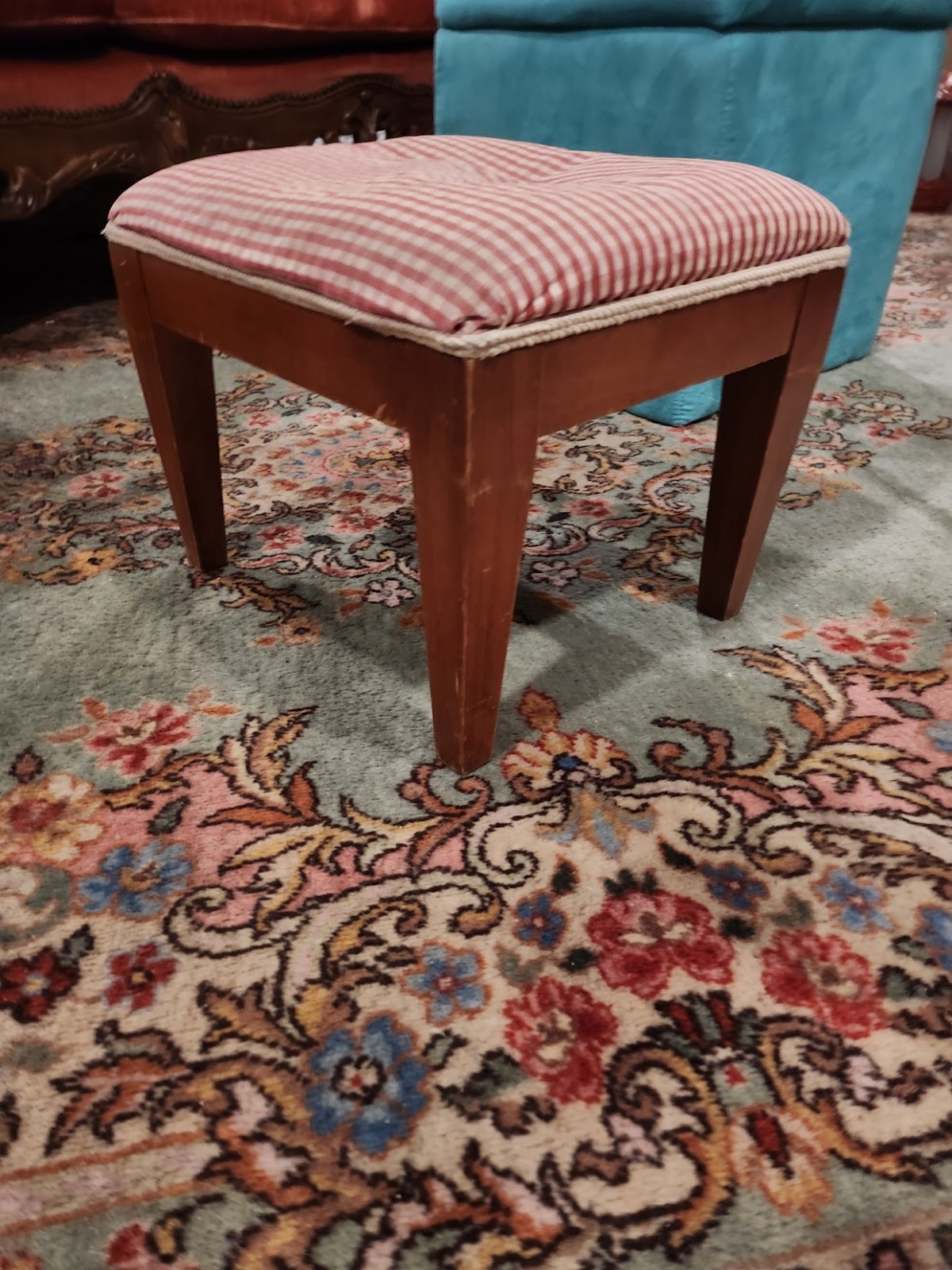
 Not my normal type of post but I am working on stuff.  :-)  I have had this old footstool for a few years and keep it at work, normally.   


I bought it for €5 in Italy and wasn't too concerned about how kitschy it looked.  It's clearly 1990s and well, it needed a refresh.   First, I took the rope trim off the footstool.  I realized after taking the rope trim off that the rope trim and the fabric were pretty well glued down.  I decided to keep the fabric on it footstool, mostly, and just use it to help keep the new stuffing in place rather than mostly sew down the new fabric and stuff it that way.  


It became very, very stuffed.  

I then stapled on a rather nice golden tan cotton velvet I had on hand.  I just folded the edges under and used an upholster staple gun - which I found out are pretty cheap.  In order to make the footstool fancy, I gathered a blue lace I had in the stash and wanted to add it as a skirt.  The plan was to add another trim on top of that and I found a fabulous fringe that went perfectly.


The finished footstool!   I sewed the fringe trim and the gathered lace to the velvet.  The corners are far from perfect but this is for work so my ability to care too much is gone.  I just wanted it to look fancy.  :-)


Tuesday, January 7, 2025

Madder Dye


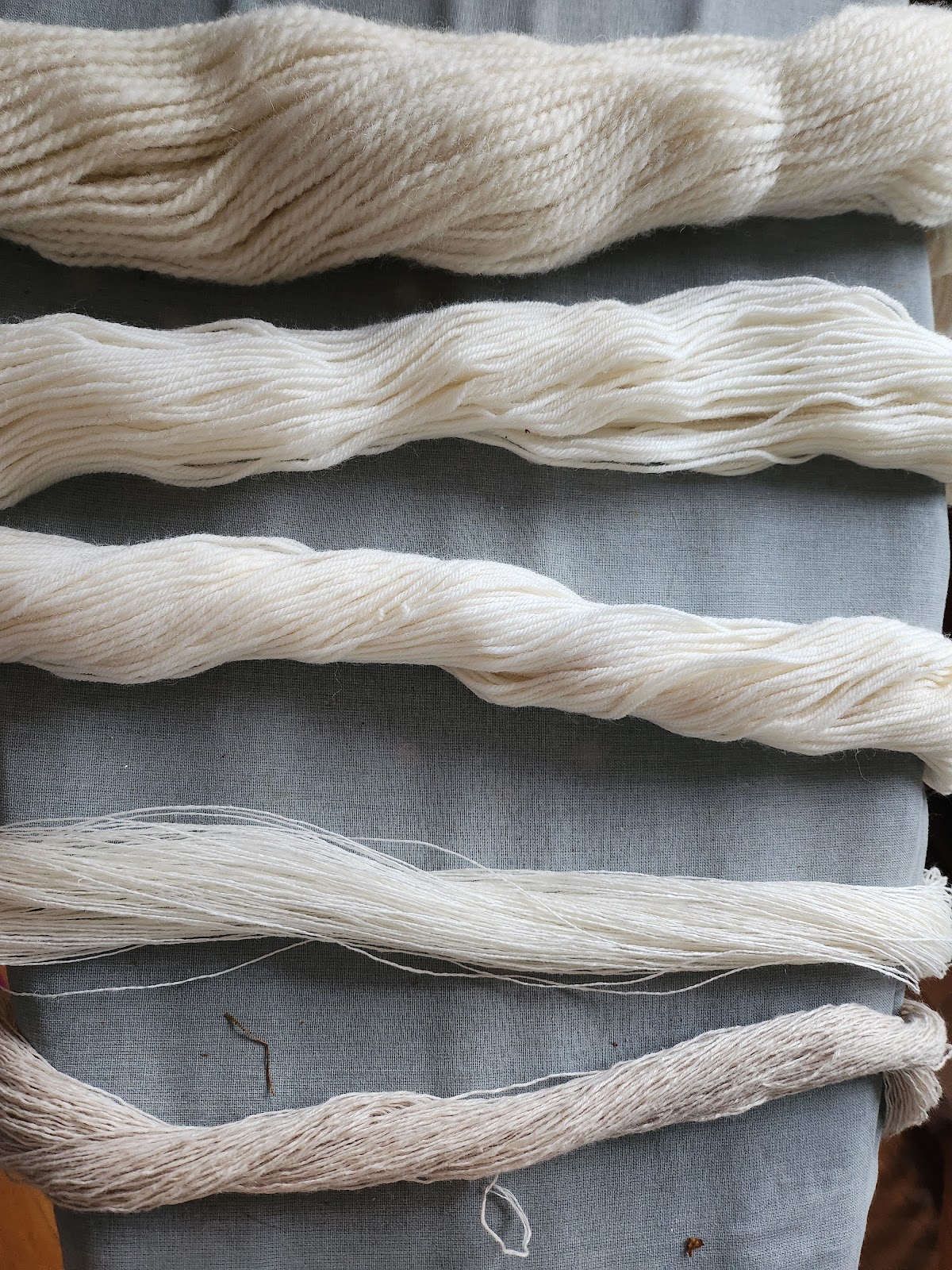
I've had this jar of dried madder for probably three years now, at least.  It may be longer than that.  I've read that old madder won't dye and I've also read that old madder gives the best reds.   I figured I could sacrifice some of the yarn I have and see what I end up with.


This time, I dyed three wools and two linens.  One of the wools and the natural linen were given an iron mordant and the others were all dunked into the alum mordant.  I wanted to see if it would give me different shades or even different colors.   For the iron, I just used old SOS pads that had rusted.   I keep them in a small bowl after I do the dishes.   


The dye pot once again looks like spaghetti.  I had the water and white vinegar mix at 70°C before I turned the gas off the stove.  I just left the lid on the pot and waited for three hours to see what colors I might get.   


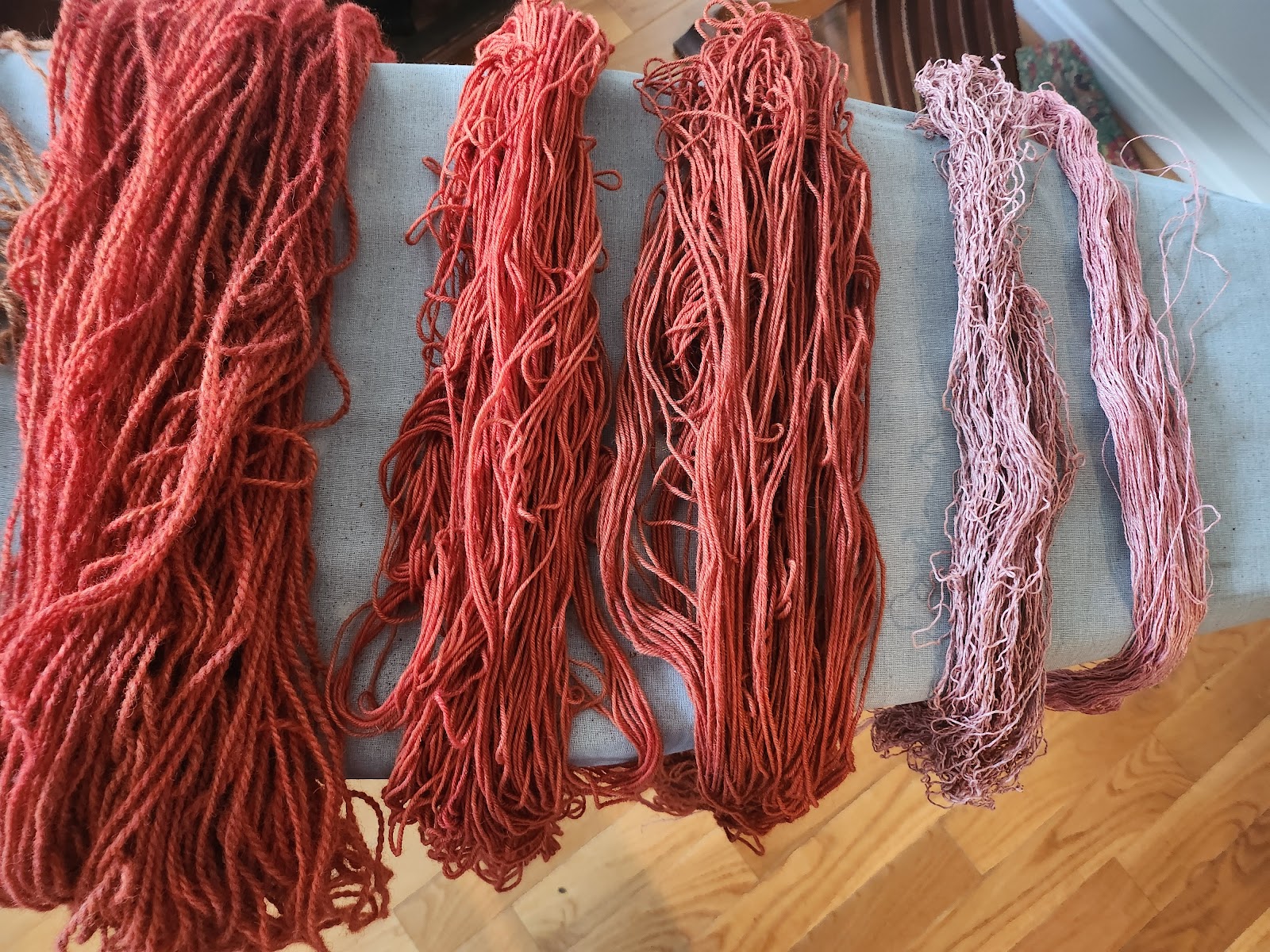
This is just the wools after I rinsed them. They looked very, very Christmas red and Turkey Red!   The linens didn't have much color so I left them overnight.   I'm so glad I did.   I also overdyed the onion skin wool that wasn't as bright as the others.  


From left to right, madder with alum, madder with alum, madder with iron, linen madder with iron, and linen madder with alum.  I need to show a close up of the linens because they are fabulous pinks!!!


This is more true to the color in person.  The natural linen with an iron mordant came out a nice mauve and the bleached linen with an alum mordant came out petal pink!   I'm really happy with the way those came out.


All the yarns I've dyed this week!   There is the two linens with the onion skin dye, one wool with the onion skin dye, the wool I originally dyed with onion skin and then overdyed with madder, plus all the madder yarns!   I'm not in love with the overdye.  It looks more burnt siena in person than the flesh tone it shows here.  However, I think it will go really well with some of the other yarns I have as a secondary color.   

Besides, getting pink on linen really is the best part of all this experiment!