Wednesday, August 22, 2018

Castello Del Buonconsiglio Part Two


Snowball fight!!!   This will be a picture heavy post.  All the paintings in this post are from Torre Aquila also known as the Eagle Tower.  The paintings are from the late 14th Century/early 15th Century - probably between 1392 and 1407 based upon records of the time.  The room is filled with a allegory of the months theme.  When you first step in, the first thing you see is January, or the snowball fight.  

It was really quite difficult to get good photos only because of the angles.   All of these paintings start roughly at 8 feet from the floor.  Also, each of these paintings were done in a mix of fresco and oil - it's why some figures look fine and others look faded or blurry.

 December.  This is pretty much above the door when you walk in. 

Slight better angle of the snowball fight.  Click on any of the photos to make them bigger!

More of the snowball fight.  I just like snowball fights.  Sorry.  

February is above a window.  March was destroyed in a fire where a wooden staircase now stands.  Luckily, it was the only month to be destroyed.  

The Spring/Summer wall.  

The far wall show July and August.  

August, with the lady clad in black, is at the back wall and on the right are October, November, and December.  

Slightly better overall view of October-Dec frescos. 


November going into December

Slightly better look at the December Fresco.  
This is one of the lower walls.  I forget what was originally there but, in the late 16th C, everything on the lower section got painted over and they were going to put up portraits.  However, only a sketch was ever completed.  

April

The upper part of April.  One of the points the tour guide pointed out is that everything is not to the realism scale but to the ideological scale.  Humans are shown in enlarged detail - with nobles being larger that serfs.  However, even the serfs are larger than trees,plants, and even buildings.  It's because humans are more important that all the other visible works of God's creation.   (That's why the horses look so tiny in the next picture!)

April going into May.  

Detail of the oxen and horses helping on the farm in April.  


Mostly May with May flowers.  

Upper May scene.


Most of the June scene.  


Here, I was trying to get a better photo of the lovely garments in the June scene.  I mean, look at the lady with the blue and red striped gown!

The parade of people in the June scene.  The bishop is in the red gown being escorted by a priest in the pink gown. 

Upper June scene.


No matter what, I couldn't get a good angle for the July scenes.  

Lower July scene

Top of the window going from July into August.


Closer look at the lady with the striped gown in the June scene again because stripes!

Corner of the room going from August into September.  

Lower August scene.  


Upper August scene.

September.

Close up of the figures hunting in September.


Upper September scene.


October and wine making!!!!


Close up of the ladies sampling the grapes in October.

Close up of the wine making process

August through November


November through January

Another view of the Snowball fight in January

November and December.

December.


This was one of the better preserved examples of the patterns on the lower wall.  It was painted in a motif that is common to fabrics as well at the time.  


More snowball fight.  :-)


Upper January 

This is a bad photo of the February that was above the window.  It shows a jousting match with the spectators. 

A loan blacksmith in the corner of the window for the February scene.


Better photo of the February scene.  

As much of the room as I could get all together.  From left to right is April through October.
Much better close up of the couple in July.  Notice his parti colored garments!

Another better photo of July


And ending with the awesome snowball scene.

Hopefully, I'll get the rest of the photos up in the next week!  Sorry this is taking so long.  

Sunday, July 15, 2018

Castello del Buonconsiglio in Trento Italia Part 1


Last weekend, I went to Trent to check out the Buonoconsiglio Castle.  In one of the towers is a very famous fresco of an early 15th Century snowball fight.  :-)   It's easy to understand why they'd depict snow given the location.  It's high up in the Alps.  The picture above is looking out from the castle towards the mountains.  

The castle itself.  It's actually even bigger than it looks here.   It was a maze to get through but there were a lot of neat paintings and artifacts through out.  I'll post some of them here and give a link to the rest of my photos in the last part of this series of blog posts.   

The castle was owned by the prince-bishops of Trento which, during the 13th-16th Century, was part of the Holy Roman Empire.  However, due to how close it is to both Milan and Venice, you see a lot of influences from those places as well.  It's an interesting mix of artwork and styles.


The above courtyard ended up being really neat.  The ceiling of the "loggia" is a series of Frescos by Gerolamo Romanio.  He was a painter through the first half of the 16th Century known mostly in the Venetian (Veneto) region.   The paintings in the loggia are all pretty clearly 1520's/1530's Venetian.    

Looking to the left

Looking to the right

Towards the hall where the staircase is

The lady in the forefront is wearing a golden hued dress with a pinked, high neckline.   Really, that isn't her chemise or partlet.  If you click on the image, you can see the button to the collar of the dress and tell that it's all part of the dress.  She's wearing a more German style hat although the sleeves and overall impression of the gown is much more Venetian.   


The lady to the right in this one has a much more typical Venetian style dress.  However, her chemise is a high necked one and she has her sleeves rolled up.  Also, her coif!  Much more German in style than Venetian. 
This one, I couldn't get a good image of.  The lady somewhat towards the center left is wearing a green dress, a balzo, and has her chemise sleeves rolled up.  All of which is typical Italian.  However, the lady on the far left, has a typical Venetian gown with a more German style hat.  

A slightly better picture of the lady with the German hat.  

A bigger image of the lady with the balzo and green dress.  


This one is pretty typical late 1520's/early 1530's Venetian.  The large puffs at the top of the sleeves with the more fitted lower sleeve and even the non-existent neckline are pretty normal for some of the more daring ladies in Veneto.  However, this might be an attempt at Lucretia who stabbed herself in the heart due to being raped.   It's a very common painting motif in the Renaissance. 

The lute players appear almost fantastical with the feathers and flowing gowns.  However, this too is a mix of the German and Italian styles.  The lady has a more German neckline while the dress, overall, is more Venetian in style.  

Judith in her maid is another very common theme in Renaissance paintings.  The maid's dress is in keeping with the 1530s Venetian styles but Judith's dress is interesting.  It opens at the front and has lacing but the sleeves and the cut appear almost Turkish.  Judith is wearing what appears to be cloth of gold as well and her head covering appears almost Flemish or English.  

This lady was hidden on the way up the staircase.  Her pinked white dress is typical 1520'sVenetian in cut.  You can see green through the pinking that matches her German style hat.  Her chemise is not the usual gathered neckline with most Venetians.  It's very smooth, meaning it was probably cut in a more Flemish/English/French manner.  

I couldn't get a good photo of the gentleman in the green outfit.  He has a gathered neckline which did come back briefly in the 1530's.  


This is the hallway next to the staircase.  It was pretty magnificent on it's own.  

Even with the guys, you see the mix of German and Italian influence.  The gentleman closest to us has a German style hat with some elements of Venetian influence in his doublet.  The man hiding in the background with the red hat is actually typically of the Veneto area.  

The stairwell down 


Above one of the doors before the stairwell

I love her sleeves.  Yes, it's probably not what was really worn but the dags!!!

Blurry photo of the stairwell


I need to go back and get a better photo of this one because the lady in the gold dress is also wearing what looks like a balzo.  It only appears to go back as much as French Hood, really.   Her dress, itself, is very typical late 1520's/early 1530's Venetian. 
I wanted to get a photo of the lady above them as well.


Next, I'll post about the Eagle Tower that was built in the 14th Century.   There is a lot of neat paintings in there and on the way leading to the tower. 

Thursday, June 28, 2018

Basic Cloak Pattern

First, the really bad horrible Paint image I drew.


So, really, how this would go is you would buy about five yards of fabric.  45" wide is fine.  You then take maybe a 1/2 yard and cut out a square with the upper right corner curved off.  This is your hood.  The rest of the fabric, you fold you are cutting the cloak body pieces - both a front and a back- on the normal fold of the fabric.  They will be narrow and the left over gore pieces won't be as big as it looks in the picture.  This is just to give you a general idea of the shapes.

Hood:

Really, measure from your shoulder to the top of your head.  This is the measurement you need for how "tall" the square/rectangle of the hood will be.  Also, measure from the back of your head to your forehead.  Add an inch.  This is how "long" the hood should be.  Draw out the rectangle based on these measurements.  Add a slight curve to the upper right and cut out the hood.   Sew up along the curved lines.   You'll add this to the cloak last.

Cloak:

It's really a big trapezoid with sloped shoulders and a curve for your neck.  Measure from the center of your collarbone to the end of your shoulders.  This is for the top of the trapezoid measurement.   Then, measure how long you want your cloak to be.  For the purposes of these instructions, we'll say 40" which is roughly knee length to mid-calf for many people.

Taking a measuring tape, measure from the bottom edge up 40".  At the 40" mark, draw a line that measures the same as from the center to the end of your shoulders plus 1/2".   From the end of that shorter line - say about 8", draw another line going straight down to the corner of the fabric opposite that you started from.  You now have a trapezoid. 

Starting from the folded edge of the fabric, measure about 3" or 4" in and mark that point.  On the long trapezoid line, mark about 1" down from the start of that line (it's also the end of the short line).  From the point that is 3" or 4" in on the short line, draw line to the 1" down point.  This is your shoulder slope.

For the neckline, you are drawing a circle of your neck but you'll want more room in the front than in the back.   Cutting out a quarter circle will help to start but, once you cut out everything, cut the front another 1" deeper.   This will help to not feel like you are choking.

The gores are really just continuing the straight short line across the fabric.  You'll sew these to the sides of the cloak body first and then sew the front and back of the cloak together.   Sew the hood on matching up the center back.  Hem and sew up the edges.

This is pretty simple and you don't have to do the hood.  Cut out any lining fabric in the same way.  You'll have to cut out the front opening if you cut it out exactly this way.  You can also just cut out the body on the edge and have a back center seam. 

Saturday, June 16, 2018

The Lady Combing Her Hair - 1530's, Bernardo Licinio


A couple of years ago, this painting began to circulate in the Renaissance costuming circles like wildfire.  The question that came up was a simple one; what the heck is she wearing?  Theories included some sort of petticoat stays despite it being the wrong region and a few decades two early, some sort of white gown, or just some early prototype of stays.

The painting is housed at the Belluno Civic Museum.  The museum isn't as grand as some of the others I've been to in Italy but it does have a few curious pieces, such as this beauty.   The painting is large and it's easy to see details in it.   That said, I'd like to start with tackling the petticoat stays theory regarding this painting.

Many people theorized the petticoat stays due to the fact she's combing her hair, her sleeves are rolled up and the lines in the painting make it look like stitching lines you'd see in stays.   However, this is not the only painting to show a woman doing her hair or with her sleeves rolled up.

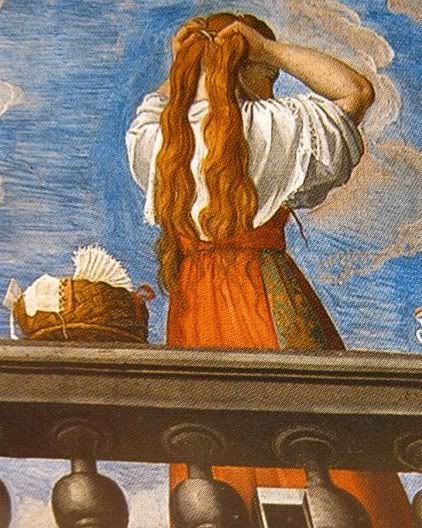
   The above is from much later in the 1580s and was painted by Alessandro Allori.  It's part of a ceiling in Florence.   The lady is putting ribbons in her hair to wrap it up around her head.  Also, notice, she too has her sleeves up.  If you have big baggy sleeves, you'd want them out of the way too when you are doing your hair.  It's highly annoying otherwise.  

However, having rolled up sleeves wasn't just a "brushing your hair" thing.  This lady, from 1548, is currently house in the Louvre.   However, the painting is done by the Venetian artist Veronese.  Starlight Masquerade has a much large photo with a bit more information.  The nice thing about this painting is that it's closer to the time period suggested by the museum of the lady combing her hair painting.   

Of course, the important thing that has confused many people are the apparent lines that suggest stays.  Having seen the painting in person, I can say they aren't stitch line.  Really, is a combination of the painting being old and wrinkled (maybe it's the lines of the canvas underneath?) and what were probably, orginally, pinstripes.


Close up detail of the shoulder area.  Here, you can faintly see what look like white on cream pinstripes.  The dress is a different color than the chemise and the partlet underneath.   This is even more apparent in person than it is here.  


This is what killed any idea that is could be any type of petticoat stays.  The lines are on the skirt as well.   However, notice that you can see two distinctive folds in the skirt - one in the dead center and another near the ring finger.  This appears in a few other paintings and may be some sort of dog-legged closure.
The strips and gathering in the skirt are even more apparent beneath her arm to the right of the comb.  If the bodice of the gown was made into stays, then the skirt wouldn't have the same, even lines.  


Really, it reminds me of the fabric shown in Marietta Robusti's self portrait from much later in the century.


Although I'm personally now sure that the painting shows a dress and not any chance of it being stays, what has me still curious about it is the dating.  The lady combing her hair looks to be from at least a decade or two later than the given date.  By the tail end of the 1530's, the pointed waistline came in but this seems to fit more with the 1540s or 1550s overall in style.   Rather than the 1530s as the Museum has it, I'd put it in the 1540s.