First, the really bad horrible Paint image I drew.
So, really, how this would go is you would buy about five yards of fabric. 45" wide is fine. You then take maybe a 1/2 yard and cut out a square with the upper right corner curved off. This is your hood. The rest of the fabric, you fold you are cutting the cloak body pieces - both a front and a back- on the normal fold of the fabric. They will be narrow and the left over gore pieces won't be as big as it looks in the picture. This is just to give you a general idea of the shapes.
Hood:
Really, measure from your shoulder to the top of your head. This is the measurement you need for how "tall" the square/rectangle of the hood will be. Also, measure from the back of your head to your forehead. Add an inch. This is how "long" the hood should be. Draw out the rectangle based on these measurements. Add a slight curve to the upper right and cut out the hood. Sew up along the curved lines. You'll add this to the cloak last.
Cloak:
It's really a big trapezoid with sloped shoulders and a curve for your neck. Measure from the center of your collarbone to the end of your shoulders. This is for the top of the trapezoid measurement. Then, measure how long you want your cloak to be. For the purposes of these instructions, we'll say 40" which is roughly knee length to mid-calf for many people.
Taking a measuring tape, measure from the bottom edge up 40". At the 40" mark, draw a line that measures the same as from the center to the end of your shoulders plus 1/2". From the end of that shorter line - say about 8", draw another line going straight down to the corner of the fabric opposite that you started from. You now have a trapezoid.
Starting from the folded edge of the fabric, measure about 3" or 4" in and mark that point. On the long trapezoid line, mark about 1" down from the start of that line (it's also the end of the short line). From the point that is 3" or 4" in on the short line, draw line to the 1" down point. This is your shoulder slope.
For the neckline, you are drawing a circle of your neck but you'll want more room in the front than in the back. Cutting out a quarter circle will help to start but, once you cut out everything, cut the front another 1" deeper. This will help to not feel like you are choking.
The gores are really just continuing the straight short line across the fabric. You'll sew these to the sides of the cloak body first and then sew the front and back of the cloak together. Sew the hood on matching up the center back. Hem and sew up the edges.
This is pretty simple and you don't have to do the hood. Cut out any lining fabric in the same way. You'll have to cut out the front opening if you cut it out exactly this way. You can also just cut out the body on the edge and have a back center seam.
Thursday, June 28, 2018
Saturday, June 16, 2018
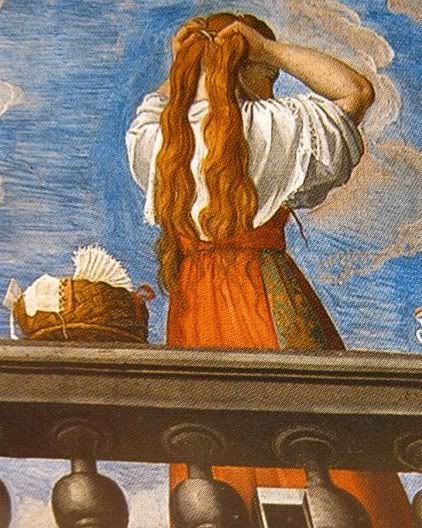
The Lady Combing Her Hair - 1530's, Bernardo Licinio
A couple of years ago, this painting began to circulate in the Renaissance costuming circles like wildfire. The question that came up was a simple one; what the heck is she wearing? Theories included some sort of petticoat stays despite it being the wrong region and a few decades two early, some sort of white gown, or just some early prototype of stays.
The painting is housed at the Belluno Civic Museum. The museum isn't as grand as some of the others I've been to in Italy but it does have a few curious pieces, such as this beauty. The painting is large and it's easy to see details in it. That said, I'd like to start with tackling the petticoat stays theory regarding this painting.
Many people theorized the petticoat stays due to the fact she's combing her hair, her sleeves are rolled up and the lines in the painting make it look like stitching lines you'd see in stays. However, this is not the only painting to show a woman doing her hair or with her sleeves rolled up.
The above is from much later in the 1580s and was painted by Alessandro Allori. It's part of a ceiling in Florence. The lady is putting ribbons in her hair to wrap it up around her head. Also, notice, she too has her sleeves up. If you have big baggy sleeves, you'd want them out of the way too when you are doing your hair. It's highly annoying otherwise.
However, having rolled up sleeves wasn't just a "brushing your hair" thing. This lady, from 1548, is currently house in the Louvre. However, the painting is done by the Venetian artist Veronese. Starlight Masquerade has a much large photo with a bit more information. The nice thing about this painting is that it's closer to the time period suggested by the museum of the lady combing her hair painting.
Of course, the important thing that has confused many people are the apparent lines that suggest stays. Having seen the painting in person, I can say they aren't stitch line. Really, is a combination of the painting being old and wrinkled (maybe it's the lines of the canvas underneath?) and what were probably, orginally, pinstripes.
Close up detail of the shoulder area. Here, you can faintly see what look like white on cream pinstripes. The dress is a different color than the chemise and the partlet underneath. This is even more apparent in person than it is here.
This is what killed any idea that is could be any type of petticoat stays. The lines are on the skirt as well. However, notice that you can see two distinctive folds in the skirt - one in the dead center and another near the ring finger. This appears in a few other paintings and may be some sort of dog-legged closure.
The strips and gathering in the skirt are even more apparent beneath her arm to the right of the comb. If the bodice of the gown was made into stays, then the skirt wouldn't have the same, even lines.
Really, it reminds me of the fabric shown in Marietta Robusti's self portrait from much later in the century.
Although I'm personally now sure that the painting shows a dress and not any chance of it being stays, what has me still curious about it is the dating. The lady combing her hair looks to be from at least a decade or two later than the given date. By the tail end of the 1530's, the pointed waistline came in but this seems to fit more with the 1540s or 1550s overall in style. Rather than the 1530s as the Museum has it, I'd put it in the 1540s.
Labels:
16th Century,
dress,
gown,
Italian,
renaissance,
research,
sca
Wednesday, April 4, 2018
New Easter Dress!
I was super lucky and got a ticket to go to Easter Mass at the Vatican! One word of warning if you ever decide to try that - you will be in a crush. The Italians do not believe in queuing or in crowd control. At all. Still, I was very happy to go and to be there in Saint Peter's square on Easter Sunday.
Of course, when one finds out they are going somewhere as special as the Vatican for the most holy day on the Christian calendar, you need a new outfit! The teal jacket - which is unfortunately lopsided in the photo- is something I made back in 2014. I made a couple of dresses around the same time.
The floral dress is new. One of the dresses I made around the time of the teal jacket, my purple knit sleeveless dress that I wear to work, I love. Here is a linke to the original write up. I know the pattern I used, Simplicity 9103, very well as I've used it several times since the purple dress. The problem was that I forgot to pack it when I moved. D'oh!
The pattern is basically three pieces, a front piece, cut on the fold, and two back pieces with a slight curve in the middle back. It's the curve in the back that gives the dress a very flattering shape to it.
Recently, I bought a few gazillion yards of knit fabric from a lady selling off her Grandma's stash. Almost all of it is 1960's/1970's. While some of it is pretty useless, some of it is really quite cool - or groovy. The floral is actually a very low pile velor knit. It looks like a brushed cotton knit and I think it does have some cotton in it. I fell in love with it and decided it had to be the Easter dress.
For the pattern, since I was dumb and didn't pack it with me to go to Italy, I just folded the purple dress while it was inside out, and traced along the seams on to brown packaging paper. I made sure to add seam allowances for places like the neckline where the seams weren't sticking out. I then cut out the cloned pattern pieces and used that as a base for my new dress.
I desperately wanted a ruffle at the bottom so I cut the dress about 5" shorter than I normally would and I cut out a couple of wide strips for the ruffle out of the floral knit fabric. Because the ruffler foot refused to work, I just played with the settings on my Singer Quantum and the "baste" stitch I used caused the fabric to automatically gather. I then easily sewed the gather to the bottom.
Once the dress was mostly sewn up - everything but the hem of the ruffle- I tried it on. I then marked out where I wanted the hemline to be, cut about a 1/2" below that, and hemmed up the dress. Really, it only took maybe an hour to cut the dress out and sew it up.
The dress is very comfortable and goes much better with my summer shrugs but it was a bit too cold to wear those on Sunday. :-) I'm really happy with how the dress came out.
Sunday, March 25, 2018
Bunratty Folk Park, Ireland part one
I'm going to start this off with one very simple request: if you ever get a change to go to Ireland, go to Bunratty. Seriously, despite a problem with some mis-information by the interpretors, it is completely fabulous. The biggest issue with Bunratty is they have no clue of what a gem they really have. The castle and the grounds cover everything from the 15th up to the early 20th Century. It's 500 years of history in one little park where you can peak back in time. The castle, the homes, and many of the artifacts are all extant.
The problem is that the interpretors have zero idea of what they are talking about. I think Bunratty got hit hard during the recession of '08 and is just starting to bounce back. I recall the medieval banquet I went to uh....many, many years ago and it was very different from what it is now. Not that it's bad now - it's definitely better than the Medieval Times in the U.S. but only just.
Some issues - the costuming. Okay, granted, that's the first thing I would notice. The castle was built in the mid 15th Century. The garments the actors and actresses wore were want-to-be-16th Century. I get that you need garments that can be used by other actors and can be cleaned easily but there are plenty of garments from that range that fit the bill that don't involve zippers up the back. ...Or panne velvet.
Really, I think hoppelande gowns or even just really basic sideless surcotes (which were worn for festive occasions up into the 16th Century) over a-tunics would be perfect for the actressess. The sideless will fit pretty much any size and the a-tunics are very easy to make. Making them out of linen and wool - to show off what would have been worn in Ireland anyway- would also look stunning. For the men, a short hoppelande or a liene with hosen would look nice.
The second problem was the entire dinner. Don't get me wrong - it was delicious- but BBQ ribs with tomato sauce (they gave me mine without the sauce) and potato soup are pretty distinctly post period for the castle. It's clear they wanted to give a 15th/16th vibe. The potato was introduced from the New World in the 16th C - but you don't see many recipes for it until the later half. Even then, it's more baked potato stuff. The tomato isn't commonly eaten until the late 18th/early 19th C.
Also, the actors and actresses claimed that any cutlery other than a knife wasn't a thing which is blatantly false. I'm not sure why that is even still a common myth. We had to eat our soup without a spoon. This goes directly against the Irish archeology finds in southern Ireland that include...wooden spoons. Now, this entire event could have been an excellent learning experience and still allowed the castle to get away without having spoons. Really, in the middle ages, people were expected to bring their own cutlery - to include spoons. Since we, as 21st guests, don't regularly keep our flatware on our persons, the "host" of the evening could declare that they don't have enough spoons for more than the household. Therefore, the guests will need to sop up their soup with the bread - which is what we pretty much did without anyone telling us too. Still, teaching about sopping up the soup and going into that part of history would be much more accurate and truthful than just saying spoons weren't a thing despite direct evidence against that.
As for forks, they aren't a thing until pretty late in the 16th c so it's doubtful they'd be a thing in Ireland for the time that the medieval banquet is trying to re-create. Still, providing a spoon and a knife and explaining about the archeology of Ireland would be beautiful.
A couple of days later, I went back to the folk park to get some better pictures of the castle (since I was an idiot and forgot my camera in my bag back in the B&B) as well as check out the rest of the park. My memories of the park many years ago are a bit fuzzy but I do recall the 19th C village and the people dressed up talking about various aspects of pre and post famine Ireland.
I wanted to get photos of some of the tapestries in the castle and other antiques because, what Bunratty does have, is absolutely fabulous artifacts from the 15th ~18th Centuries. When I went into the main hall, a gentleman was dressed up in far better 16th Century garb than I saw at the banquet. However, what I heard him say made me cringe and I had to walk away.
Another myth the gentleman spoke about that made me cringe was that, apparently, according to him, there were no vegetables or fruit in Ireland before Sir Walter Raleigh brought back the potato. .... I'm not joking. That's what he said.
The problem is that the interpretors have zero idea of what they are talking about. I think Bunratty got hit hard during the recession of '08 and is just starting to bounce back. I recall the medieval banquet I went to uh....many, many years ago and it was very different from what it is now. Not that it's bad now - it's definitely better than the Medieval Times in the U.S. but only just.
Some issues - the costuming. Okay, granted, that's the first thing I would notice. The castle was built in the mid 15th Century. The garments the actors and actresses wore were want-to-be-16th Century. I get that you need garments that can be used by other actors and can be cleaned easily but there are plenty of garments from that range that fit the bill that don't involve zippers up the back. ...Or panne velvet.
Really, I think hoppelande gowns or even just really basic sideless surcotes (which were worn for festive occasions up into the 16th Century) over a-tunics would be perfect for the actressess. The sideless will fit pretty much any size and the a-tunics are very easy to make. Making them out of linen and wool - to show off what would have been worn in Ireland anyway- would also look stunning. For the men, a short hoppelande or a liene with hosen would look nice.
The second problem was the entire dinner. Don't get me wrong - it was delicious- but BBQ ribs with tomato sauce (they gave me mine without the sauce) and potato soup are pretty distinctly post period for the castle. It's clear they wanted to give a 15th/16th vibe. The potato was introduced from the New World in the 16th C - but you don't see many recipes for it until the later half. Even then, it's more baked potato stuff. The tomato isn't commonly eaten until the late 18th/early 19th C.
Also, the actors and actresses claimed that any cutlery other than a knife wasn't a thing which is blatantly false. I'm not sure why that is even still a common myth. We had to eat our soup without a spoon. This goes directly against the Irish archeology finds in southern Ireland that include...wooden spoons. Now, this entire event could have been an excellent learning experience and still allowed the castle to get away without having spoons. Really, in the middle ages, people were expected to bring their own cutlery - to include spoons. Since we, as 21st guests, don't regularly keep our flatware on our persons, the "host" of the evening could declare that they don't have enough spoons for more than the household. Therefore, the guests will need to sop up their soup with the bread - which is what we pretty much did without anyone telling us too. Still, teaching about sopping up the soup and going into that part of history would be much more accurate and truthful than just saying spoons weren't a thing despite direct evidence against that.
As for forks, they aren't a thing until pretty late in the 16th c so it's doubtful they'd be a thing in Ireland for the time that the medieval banquet is trying to re-create. Still, providing a spoon and a knife and explaining about the archeology of Ireland would be beautiful.
![]() |
| Medieval Banquet Hall |
A couple of days later, I went back to the folk park to get some better pictures of the castle (since I was an idiot and forgot my camera in my bag back in the B&B) as well as check out the rest of the park. My memories of the park many years ago are a bit fuzzy but I do recall the 19th C village and the people dressed up talking about various aspects of pre and post famine Ireland.
| Bunratty Castle |
According to him, the Irish didn't have glass for windows until the 17th Century. /facepalm The way he said it, it made it sound like glass hadn't been invented yet. I later had to explain to a few people that - no, glass is ancient. Even the Romans had it. I also eventually piped up a bit and did point out they had shutters on the archer windows. It's not like our medieval ancestor let all the heat from the fireplace go out an open window in the middle of winter. We have manuscripts from England, Germany, and Italy showing glass windows as early as the 14th Century.
Now, you wouldn't want to glass over an archer's window because it would just get in the way. Having shutters that come inside the window and covering the window with those fabulous heavy velvets or tapestries also kept the cold outside. Despite what the gentleman said about it being very cold and how spoiled we are with our heating and a/c - it's just not that bad in the middle ages. Anyone who has been camping in the winter knows a good fire will keep you pretty darn warm. Add that having four walls and roof? Well, I know I've been in power outages for as long as a week in winter. A good fireplace, good curtains, and warm clothing will keep you plenty warm.
| The Great Hall |
I guess carrots, turnips, onions, and apples which were common in England never made it across with all the nobles going back and forth? Of course, that's not the least bit true. The truth is that apples have been a part of Ireland for at least 3,000 years. In fact, crabapples, hazelnuts, and waterlily seeds were part of the mesolithic diet. So, they had fruit. Various types of cabbage were a thing since the Roman era (I mean, come on! Irish and boiled cabbage is almost more Irish that potatoes!!) with the Savoy cabbage being introduced in the late 16th century. The biggest part of the medieval Irish diet, however (which both this gentleman and the actors at the banquet overlooked) was cheese. Dairy was a huge part of the medieval Irish diet. Add that with some fish, bread, and apples...and I think they ate rather healthily in times when there wasn't a famine.
They certainly weren't just hunting elk and eating that - unlike what the gentleman said. Seriously, he said they only ate meat....which uh. No. Just no. Meat was actually pretty rare except for the rich. He mentioned that the Irish deer were smaller so there wasn't much meat. Really, he made out the medieval Irish to be small, starving, people who were constantly cold and died at 20. Yet, somehow, there are Irish today....
Yeap, he did the whole life expectancy thing. While life expectancy was lower before, well, antibiotics, it didn't mean you dropped dead at 30. Nor did it mean that a bunch of people were dying at 30. Rather, a LOT of people died before they got to be five years old and a lot of people died when they were in their mid to late 60s. You get an average life expectancy of 30 from that. Yes, more women died in childbirth than they do today - but the rate (thank you Dublinia for getting right!) was 15% of women died in childbirth. Not exactly the 50/50 chance that many people make it out to be.
Another aspect that the gentleman said that rubbed be the wrong way was that women were second class citizens in Ireland and were expected to just sit around and have ten children, with a couple of male heirs maybe making it to adulthood. Well...no. I mean, just look at Grace O'Malley who is still considered one of the greatest pirate Queens in history. She had control over her own lands, ships, and got such a reputation as a pirate, that Queen Elizabeth of England demanded an audience with her. Also, Grace had three kids - not ten.
Okay, so pretty much everything he said was a myth. The Irish weren't always cold, starving, and dying - although there were famines. Women weren't just baby factories - they had more rights than their English counterparts. And the Irish had veggies and fruit. I mean...seriously! Cabbage! /sigh
Anyway, on to the beauty that is Bunratty castle itself.
They certainly weren't just hunting elk and eating that - unlike what the gentleman said. Seriously, he said they only ate meat....which uh. No. Just no. Meat was actually pretty rare except for the rich. He mentioned that the Irish deer were smaller so there wasn't much meat. Really, he made out the medieval Irish to be small, starving, people who were constantly cold and died at 20. Yet, somehow, there are Irish today....
Yeap, he did the whole life expectancy thing. While life expectancy was lower before, well, antibiotics, it didn't mean you dropped dead at 30. Nor did it mean that a bunch of people were dying at 30. Rather, a LOT of people died before they got to be five years old and a lot of people died when they were in their mid to late 60s. You get an average life expectancy of 30 from that. Yes, more women died in childbirth than they do today - but the rate (thank you Dublinia for getting right!) was 15% of women died in childbirth. Not exactly the 50/50 chance that many people make it out to be.
Another aspect that the gentleman said that rubbed be the wrong way was that women were second class citizens in Ireland and were expected to just sit around and have ten children, with a couple of male heirs maybe making it to adulthood. Well...no. I mean, just look at Grace O'Malley who is still considered one of the greatest pirate Queens in history. She had control over her own lands, ships, and got such a reputation as a pirate, that Queen Elizabeth of England demanded an audience with her. Also, Grace had three kids - not ten.
Okay, so pretty much everything he said was a myth. The Irish weren't always cold, starving, and dying - although there were famines. Women weren't just baby factories - they had more rights than their English counterparts. And the Irish had veggies and fruit. I mean...seriously! Cabbage! /sigh
Anyway, on to the beauty that is Bunratty castle itself.
The pantry is right off the main hall. Amazingly, they actually have this pretty accurate for the late 15th/early 16th C. It's basically slightly poorer version of what King Henry VIII would have had. Also, those look like water fowl hanging up to be prepared - not small starving deer. /headdesk
Late 15th Century/early 16th C tapestry on one of the walls in the great hall. Luckily, my camera got an excellent shot of them.
Late 16th Century tapestry. This one was the best preserved of the lot.
A lovely gothic window. The windows appear to be a mix of glass from various time periods put together with some modern methods. Really, most of the glass was quite lovely up close but was all recreations of other pieces.
This bed. Let me tell you how much I love this bedroom. The bedspread is a bit blurry but is is, in fact, early 17th Century Jacobean embroidery. Real. Not a recreation. And the canopy?
Oh the canopy....
I got as close as I dared to get a good close up of the polychrome embroidery on the purple silk. Yes, it is a real late 16th/early 17th Century embroidery piece - most likely Italian. A similar style of embroidery is at the Hermitage and seen in in this embroidery pattern book form 1608.
Another fabulous bedroom with 16th and 17th C artifacts
The upper hall
A 16th Century Gentleman
15th Century original floor tiles
This photo is hard to see but I wanted to show how hard it was to see the next beauty. It's in the corner, to the right. See the cross? Okay, the next beauty is inside the glass case...
See that embroidery? I know it's difficult - there was no way to get close to it as the room was roped off. However, the embroidery style? This green velvet chasuble has early 15th Century Embroidery all over it. *dies* Did I mention that the Bunratty Folk park have no clue what they really have? This is evidence of that... This poor chasuble is back in a corner where no one can see it properly and yet early 15th Century embroidery?!?
It was like that through out the entire castle. In my next post on the Folk Park, I'll actually get to the folk park. :-) One item I do remember of the original banquet I went to ...err..a while ago, I'd like them to bring the snuff boxes back. They had them many years ago and I remember trying it. Let's just say, I didn't have sinus issues for weeks afterwards! :-)
Labels:
15th Century,
16th Century,
17th Century,
Bunratty,
embroidery,
Ireland
Monday, February 12, 2018
A quick short cape for Carnivale
One of my co-workers wanted to come with me to Venice. I told her, if she came, I would make her a quick cape or surcote - something that wasn't very difficult to put together but would look carnivalish. We bought 2 meters of poly/rayon white moire and 6 meters of orange cotton trim. She wanted orange because her mask is orange. :-)
The cape itself is pretty simple. I did a basic circle cape with a rectangle for the hood that was then gathered in the 18th C style. Really, since she wanted a short cape, I drew out the circle from the center of the fold of the fabric to 32", using my marker and my measuring table like a compass. Once it was cut out, I cut a small circle at the neckline area to give it a neckline and I cut the front opening because the fabric was a huge circle of fabric. With the leftover piece of fabric, I cut out a long enough rectangle to fit over the head. I think it was about 19" by 23" just so I'd have enough of a seam allowance. With the hood, I sewed one long side of the rectangle first by rolling the fabric over a couple of times so that the edges would be enclosed by I could get a ribbon through it. I put the ribbon through, gathering a lot of the material towards the middle but leaving the last 3" on either side ungathered. I then sewed up these 3~4" so there is just a small hole in the back where all the fabric is gathered. I then stitched the front so there were no raw edges as well.
I pleated the hood to the neckline and used some of the leftover fabric from around where the cape was cut as bias tape for the neckline. Again, no raw edges showing. I then hemmed the rest of the cape and added the orange trim. I had just enough to go down the front and along the hem line. I was hoping to have enough for the hood as well but, eh, whatever. She was very pleased with her little cape. :-)
The cape itself is pretty simple. I did a basic circle cape with a rectangle for the hood that was then gathered in the 18th C style. Really, since she wanted a short cape, I drew out the circle from the center of the fold of the fabric to 32", using my marker and my measuring table like a compass. Once it was cut out, I cut a small circle at the neckline area to give it a neckline and I cut the front opening because the fabric was a huge circle of fabric. With the leftover piece of fabric, I cut out a long enough rectangle to fit over the head. I think it was about 19" by 23" just so I'd have enough of a seam allowance. With the hood, I sewed one long side of the rectangle first by rolling the fabric over a couple of times so that the edges would be enclosed by I could get a ribbon through it. I put the ribbon through, gathering a lot of the material towards the middle but leaving the last 3" on either side ungathered. I then sewed up these 3~4" so there is just a small hole in the back where all the fabric is gathered. I then stitched the front so there were no raw edges as well.
I pleated the hood to the neckline and used some of the leftover fabric from around where the cape was cut as bias tape for the neckline. Again, no raw edges showing. I then hemmed the rest of the cape and added the orange trim. I had just enough to go down the front and along the hem line. I was hoping to have enough for the hood as well but, eh, whatever. She was very pleased with her little cape. :-)
Saturday, February 10, 2018
1510s/Early 1520's Venetian gown with velvet sleeves
First, a few of the inspiration images:
The volumonous sleeve that tapered to the wrist was common in both the Venice and Florentine regions. The sleeve is so easy to make as well. I love making them - seriously, the ones in the pictures below took maybe 25 minutes from cut to sewing up on the machine to handsewing the cuff. I like the idea of having sleeves that I can change or even take off completely - particularly in the summer when it can be cool in the morning and burning in the afternoon.
At this point, the bodice waistline is still pretty high. This makes it easy to change out the style with just some sleeve changes and maybe a few other accessories. Add an overdress and it's 20 years earlier. Add gauntles instead and an apron front and back, it's 10 year earlier. The high waistline style is also pretty easy to make and it looks pretty decent as well.
I'll eventually add additional ties to the back but this gown is out of strawberry pink brocade. I got it from either Pennsic or Fabricmart, I'm not too sure. I made gown for 12th Night and didn't have enough scraps yet to make sleeves. A day or two ago, the fabric I ordered from SyFabrics came in. I ordered an assorted lot of cotton velvet with the idea of either trims or sleeves depending on the pieces. Some of the pieces were actually surprisingly large - as in 3 yards! The sleeves came from a little under a yard piece that was 60" wide, I believe.
Pattern: For the dress, I used the McCall's pattern as a base.
I only used the bodice back and front. To make it more accurate, I drafted out the darts and then lifted the front of the dress because ummm...the neckline of the original is super low. Because I originally cut out a much larger pattern size than I am now, I also resized the pattern down. I ended up having to cut a few inches off but, eh, at least I didn't have to figure out the whole underarm drawing thing because I really, truly suck at that when it comes to drafting your own patterns.
The sleeves are my own pattern, however. Really, it's a super simple design. I made a trapezoid that looked like it swallowed a pomegranate.
I apologize for my poor paint skills. I started with a basic trapezoid - the length is the length of your arm from your wrist to the shoulder joint. The wrist length is actually the circumference of the widest part of your hand plus at least an inch for seam allowance and some movement. Typically, this is the base of the thumb part of your hand. The top of the sleeve is the measurement of the bicep area right around to the armpit. Once the trapezoid was drawn, I just "ballooned" the trapezoid from the 3/4 length area of a normal sleeve to the top of the sleeve. In order to make sure both sides were cut exactly the same, I cut one side first, folded the cut side over, and then cut along the same line.
This is what I wore to Venice for Carnival. :-)
![]() |
| Lucrezia di Baccio del Fede, the Artist's Wife - Andrea del Sarto, 1513 |
![]() |
| 1510 |
![]() |
| 1510's Photo Taken in Padua |
The volumonous sleeve that tapered to the wrist was common in both the Venice and Florentine regions. The sleeve is so easy to make as well. I love making them - seriously, the ones in the pictures below took maybe 25 minutes from cut to sewing up on the machine to handsewing the cuff. I like the idea of having sleeves that I can change or even take off completely - particularly in the summer when it can be cool in the morning and burning in the afternoon.
At this point, the bodice waistline is still pretty high. This makes it easy to change out the style with just some sleeve changes and maybe a few other accessories. Add an overdress and it's 20 years earlier. Add gauntles instead and an apron front and back, it's 10 year earlier. The high waistline style is also pretty easy to make and it looks pretty decent as well.
I'll eventually add additional ties to the back but this gown is out of strawberry pink brocade. I got it from either Pennsic or Fabricmart, I'm not too sure. I made gown for 12th Night and didn't have enough scraps yet to make sleeves. A day or two ago, the fabric I ordered from SyFabrics came in. I ordered an assorted lot of cotton velvet with the idea of either trims or sleeves depending on the pieces. Some of the pieces were actually surprisingly large - as in 3 yards! The sleeves came from a little under a yard piece that was 60" wide, I believe.
Pattern: For the dress, I used the McCall's pattern as a base.
I only used the bodice back and front. To make it more accurate, I drafted out the darts and then lifted the front of the dress because ummm...the neckline of the original is super low. Because I originally cut out a much larger pattern size than I am now, I also resized the pattern down. I ended up having to cut a few inches off but, eh, at least I didn't have to figure out the whole underarm drawing thing because I really, truly suck at that when it comes to drafting your own patterns.
The sleeves are my own pattern, however. Really, it's a super simple design. I made a trapezoid that looked like it swallowed a pomegranate.
I apologize for my poor paint skills. I started with a basic trapezoid - the length is the length of your arm from your wrist to the shoulder joint. The wrist length is actually the circumference of the widest part of your hand plus at least an inch for seam allowance and some movement. Typically, this is the base of the thumb part of your hand. The top of the sleeve is the measurement of the bicep area right around to the armpit. Once the trapezoid was drawn, I just "ballooned" the trapezoid from the 3/4 length area of a normal sleeve to the top of the sleeve. In order to make sure both sides were cut exactly the same, I cut one side first, folded the cut side over, and then cut along the same line.
This is what I wore to Venice for Carnival. :-)
Tuesday, January 16, 2018
Everything you need to know about garbing you learned in Kindergarten part 5! Easy patterns and other useful info.
Below is a list of various patterns online for free. Many of these are pretty easy to cut if you can cut out squares, rectangles, and something close to triangle. Medieval clothing was not always complicated. A basic tunic with a belt really does work for a wide variety of periods - it's the way the neckline is done and the trims or embroidery that change.
- How to make an easy Italian chemise
http://www.festiveattyre.com/p/how-to-make-easy-italian-chemise.html
A classic and very good pattern. I still use a similar pattern for my chemises.
- The SMOCK Pattern Generator
http://www.elizabethancostume.net/smockpat/
Still one of the best patterns out there. Just input your measurements and you'll get a fabulous pattern for your own smock or t-tunic!
- Variation of ITALIAN CAMICIA
https://web.archive.org/web/20070816131803/http://www.feoragdubh.eastkingdom.org/Patterns/ItalianRenChemise.gif
Another fabulous Italian chemise pattern. Really, if you use wide enough widths, you don't need the side gores.
- T-Tunic, the period way http://www.forest.gen.nz/Medieval/articles/Tunics/TUNICS.HTML
This one is a classic and still the way I make a-line tunics. This is perfect for a lot of different periods without only slight variations on the neckline, sleeve width, and length.
- Making a FARTHINGALE
http://www.elizabethancostume.net/farthingale/period.html
Pretty much anything from Elizabethan Costume will be good and fabulous. If you are at all into the Elizabethan era, USE her website.
- CORSET Pattern Generator aka CPG
http://www.elizabethancostume.net/custompat/
- Patterning the EFFIGY CORSET
http://www.elizabethancostume.net/EffigyReconstruction.htm
- The CPG Modified to Make a BODICE Pattern
http://www.elizabethancostume.net/kirtlepat/index.html
- The bodice from the previous link attached to a gathered skirt and made into a KIRTLE
http://www.elizabethancostume.net/makekirtle.html
- Constructing a 16th CENTURY FLEMISH OUTFIT
http://www.elizabethancostume.net/lowerclass/makeflem.html
- HATS
https://web.archive.org/web/20090414061709/http://www.sempstress.org/patterns/hatmaking/index.shtml
The sempstress used to be a fabulous website. If you go to the archive page, click on any of the hats. The links will take you to the patterns for the various 16th C styled hats.
Very basic but still quite good tutorial on how to make fabric covered buttons.
- Sideless Surcote
http://www.wodefordhall.com/surcote.htm
The sideless surcote is one of my favorite patterns. It's simple, it looks good, and it works for a wide variety of people. I like making these for my "morning robe" at Pennsic. This way, I wear this over a shift in the morning to get coffee and breakfast and don't have to get gowned up right away. Also, it looks vaguely correct enough that no one questions it. :-) As to why I don't get gowned up right away - trying to do the laces without coffee is not recommended. Ever.
- Depicts seam lines of various tunics
http://personal.utulsa.edu/~marc-carlson/cloth/tunics.html
This is the ultimate guide to the seam lines of a large variety of extant tunics. If you are someone with intermediate skills or better, this is the page you want for historically accurate seam lines.
- Turkish Coat
http://isabelladangelo.webs.com/turkishcoat.htm
I made this up as a pattern for a basic Turkish style coat what feels like a million years ago. It still works although the seam lines are exactly correct.
- Women’s Norse Dress
http://www.tjurslakter.nl/viking%20apron-dress.pdf
The ultimate guide to a Norse dress. Lots of archeology as well as patterns. If you have even a passing interest in Norse, this is an excellent read.
- Gothic Fitted Gown
http://www.cottesimple.com/
Go to the tutorials on the website for some pretty good ideas on how to get a fitted gown. Although it's older, it will still get you a decent pattern.
- Houppeland
http://www.virtue.to/articles/index.html
Fabric Stores
A few months ago, I created a list of fabric stores online that I'm familiar with. The list is located here. I typically use fabricmart anymore because they are still a "small" company with good prices. Their sales are amazing. I say "small" as in they aren't owned by Amazon or China. :-)
My biggest suggestion to anyone starting out with garbing is use plain fabrics. I know the damask is pretty or the brocade but nothing screams modern like the wrong design. You'll be a lot happier in the long term with a plain, single color silk than that pretty floral but completely 20th Century looking brocade.
Use trims! Embroider! Trims can be changed out if you don't like them later. Just use woven trims - a lot of 1970's trims look more "correct" than some of our modern trims. Just don't use fringe of any kind and you'll probably be okay.
I hope all this information through this series of posts has been helpful. If you have questions, please feel free to ask.
Subscribe to:
Posts (Atom)