Tuesday, October 21, 2014

Natural Form Dress Part 1


A few weeks ago, I bought the Wearing History 1879 Dress Bodice e-pattern.  According to the description, the pattern should be very similar to my corseted measurements.  The pattern doesn't have seam allowances so I traced around each piece - after putting the pattern puzzle together (which was very easy) - to give a bit of a seam allowance.   I then cut out each piece and pinned to together to get....

This!   I only put one sleeve on - the sleeves are longer than they look on the illustration of the bodice.  The asymmetrical front went together pretty naturally, honestly.  The only things I really have to take in/down are the shoulders and where the armscye is for my own comfort.  


You can see a little bit how far the shoulder straps jut out over the sleeve. I ended up cutting a lot down/off around the shoulder area. The rest? So far I haven't had to play with it. Now for a wearable mock up....

My overall inspiration is this image:

http://archive.org/stream/BookUnSiecleDeModesFeminines/UnSiecleDeModesFeminines#page/n183/mode/2up

I want to do something similar to the red and black - but in lavendar and dark grey. The main body of the dress will be velvet with lavendar wool - hopefully to be a proper half mourning dress for the MET exhibit. We'll see!

Sunday, October 19, 2014

HFF: Cake!

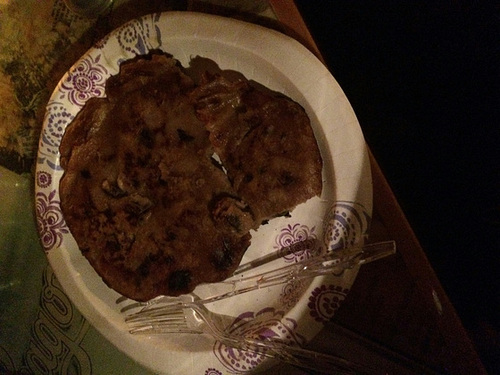
Medieval pancake

The Challenge: Cake!


The Recipe: (where did you find it, link to it if possible)Frutowr for Lentyn


The Date/Year and Region: 15th Century English


How Did You Make It: (a brief synopsis of the process of creation)I mixed flour, store bough almond milk (vanilla!), a bit of sugar, cinnamon, diced figs, and raisins into a plastic container then shook it. I then poured the mix into a skillet with olive oil over a flame (a gas grill) and fried the baby up.


Time to Complete:5 minutes, maybe


Total Cost: I had everything except the figs which I *think* were $4 for the bag. I used maybe a 1/4 of the bag, if that.


How Successful Was It?: (How did it taste? How did it look? Did it turn out like you thought it would?) It looked horrible because a)it was dark and b) I burnt it a bit. However, it tasted like a funnel cake with fruit - which is about what I think it's supposed to taste like. Funnel cake is totally a cake - and this is very much a medieval pancake so it counts too!

How Accurate Is It?: (fess up to your modifications and make-dos here) I used store bought almond milk this time because I was camping. The flour I used probably isn't the same as they would have used in period either. I added the sugar and the cinnamon - both period ingredients- because it tastes off without them. The raisins are just regular raisins because I'm not sure if I'm allergic to real currants or not. However, there is some confusion over whether "rasyns of corance" are actually currants or black raisins - so I might be perfectly okay.

The full recipe:

Frutowr for Lentyn. Recipe flour & almondes mylk, & temper þam togyder; þan take fyges & rasyns of corance & fry þam with þe batour with oyle & tyrne þis & serof.

- Hieatt, Constance B. "The Middle English Culinary Recipes in MS Harley 5401: An Edition and Commentary." Medium Ævum vol. 65, no. 1 (1996): 54-71.

And I will add that I did finish it on time! I was camping and didn't get to post it until today.

Wednesday, October 15, 2014

#19: HSF Inspiration

The Challenge:
Inspiration. Although many people have done partlets, I was particularly looking at the Venetian one by Aurora. Actually, I cut it out a year ago or so and was finally inspired to finish it after looking through other HSFs.
Fabric:
Silk
Pattern: 
My own
Year: 
1540/1550
Notions:
Silk thread, linen tapes
How historically accurate is it?
The only way to get to be more accuarate would be to steal the police box from the Doctor or the starship Enterprise and slingshot around the sun. It's 100% hand sewn using period correct techniques (rolled edges) and materials.
Hours to complete:
2 or so really - It wasn't long once I sat down and sewed it. Although, giggling through Top Gear probably did impact the sewing time greatly.
First worn:
Tomorrow, I hope
Total cost:
Apparently, I spent $9.98 on the fabric back in 2010. The linen tape was about a $1 a yard and I think I used a quarter of a yard. The thread came in one of those $1 bags I get at the thrift store with a bunch of other things - so a little over $10?

I will admit I almost didn't do this one due to the political overtone this challenge took on. However, this should be about sewing and fun - never about politics.

Monday, October 13, 2014

Anne of a Thousand Days

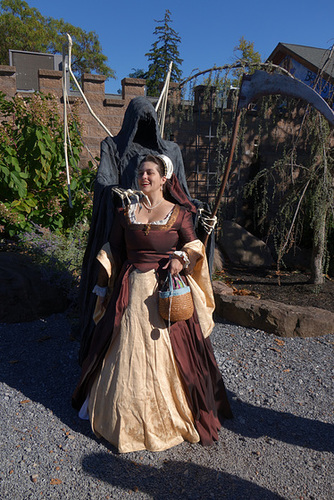
First, much thanks to this site for providing LARGE images of the brown gown Anne wears in the movie.  It helped a lot for figured out a couple of things for the dress.

Ever since I saw the movie first 10 years ago, I've wanted this dress.  I have no idea why - it's not my normal colors or anything - I just love it.   The hood isn't accurate but the dress actually isn't that bad - it's something I can easily wear to SCA events and not get shunned.


080


I forgot my stays the day of the faire and couldn't exactly drive the two hours back home to get them so, I relied on the dress itself to hold everything correctly. It did okay - I didn't look ridiculous- but next time I need to remember my stays.

I bought the material years upon years ago. I think the main brown fabric is some sort of man made material meant for designer raincoats - perfect for a rainy day or a day right after a rainy day as long as it stays below that 72F threshold. It did, thankfully.

The gold material is gold cotton damask I think I got off of ebay four years ago. Maybe longer. The trim and false undersleeves are out of the paisley orange and black fabric that just happened to match the colors of the original movie gown - and I think the material is probably from the same time period as when the movie was made.

So hardly any natural fibers and a not historically accurate gown was a switch for me - however, I do like this dress.

I used the old McCalls Tudor gown pattern 3282. I have used this pattern a ton of times and love it. I drafted out the princess seams and the back darts. I enlarged the upper sleeve by adding a half inch on either side (you have to - they made it too small unless you have t-rex arms). I didn't bother cutting out the skirt and just used the remaining fabric, pleated it, and used that as the skirt fabric - which matches what they did on the movie gown better.

The french hood is, of course, hilarious. I didn't manage to finish what I wanted to do but I put together "something" so I'd have a dress many would hopefully recognize. I need to get some puffy gold fabric paint to make the "embroidery" on it. (The original really looks like fabric paint when you see a close up of it) I won't be able to wear it to SCA events but I want to complete the gown so I can wear it next year. :-)

My Medieval Houppelande Gown


Both of the above images are from the early part of the 15th century - the first is from between 1405-1410- and were a couple of my inspiration images for making a Houppelande gown.  

I had to go to an SCA event that had a theme of late 14th/early 15th century.  I've wanted to make a houppelande for a while so this was as good an excuse as any.  

The houppelande I made is based on the very early Italian styles for the dress.   I dyed some blue cotton brocade (the Italians had cotton) with RIT red Scarlett dye and it came out a stunning deep lilac as you see here.  The sleeves are my own pattern but the dress is a slightly changed version of McCalls M5155.  I changed the neckline for the body.   I had to piece the dress - which is very period and fine by me.  The sleeves are lined in some satin I had left over from my winter coat and the body is lined in some pink linen.   It's a heavy dress but not overly so.  I was quite happy to wear it...I just wish the belt didn't break...twice!

For the sleeves, I made a simple basic sleeve and then, rather than have the sides taper, I made them as big as I could at the wrist.  I ended up having to add gores to the sleeve to make it even bigger.   

Sekanjibin!

Sekanjabin in it's simplest, medieval form is sugar and vinegar put together to make a syrup.  I decided to take a play on that to make a new corn free syrup that was both cheap and good in a soda.  The one I made ended up tasting most similar to a cream soda - which is what I was aiming for.  :-)

1 1/2 cup water
3 3/4 cup sugar (I used a mix of brown sugar and white sugar but anything that is pure sugar is fine)
1 teaspoon Vanilla Extract
a little less than 1 cup of Vanilla infused Balsamic Vinegar (if you don't have a store that carries this, try apple cider vinegar instead and increase the amount of Vanilla Extract to taste)

I put everything in the sauce pot and brought it to a boil.  I then stirred it, while it was boiling, for a couple of minutes, only to turn it down to low and leave it for about 10 minutes.  I then took it off the stove and let it cool.

Once it was cool, I put about a tablespoon in my cup and poured sparkling water over it (from my Sodastream).  I was worried it would be too bitter but it's surprisingly light and gives just the right amount of flavor for a soda.  Since sugar isn't exactly expensive (you can buy a box at the dollar store), this is a pretty easy, cheap soda flavoring syrup recipe.  


Monday, September 29, 2014

An attempt at the Moy Gown, part 1


First, yes, bedsheets work wonders for mock ups. Particularly the ones you've hated for the past 10 years since your mother got them and put them on your bed in the beach house. :-) You have no idea what pleasure it was to chop this baby up.

Second, the Moy gown. There are now several good write ups out there on the Moy Gown. The first of which is March Carlson's experiment on the construction of the gown. Another fabulous one is here by Matilda La Zouche.

Basically, the Moy gown was found in an Irish bog back in 1931. It's most likely from about the 1460's to the 1480's based on contemporary drawings of the time - however it might be a bit later than that as Ireland tended to be a bit behind the times when it came to fashion.


The above is from 'Sol und Siene Kinder' by the Housebook Master, the last quarter of the 15th century, South Germany.

This image done by Maître François in his illuminations of La Cité de dieu by Augustine around 1475-1480. This image is called Mysteries of Cybele (Virgo caelestis, Berecynthia) – fol. 86 verso. (I found it at Cottesimple.com.)


I want to create a Moy gown because I am fascinated by something that has lasted this long, clearly spans a few countries (France, Germany, Ireland), and it looks interesting in construction. However it's the construction that is getting me right now.

Although the body was easy enough -I used my 1790's bodice as a template since it has the weird back thing going on as well- the sleeve has me going crazy. I'm leaving it as is until the morning.

I had to play with the construction a bit in the body as well - the original neckline I had was too wide, which is why I have it pinned.  Other than that...it really was easy.  Now to figure out that sleeve...in the morning.  Hmm...

Edit: Me? Actually wait until the morning? Bwahaha! Yeah....no.


Fixed it! The sleeve fits perfectly now. The bodice is a bit tight but that I know how to adjust for. Now to do the second mock up, fully destroy these hideous sheets, and then work on the actual dress!